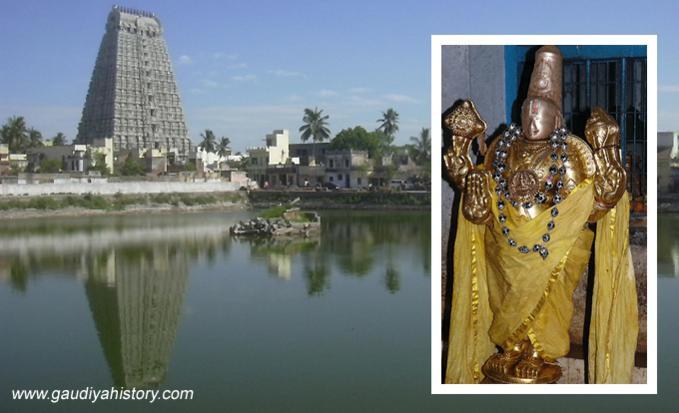
A brahmana who had chanted only Rama's holy name since childhood finds, after one meeting with Sri Chaitanya Mahaprabhu, that Krishna's name will not leave his tongue.
Siddhavata, near the Sri Ranganatha temple, South India, during Sri Chaitanya Mahaprabhu's South India tour, c. 1510-1512
Sri Chaitanya Mahaprabhu's tour through South India brought Him first to see the Deity of Lord Nrisimha, and from there to Siddhavata - a pilgrimage town known for its great banyan tree and for a Deity of Ramachandra, Lord of Sitadevi, whom Mahaprabhu greeted with prayers and obeisances. A brahmana there invited Him to take lunch. Krishnadasa Kaviraja Goswami is specific about this brahmana's character before the story moves any further: "That brahmana constantly chanted the holy name of Ramachandra. Indeed, but for chanting Lord Ramachandra's holy name, that brahmana did not speak a word." Mahaprabhu accepted prasadam at his home that day and, after showing him this mercy, continued on His way.
What makes this brahmana's story different from a simple pilgrimage-stop encounter is what happened next. From Siddhavata, Mahaprabhu went on to visit the temple of Skanda at Skanda-kshetra, and from there to Trimatha, where He saw the Deity of Vishnu known as Trivikrama. Only after these two further stops did He turn back and return to Siddhavata - to the same brahmana's house, for a second time.
What Mahaprabhu found on returning was a man transformed. The brahmana who had spoken almost nothing but Rama's name at their first meeting was now chanting the Hare Krishna maha-mantra continuously instead. Mahaprabhu asked him directly: "My dear friend, kindly tell Me what your position is now. Formerly you were constantly chanting the holy name of Lord Rama. Why are you now constantly chanting the holy name of Krishna?" The brahmana's answer is unusually candid about how sudden and involuntary the change had felt to him: "This is all due to Your influence, Sir. After seeing You, I have lost my lifelong practice. From my childhood I have been chanting the holy name of Lord Ramachandra, but upon seeing You I chanted the holy name of Lord Krishna just once. Since then, the holy name of Krishna has been tightly fixed upon my tongue. Indeed, since I have been chanting the holy name of Krishna, the holy name of Lord Ramachandra has gone far away."
What follows in Chaitanya-charitamrita is not simple confusion on the brahmana's part but a scholar's attempt to reconcile what scripture had taught him with what he was now experiencing. He recalls verses holding Rama and Krishna's holy names to be on an equal footing as the Supreme Absolute Truth - one from the Padma Purana's Shata-nama-stotra explaining that "Rama" names the Lord because transcendentalists take unlimited pleasure (ramante) in Him, another from the Mahabharata explaining "Krishna" through the verbal root krish, meaning attractive existence, joined to a syllable meaning spiritual pleasure. Yet he also recalls further verses - Lord Shiva's own words to Durga, and a line traced in the Laghu-bhagavatamrita to the Brahmanda Purana - holding that a single utterance of Krishna's name yields what three full repetitions of Vishnu's thousand names would give. "According to this statement of the shastras," the brahmana says, "the glories of the holy name of Krishna are unlimited. Still I could not chant His holy name. Please hear the reason for this... My worshipable Lord has been Lord Ramachandra, and by chanting His holy name I received happiness... By Your appearance, Lord Krishna's holy name also appeared, and at that time the glories of Krishna's name awoke in my heart."
The brahmana's conclusion, once he reached it, was unambiguous: "Sir, You are that Krishna Himself. This is my conclusion." Saying this, Chaitanya-charitamrita records, he fell down at Mahaprabhu's lotus feet. Mahaprabhu showed him mercy and left the following day, continuing south toward Vriddhakashi and the temple of Lord Shiva there. Nothing further is recorded of this brahmana - no name beyond "the brahmana of Siddhavata," no later life, no other appearance anywhere in Chaitanya-charitamrita. What remains is this one afternoon: a lifelong devotee of Rama's holy name who found, in the presence of Sri Chaitanya Mahaprabhu, that a different name of God had quietly taken its place on his tongue - and who understood exactly what that meant.
Scriptural sources for this pastime
vipra bale, — ei tomāra darśana-prabhāve
tomā dekhi' gela mora ājanma svabhāve
Word for word
vipra bale — the brahmana replied; ei — this; tomāra darśana-prabhāve — by the influence of Your visit; tomā dekhi' — after seeing You; gela mora ājanma svabhāve — my lifelong nature went away.
The brahmana replied, "This is all due to Your influence, Sir. After seeing You, I have lost my lifelong practice.
kṛṣiḥ — the verbal root krish; bhū-vācakaḥ śabdaḥ — a word signifying attractive existence; ṇaḥ ca nirvṛti-vācakaḥ — and the syllable na indicating spiritual pleasure; tayoḥ aikyam — the amalgamation of both; paraṁ brahma — the Supreme Absolute Truth; kṛṣṇa iti abhidhīyate — is called Krishna.
"The word 'krish' is the attractive feature of the Lord's existence, and 'na' means spiritual pleasure. When the verb 'krish' is added to the affix 'na,' it becomes 'Krishna,' which indicates the Absolute Truth."
From the purport: Purport excerpt: "This is a verse from the Mahabharata (Udyoga-parva 71.4)."
The Sanskrit etymology the brahmana himself cites in explaining why Krishna's name had suddenly taken hold of him.
sei kṛṣṇa tumi sākṣāt — ihā nirdhārila
eta kahi' vipra prabhura caraṇe paḍila
Word for word
sei kṛṣṇa tumi sākṣāt — You are directly that Krishna; ihā nirdhārila — this he concluded; eta kahi' — saying this; vipra prabhura caraṇe paḍila — the brahmana fell at the Lord's feet.
"Sir, You are that Lord Krishna Himself. This is my conclusion." Saying this, the brahmana fell down at the lotus feet of Sri Chaitanya Mahaprabhu.
ramante — take pleasure; yoginaḥ — transcendentalists; anante — in the unlimited; satya-ānande — real pleasure; cit-ātmani — in spiritual existence; iti — thus; rāma-padena — by the word Rama; asau — He; param brahma — the Supreme Absolute Truth; abhidhīyate — is called.
"The Supreme Absolute Truth is called Rama because the transcendentalists take pleasure in the unlimited true pleasure of spiritual existence."
From the purport: This is the eighth verse of the Shata-nama-stotra of Lord Ramachandra, found in the Padma Purana.
param brahma — the Absolute Truth; dui-nāma — two names (Rama and Krishna); samāna ha-ila — were on an equal level; punaḥ āra — again further; śāstre — in revealed scriptures; kichu viśeṣa pāila — received some specification.
"As far as the holy names of Rama and Krishna are concerned, they are on an equal level, but for further advancement we receive some specific information from the revealed scriptures."
rāma rāma iti rāma iti — Rama, Rama, thus Rama; rame rāme — I enjoy in the holy name of Rama; manorame — most beautiful; sahasra-nāmabhiḥ tulyam — equal to the one thousand names; rāma-nāma — the holy name of Rama; varānane — O Varanana.
"[Lord Shiva addressed his wife, Durga:] 'O Varanana, I chant the holy name of Rama, Rama, Rama and thus enjoy this beautiful sound. This holy name of Ramachandra is equal to one thousand holy names of Lord Vishnu.'"
From the purport: This is a verse from the Brihad-vishnu-sahasranama-stotra in the Uttara-khanda of the Padma Purana (72.335).
The first of the two scriptural statements the brahmana weighs: Rama's name equal to a thousand names of Vishnu.
sahasra-nāmnāṁ puṇyānāṁ
trir-āvṛttyā tu yat phalam
ekāvṛttyā tu kṛṣṇasya
nāmaikaṁ tat prayacchati
Word for word
sahasra-nāmnām puṇyānām — of one thousand holy names; triḥ-āvṛttyā — by thrice chanting; tu yat phalam — but which result; eka-āvṛttyā tu — but by one repetition; kṛṣṇasya nāma ekam — of the one name of Krishna; tat prayacchati — that it delivers.
"'The pious results derived from chanting the thousand holy names of Vishnu three times can be attained by only one utterance of the holy name of Krishna.'"
From the purport: This verse from the Brahmanda Purana is found in the Laghu-bhagavatamrita (1.5.354), by Rupa Goswami.
The second, decisive scriptural statement: a single utterance of Krishna's name equals thrice chanting Vishnu's thousand names. This is the verse the brahmana cites as tipping the balance toward Krishna's name.
Our editorial team comprises trained devotees and researchers of the Hare Krishna Movement, Kota, who follow this same disciplic tradition in daily practice. Every biography is carefully researched, fact-checked against Vedic scriptures, and cites its sources.
Reviewed by
Temple & Scriptural Research Team
Each biography undergoes a detailed review by our senior devotees and scriptural researchers to verify factual accuracy and ensure alignment with Vaishnava philosophy and Srila Prabhupada's teachings.