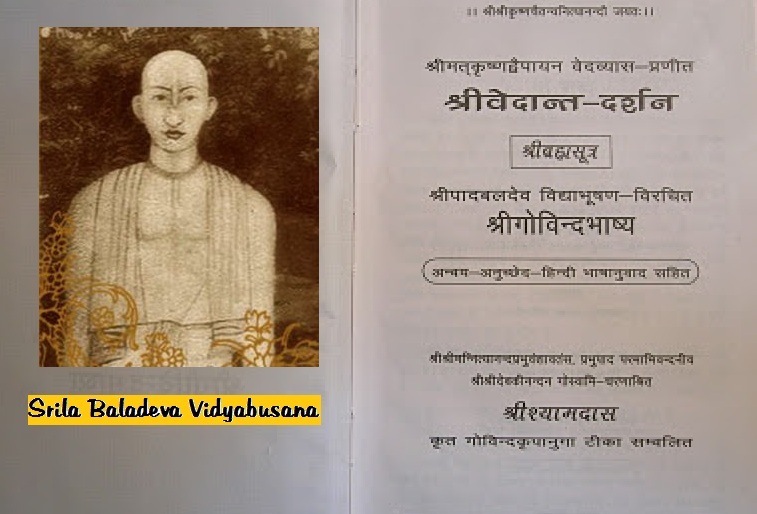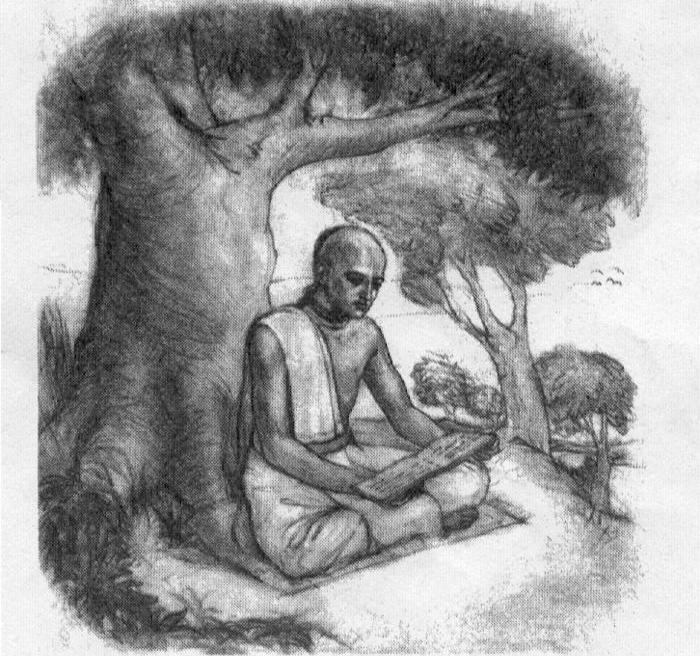
Having promised the Jaipur assembly a Vedanta-sutra commentary he had not yet written, Baladeva went straight to the temple of Govindaji in Jaipur — the very Deity whose worship was under dispute — and laid out the whole situation. Several biographies preserve the same core image at this point, though they render its details slightly differently: Srila Prabhupada's own lecture describes Baladeva lying flat in obeisance before the Deity for three continuous days, taking no food or water, asking permission before he would even begin; the Gaudiya History biographies instead describe a single night's dream in which Govindaji spoke to him directly. What every version agrees on is the substance of the answer: "You write, and I will dictate to you what to write. No one will be able to refuse it."
Writing Under Pressure #
Baladeva began the next morning, his mind fixed, by every account, on the feet of Govindaji rather than on his own scholarship. What emerged was completed in a matter of days — an extraordinarily short time to produce a philosophically rigorous Vedanta-sutra commentary capable of withstanding hostile cross-examination by trained Sri Sampradaya pandits. He titled it the Govinda-bhashya, after the Deity he credited with its content.
At the end of the finished work, Baladeva appended a verse in his own words describing what had happened:
"By his mercy Sri Govinda revealed this commentary to me in a dream, and for this the learned gave me the name Vidyabhushana — yet all credit belongs to Him, the dearest friend of Srimati Radhika. May that Govinda be forever glorified."
Vindication at Court #
Baladeva returned to the assembly with the finished commentary. The Ramanandi pandits who had been so certain he would fail were, the accounts say, left speechless; none could find grounds to fault the work. The Gaudiya sampradaya's standing — and with it, the Bengali priests' right to continue worshiping Govindaji and Gopinatha at Jaipur — was upheld. It was at this point, several sources record, that the pandits themselves bestowed on Baladeva the title "Vidyabhushana," ornament of learning, in tribute to his scholarship — though other evidence suggests he may already have carried this title from his Tattvavada years, which would make the Jaipur naming a re-confirmation rather than a first bestowal.
In a gesture that says as much about Baladeva's character as the debate itself, the defeated Ramanandi scholars are said to have then asked to become his disciples. He declined, explaining that the Sri Sampradaya was itself a genuine and respected Vaishnava lineage, devoted to dasya-bhakti, service to the Lord, and that accepting their surrender would imply a disrespect toward that sampradaya he had no wish to show. Returning to Vrindavana, he reported the victory to Vishvanatha Chakravarti Thakura, who — by every account — received the news with great joy and gave his blessing to the disciple he had sent to Jaipur in his place. Some biographies add that Baladeva installed a Deity called Vijaya Gopala at the Golta assembly site to commemorate the victory, though the present whereabouts of that Deity, if it ever existed as described, are unknown.
What the Commentary Achieved #
The Govinda-bhashya did not replace Srimad-Bhagavatam as the Gaudiya sampradaya's primary scriptural authority; Chaitanya Mahaprabhu's teaching that Srimad-Bhagavatam is itself Vyasadeva's own commentary on his Vedanta-sutra (recorded in Chaitanya-charitamrita, Madhya-lila 25.142) remained the sampradaya's fundamental position. What Baladeva supplied was something additional: formal proof, in the accepted genre and language of scholastic Vedanta debate, that the Gaudiya reading of the Vedanta-sutra could be defended on its own terms against any rival school. Srila Prabhupada later said of this achievement that Baladeva "gave us the Govinda-bhashya" specifically because the challenge demanded a direct commentary — not because the Bhagavatam's authority had ever been in doubt among Gaudiya Vaishnavas themselves.
Baladeva himself did not treat the Govinda-bhashya as a finished, standalone project. He went on to write the Siddhanta-ratna specifically to reinforce and clarify points in the Govinda-bhashya, and the Vedanta-syamantaka as a further, independent restatement of the same Vedanta-sutra material — as if determined that no future challenger would ever again be able to say the Gaudiya sampradaya had produced only one thin proof of its legitimacy. Those later works, along with the rest of Baladeva's output, are the subject of the other literary works page.