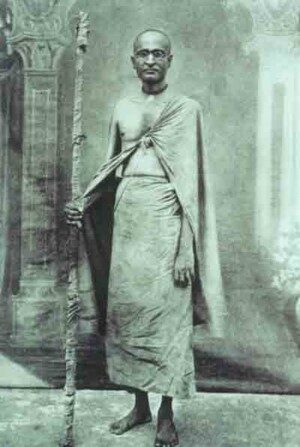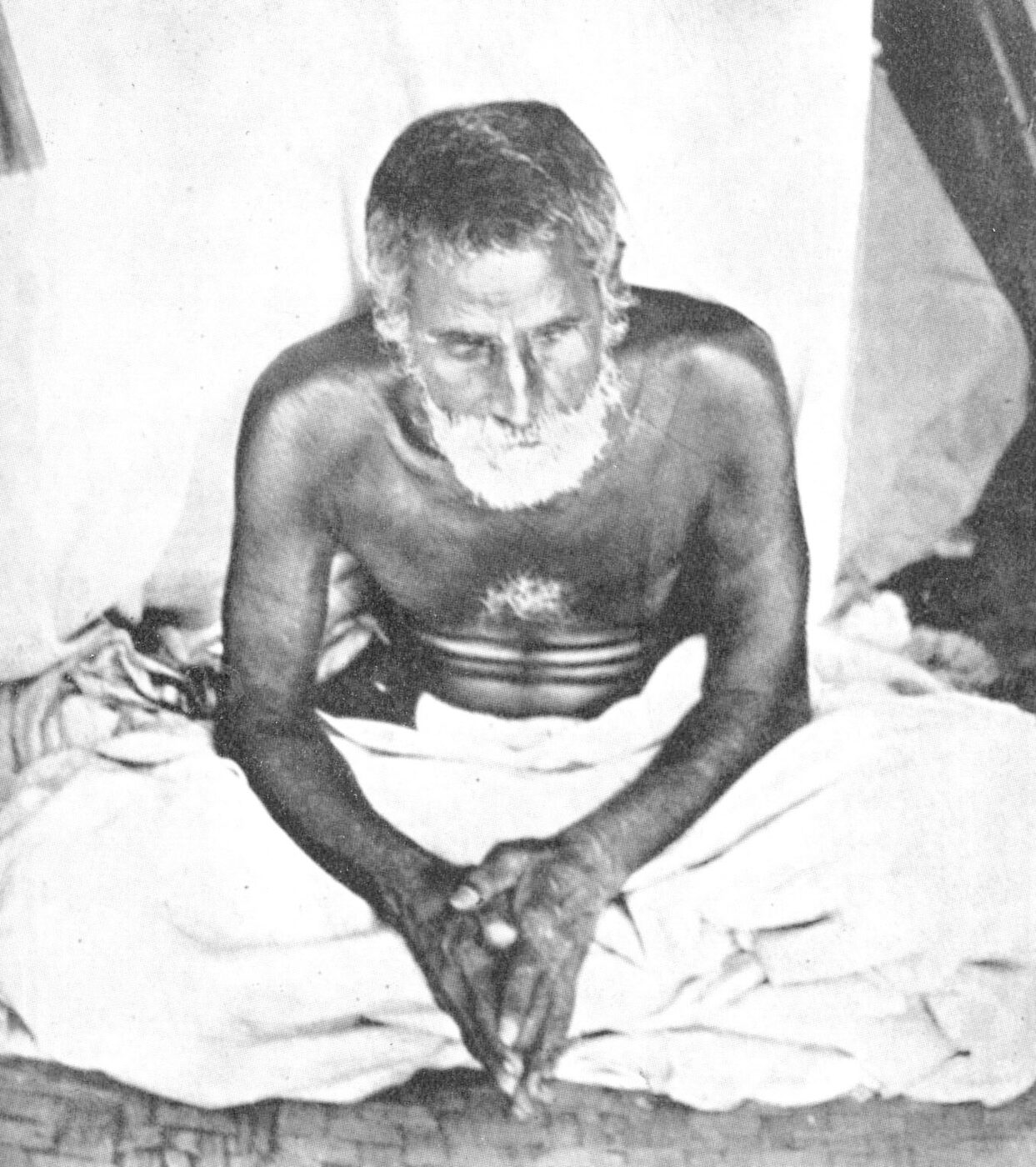
By his mid-twenties, Bimala Prasad, known across Calcutta's learned circles as Siddhanta Sarasvati, held a secure position as tutor to Tripura's royal princes, commanded genuine scholarly authority in Sanskrit, jyotisha, and philosophy, and moved comfortably among the bhadralok, Calcutta's Western-educated Hindu elite. By his own account, none of it satisfied him. He had come to feel that his religious life, for all its learning, was "confined to books and to a strict ethical life," and that such a life was incomplete without contact with someone who lived devotion rather than merely studied it. On his father's direction, he set out to find such a person, and found him not in Calcutta's colleges or courts but living beneath a tree on the bank of the Ganga: the ascetic Gaura Kishora Dasa Babaji.
| Guru sought | Gaura Kishora Dasa Babaji, Vaishnava ascetic |
| Approached on the advice of | Bhaktivinoda Thakura |
| Initiation | Around 1900, at Godruma near Mayapur (by his own later testimony, January 1901) |
| Name received | Sri Varshabhanavi-devi-dayita Dasa ("servant of Krishna, the beloved of Radha") |
| Prior standing | Titled scholar, tutor to Tripura's royal princes |
An Illiterate Teacher for a Titled Scholar #
Gaura Kishora Dasa Babaji was, by every account, an unlikely guru for a man of Siddhanta Sarasvati's formal accomplishments. He could not read. He lived in extreme austerity, wearing a waistcloth reportedly fashioned from cloth discarded from the dead, eating plain rice soaked in Ganges water and seasoned with little more than salt and chili, sometimes cooking in discarded earthen pots he had cleaned himself. He held no post, published nothing, and sought no following. What he possessed, in the judgment of Bhaktivinoda Thakura and of the son he sent to find him, was something Siddhanta Sarasvati's own education had not given him: a life of devotion so thoroughly practiced that it needed no books to communicate it. Bhaktisiddhanta Sarasvati later reflected on the effect of finally meeting such a person after years of purely intellectual religion:
It was by providential dispensation that I was able fully to understand the language and practical side of devotion after I had met the practicing master [Gaura Kishora Dasa Babaji]... Up to that time, my idea of religion was confined to books and to a strict ethical life, but that sort of life was found imperfect unless I came in touch with the practical side of things.
A Guru Who Made Him Wait #
Vaishnava biographers relate that Gaura Kishora Dasa Babaji did not accept Siddhanta Sarasvati readily. Known for being highly selective about whom he initiated, he is said to have turned the young scholar away twice, first saying he could not give initiation without Chaitanya Mahaprabhu's approval, then, on a second visit, that he had simply forgotten to ask. On a third visit, he told Siddhanta Sarasvati that Chaitanya had said learning counted for very little next to devotion, seemingly a final refusal. Siddhanta Sarasvati, undeterred, is said to have compared his own persistence to that of the medieval philosopher Ramanuja, who by tradition was turned away eighteen times before his own guru relented, and declared that he too would wait as long as necessary. Whatever exactly passed between them, and the specifics come down to us only through devotional memoir rather than independent record, the outcome is not in dispute: Gaura Kishora Dasa Babaji accepted him, and gave him initiation in a grove at Godruma near Mayapur, telling him, in the words his disciples remembered, to preach the Absolute Truth and set aside all other work.
A New Name and a Disputed Date #
Bhaktisiddhanta Sarasvati himself later dated his acceptance of Gaura Kishora as guru to January 1901, though other accounts place the meeting in the closing months of 1900. With the initiation came a new name, Sri Varshabhanavi-devi-dayita Dasa, "servant of Krishna, the beloved of Radha," and, by his own later writings, instruction in the chanting of the Hare Krishna mantra. The full story of that acceptance, told from the guru's own side, appears on Gaura Kishora Dasa Babaji's page on initiating Bhaktisiddhanta Sarasvati.
How Calcutta's Educated Vaishnavas Received It #
Nothing in the record suggests that Siddhanta Sarasvati's choice of guru went uncommented among the bhadralok circles he had until then moved in. The Calcutta of his young adulthood was a world that increasingly measured spiritual authority by exactly the credentials he already possessed: Western and Sanskritic education, published scholarship, respectable institutional position, fluency in the reformist Hindu thought then ascendant among the educated middle class. An illiterate ascetic who lived under a tree and could offer no credential beyond a life of visible renunciation cut directly against those assumptions. Bhaktisiddhanta Sarasvati would spend much of the following decade arguing, in essays and public debates, that devotion rather than birth, learning, or social position was the true measure of spiritual standing, a position that put him at odds with parts of Calcutta's brahminical and bhadralok establishment. His choice of guru in 1900 was, in effect, the first and most personal expression of that same conviction: he had gone looking for someone who lived what the books described, and found him in a man his own social world would not have thought to look twice at.
For Siddhanta Sarasvati, the decision marked less a rejection of his education than its redirection. He did not abandon his scholarship; he brought it, over the following years, into the service of the tradition his new guru embodied, a shift whose full institutional consequences unfold on the next page: Founding the Gaudiya Math.