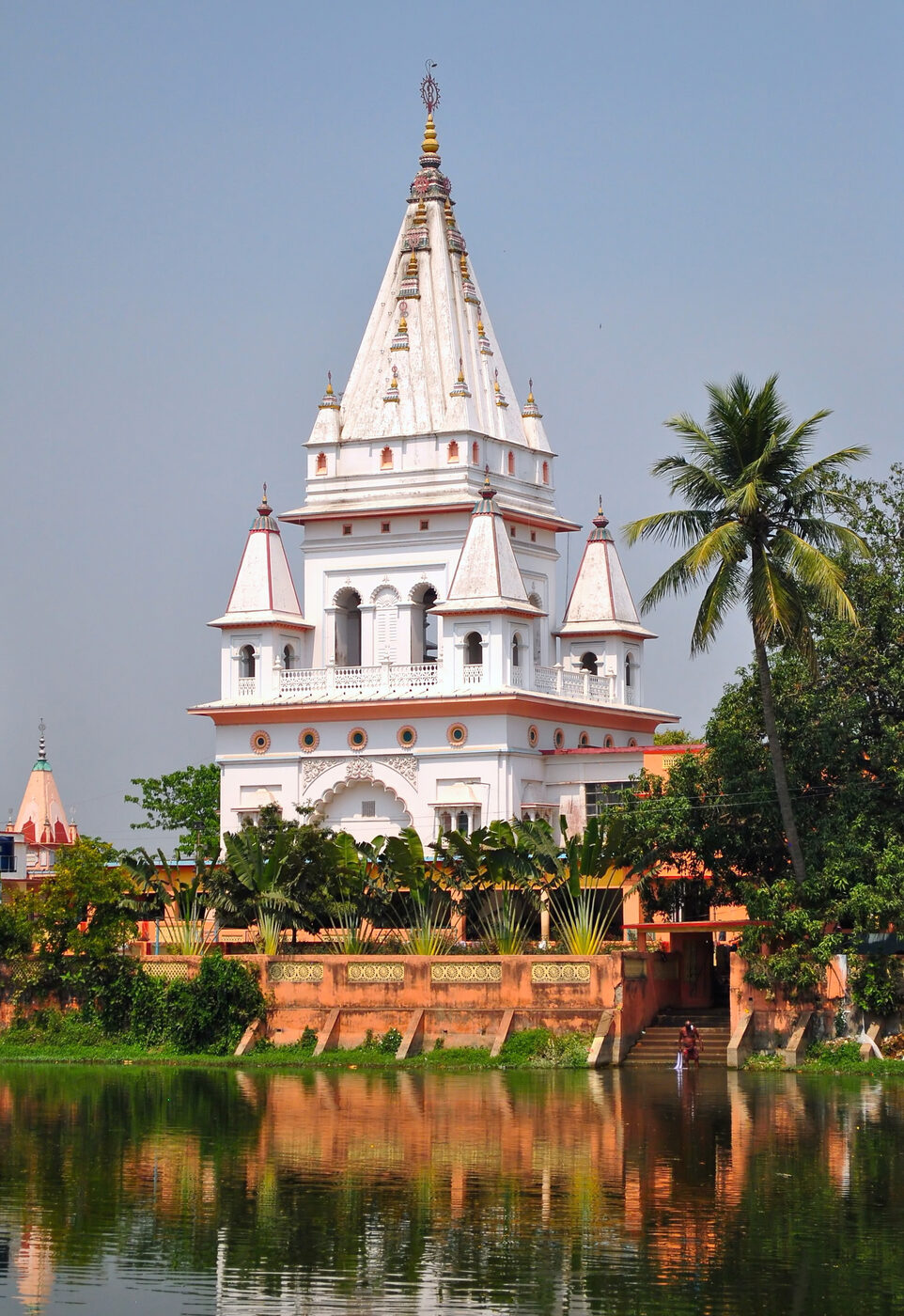
In 1887, while working as a magistrate stationed in Krishnanagar, Bhaktivinoda Thakura identified a site near Navadwip called Ballaladighi as the actual birthplace of Chaitanya Mahaprabhu, and set in motion the work that made Mayapur into the place it is today: a major center of pilgrimage and, in the twentieth century, the international headquarters of ISKCON. In the same decades he organized a very different kind of project, the nama-hatta, a traveling preaching movement that carried Chaitanya's teaching into the Bengali countryside and deliberately kept it out of the hands of the hereditary priesthood.
| Claimed discovery | 1887, birthsite identified at Ballaladighi, near Navadwip |
| Key evidence | old maps, the Bhakti-ratnakara text, local testimony, and a reported vision |
| Temple established | Deities of Gaura and Vishnupriya installed at the Yogapith, 21 March 1894 |
| Nama-hatta preaching | organized on a circuit-court model; over 500 centers by the early twentieth century |
Called Back from Vrindavan #
By 1886 Bhaktivinoda had hoped to retire from government service and settle in Vrindavan, the heartland of Krishna's pastimes, to devote himself fully to devotional life. Vaishnava biographers record that he instead experienced a dream in which Chaitanya directed him to Navadwip rather than Vrindavan, telling him there was unfinished work nearer home. Whatever weight one gives the account, the practical result is documented: Bhaktivinoda sought and obtained a transfer to Krishnanagar, a district town some twenty-five kilometers from Navadwip, traditionally revered as Chaitanya's birthplace, and began making regular visits to research the area.
A Vision Across the Ganges #
Despite poor health, Bhaktivinoda pressed his inquiry into the exact site of Chaitanya's birth, dissatisfied with the location conventionally shown to pilgrims in Navadwip proper. Vaishnava biographers record that one night, standing on the roof of a guesthouse and looking across the Ganges, he saw a large building illuminated in golden light in a spot where, by daylight, only a stand of palm trees stood; his young son, present with him, reported seeing the same thing. Inquiry identified the spot as the site of a ruined fort known locally as Ballaladighi. Taking this as a clue rather than a conclusion, Bhaktivinoda turned to more conventional methods: he cross-checked old maps against textual and oral accounts, and concluded that Ballaladighi corresponded to a place called Mayapur, named as Chaitanya's birthplace in the older text Bhakti-ratnakara.
Confirming the Site Against Navadwip's Claim #
The claim was not accepted quietly. Residents of Navadwip, whose town had long hosted pilgrims on the strength of its own claim to be Chaitanya's birthplace, rejected Bhaktivinoda's identification, and which site is the more ancient continues to be debated by some historians even today. Bhaktivinoda nonetheless pursued the matter with the same documentary seriousness he brought to his other historical and theological work, and organized fundraising through Sajjana-toshani, special festivals, and his own wide circle of acquaintance to secure the site and build on it. Within Gaudiya Vaishnavism his identification has since become the settled and accepted one: Mayapur, not the town of Navadwip itself, is where the movement's institutions, ISKCON's included, have built their central temples, and where pilgrims and devotees now travel by the hundreds of thousands each year for the annual Gaura Purnima festival marking Chaitanya's birth.
A Temple at the Birthsite #
Bhaktivinoda acquired property at Surabhi-kunj near the identified site and organized, through a body called the Nabadwip Pracarini Sabha, the construction and consecration of deities of Gaura and Vishnupriya at what became known as the Yogapith, the birthsite temple, on 21 March 1894, during a lunar eclipse. The journalist Sisir Kumar Ghosh, who had come to regard Bhaktivinoda as something close to a guru over the course of these years, praised him for the discovery by calling him "the seventh goswami," a reference to the Six Goswamis of Vrindavan, the sixteenth-century Gaudiya Vaishnava ascetics who systematized the school's theology and identified the sites of Krishna's pastimes around Vrindavan generations earlier. The title stuck, and would later give a full-length biography of Bhaktivinoda its name, discussed on the final page of this section.
The Nama-hatta: A Marketplace of the Holy Name #
Alongside the work at Mayapur, Bhaktivinoda organized what he called the nama-hatta, literally "the marketplace of the [holy] name," a traveling preaching program built on the model of a circuit court moving from village to village across Bengal and Orissa. Nama-hatta groups combined kirtan, or congregational chanting, with the distribution of prasada and lectures on Gaudiya Vaishnava teaching, and by the early twentieth century Bhaktivinoda had established more than five hundred of them.
Preaching Outside the Priestly Monopoly #
What made the nama-hatta significant was not only its reach but its structure. Bhaktivinoda ran it deliberately outside the control of the hereditary caste goswamis and initiating brahmana lineages who had, by the late nineteenth century, come to treat the right to give initiation and interpret scripture as their birthright rather than a function of spiritual qualification. He argued in print that a person's fitness for devotional life and even for spiritual authority should rest on conduct and practice rather than birth, and organized his own preaching network to put that principle into practice rather than leave it as an argument on paper. It was the same impulse, that access to Krishna consciousness should not be gate-kept by caste or heredity, that his son Bhaktisiddhanta Sarasvati Thakura would carry further through the Gaudiya Math, and that would eventually shape the open, non-hereditary structure of ISKCON itself. The guru-parampara that carried this teaching forward is set out in full on the site's sampradaya chart.
The identification was not his alone. In 1893, in extreme old age, Srila Jagannatha Dasa Babaji was carried to the site and, too infirm to walk unassisted, is said to have leapt from his carrying-basket and danced in ecstasy upon arriving there — a personal confirmation the wider Gaudiya Vaishnava community took as settling the question. That visit is told in full here.