Before anyone in Navadvipa spoke of Devananda Pandit as a man Mahaprabhu had to forgive, they knew him simply as the best teacher of Srimad-Bhagavatam in Kuliya: a brahmana whose classes on the western bank of the Ganges drew students by the dozen. What happened in one of those classes, on an afternoon Srivasa Thakura happened to attend, became one of the most cited cautionary stories in the entire Gaudiya Vaishnava tradition.
A Full Room and a Familiar Lecture #
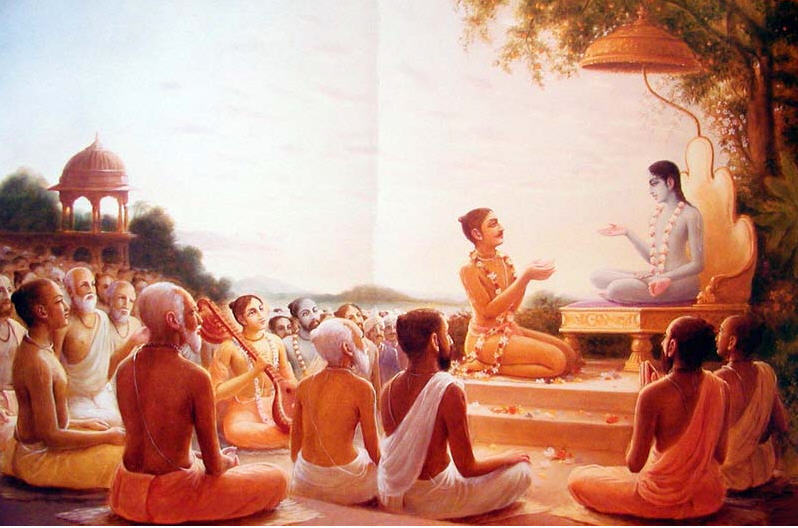
Devananda's method of teaching the Bhagavatam had a fixed shape by this point in his career: verse, explanation, and, consistently, according to every source that describes it, no real explanation of bhakti as the book's actual purpose. Sri Chaitanya-charitamrita calls him a professional reciter of the Bhagavatam, a description that is not unkind so much as precise: he knew the text inside and out, and he taught it as a scholar teaches a text, not as a devotee shares the object of his love. Students who wanted a rigorous, learned class on the Bhagavatam's Sanskrit and its Nyaya-trained logic came to exactly the right teacher. Students looking for anything more devotional went elsewhere, or simply never thought to ask.
An Uninvited Guest's Tears #
Srivasa Thakura was not one of Devananda's regular students. He came, on this particular day, simply to hear a Bhagavatam class, and he brought to it a temperament nobody in the room besides himself possessed: he was already known among Navadvipa's devotees as a rasika bhakta, someone whose heart responded to Krishna-katha the way dry wood responds to fire. As Devananda's recitation moved through the Bhagavatam's own verses, verses about Krishna, whatever the surrounding commentary left out, something in Srivasa broke open. He began to weep. Then he fell to the ground, his voice catching, his body no longer fully under his own control, absorbed in an ecstasy that had nothing to do with following the lecture's argument.
Carried Out of the Room #
To the students seated around him, none of this looked like devotion. It looked like a disturbance. Sri Chaitanya-charitamrita's purport records their reaction plainly: they judged Srivasa disruptive and simply picked him up and removed him from the assembly, so the rest of the class could continue undisturbed. Devananda watched all of this happen in his own classroom, in front of his own students, and said nothing to stop it. Srivasa, for his part, made no protest either: he simply went home, kept the incident to himself, and told no one what had happened.
The Offense Behind the Silence #
The tradition's judgment on this moment falls almost entirely on Devananda, not on the students who did the actual carrying. A teacher who allows his own disciples to insult a devotee of the Lord shares directly in whatever sin they commit. Sri Chaitanya-bhagavata's commentary describes offenses of this kind, given at the feet of a Vaishnava, as hati-mata, the mad-elephant offense: a single act careless enough to trample an entire garden of accumulated devotional merit. Devananda had spent years building a reputation as Kuliya's foremost scholar of the very book whose central teaching he had just watched trampled in his own home, without lifting a hand.
Word of the incident did not stay confined to that afternoon. Years later, during the extraordinary twenty-one-hour display of divine ecstasy at Srivasa Thakura's own house, the maha-prakasha-lila, when Mahaprabhu revealed His full identity to the assembled devotees, the Lord is remembered as having turned to Srivasa and asked whether he still recalled being carried out of Devananda's class, silently, without complaint. It is a striking detail: an old private humiliation, borne without a word to anyone, remembered and acknowledged by the Lord Himself in front of the very devotees who had gathered to witness His most public revelation of who He was. What eventually became of Devananda after this, a direct rebuke from Mahaprabhu, years of quiet remorse, and a reconciliation neither man could have predicted, is told on the mercy of Vakresvara Pandit.