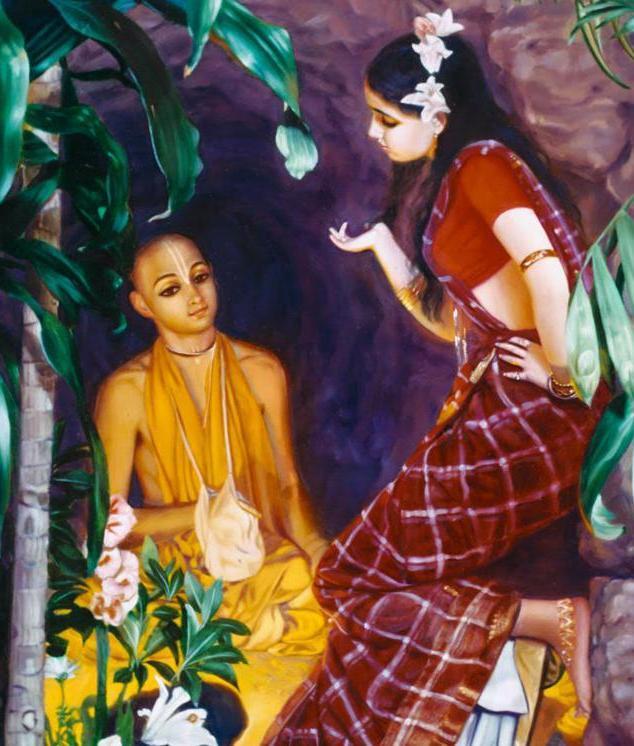
After leaving his family's home, Haridasa Thakura spent time living alone in the forest near Benapola. He built a simple cottage, planted a tulasi plant before it, and settled into a fixed daily practice: 300,000 names of Krishna chanted aloud, day and night, on whatever food he could beg. Word of this reached the local people, and Sri Chaitanya-caritamrta records that "all the neighboring people worshiped him" for it (Antya 3.101).
An Ascetic Draws a Zamindar's Envy #
One person did not share that admiration. Ramachandra Khan, the district's zamindar, was, in Krishnadasa Kaviraja Goswami's blunt description, "envious of Vaishnavas" and unable to bear the respect a man of Haridasa's standing was receiving. Unable to find any real fault in Haridasa's conduct, he decided to manufacture one, and sent for a professional courtesan, promising his constable would arrest them both the moment their union proved Haridasa's hypocrisy to the world.
Three Nights at the Cottage Door #
The woman, confident, promised to succeed within days. On the first night she dressed herself to draw every eye and came to Haridasa's cottage, offering herself openly. Haridasa did not refuse her outright and did not lecture her. He simply said he could not receive her until he had completed his vowed rounds of chanting for the day, and invited her to sit and listen until he finished. She sat through the night; dawn came before his chanting was done, and she left disappointed but not turned away.
The same pattern repeated a second night, and a third, Haridasa each time promising that his vow — by his own account, ten million names within a month, nearing its end — would soon be complete. Each night she sat by the tulasi plant listening to the Hare Krishna maha-mantra chanted without a break; each night, without quite noticing when it began, she found herself chanting along too. By the third night's end, restless and finally seeing what had actually happened to her, she fell at Haridasa's feet. She was, she confessed, no longer the person Ramachandra Khan had sent.
"Kindly Act as My Spiritual Master" #
Haridasa told her plainly that he had known about the zamindar's plan from the start, and had stayed those three days precisely because her presence gave him the chance to deliver her. When she asked him to instruct her as her guru, he told her to give away her possessions to the local brahmanas, return to that same room, and remain there chanting the Hare Krishna mantra and serving the tulasi plant for the rest of her life. She did exactly that, shaving her head, keeping a single cloth, eating only what came as alms, and chanting 300,000 names a day in imitation of the man who had refused her. Sri Chaitanya-caritamrta records that she became, in time, "a celebrated devotee," visited by serious Vaishnavas who came just to see what Haridasa's mercy had made of her (Antya 3.142).
Some later retellings of this story describe the test stretching across many more nights than Krishnadasa Kaviraja Goswami records; this page follows Sri Chaitanya-caritamrta's own account, the earliest and most detailed version available, which gives three nights.
What Ramachandra Khan Reaped #
Sri Chaitanya-caritamrta treats Ramachandra Khan's scheme as a genuine offense at a pure devotee's feet: "By inducing a prostitute to disturb Haridasa Thakura, Ramachandra Khan caused a seed of offense at his lotus feet to germinate. This seed later became a tree, and when it fructified, Ramachandra Khan ate its fruits" (Antya 3.144). When Nityananda Prabhu later toured Bengal and was turned away from proper lodging in Ramachandra Khan's own house, he left the estate that same day in visible anger. Within a short time a government tax officer, investigating unpaid revenue, occupied that same house, slaughtered a cow inside it, and stripped Ramachandra Khan of his position, wealth, and family for several days, leaving, in Krishnadasa Kaviraja Goswami's words, the entire village deserted for a long time afterward (Antya 3.163). The lesson the tradition draws from this is not really about Ramachandra Khan: it is that Haridasa's own gentleness toward the people who wronged him, never resentment, never retaliation, was the real center of the story — on display again when he faced being beaten in twenty-two marketplaces for the very same unwavering chanting.