Srila Ramananda Raya

Confidential Service in Puri

His decades as one of Sri Chaitanya Mahaprabhu's three and a half most confidential associates, alongside Svarupa Damodara Goswami.

Jagannatha Puri, throughout Sri Chaitanya Mahaprabhu's Puri years, roughly 1512-1534

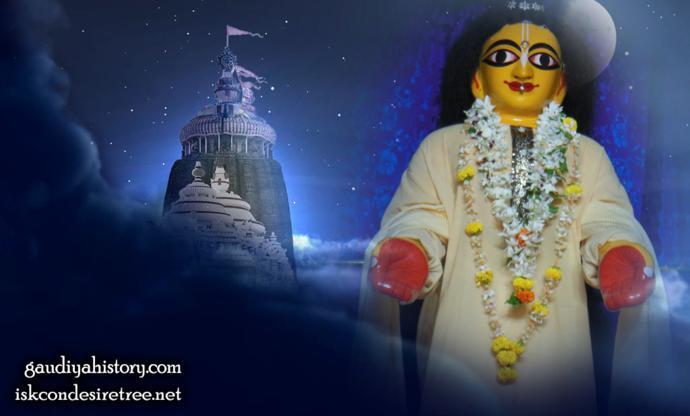
Devotional wallpaper showing the silhouette of the Jagannatha Temple at Puri beside a large devotional image of Lord Jagannatha, evoking the setting of Ramananda Raya's decades of service at Puri alongside Svarupa Damodara Goswami.
Devotional wallpaper showing the silhouette of the Jagannatha Temple at Puri beside a large devotional image of Lord Jagannatha, evoking the setting of Ramananda Raya's decades of service at Puri alongside Svarupa Damod…gaudiyahistory.iskcondesiretree.com · Used with attribution

For the remainder of Sri Chaitanya Mahaprabhu's manifest life at Jagannatha Puri, Ramananda Raya belonged to a circle so small that Sri Chaitanya-charitamrita gives it an exact, almost startling size: three and a half people, throughout the entire world, whom Mahaprabhu accepted as truly confidential associates of Srimati Radharani Herself. The three were Svarupa Damodara Goswami, Ramananda Raya and Shikhi Mahiti; the half was Shikhi Mahiti's own sister. Everything else recorded about Ramananda Raya's Puri years has to be read against that measure — this was not simply a devoted follower among many, but one of a small handful of people the tradition considers to have stood permanently at the very center of Mahaprabhu's private devotional life.

A Friend Like Subala #

Sri Chaitanya-charitamrita reaches for a specific comparison to describe what Ramananda Raya actually did for Mahaprabhu day to day: just as Subala, one of Krishna's cowherd friends in Vrindavana, once helped Krishna Himself through His own moods of separation from Radha, so Ramananda Raya gave that same kind of help to Sri Chaitanya Mahaprabhu. Together with Svarupa Damodara, he sang and recited long into the night — his own compositions, the poetry of Chandidasa and Vidyapati, verses from Bilvamangala Thakura's Krishna-karnamrita and Jayadeva Goswami's Gita Govinda, and lines from his own Jagannatha-vallabha-nataka — whenever Mahaprabhu's longing for Krishna grew too intense to bear quietly. Krishnadasa Kaviraja Goswami states outright that only Ramananda's words about Krishna and Svarupa Damodara's songs kept the Lord functioning through some of these episodes.

Training the Temple Dancers #

One pastime from these years still unsettles readers who come across it for the first time. Ramananda Raya personally trained young devadasis — temple dancers dedicated to Lord Jagannatha's service — teaching them the emotional and rhythmic art of portraying his own rasa-laden dramas, and in doing so bathed, massaged and dressed them with his own hands, every single day. Sri Chaitanya-charitamrita does not soften this or explain it away; it simply states that no small-minded person could hope to understand what was in Ramananda Raya's mind while he did it. Mahaprabhu Himself is recorded as saying that even He, a sannyasi under vows, sometimes felt His own mind disturbed by the mere sight of a woman's form — but that Ramananda Raya was greater than Him in this respect, for he remained entirely undisturbed even while touching one directly. The tradition is equally direct about the other side of that statement: this was Ramananda Raya's unique prerogative, granted for reasons particular to his own position, and not a standard for anyone else to imitate.

Declining to Speak on His Own #

Not every glimpse of Ramananda Raya's service in Puri is this dramatic. When the devotee Pradyumna Mishra came to his home hoping to hear about Krishna directly from him, Ramananda Raya's servant first had to explain that his master was occupied — busy with exactly the kind of daily service just described. When Ramananda Raya did receive him, he responded to Pradyumna Mishra's request with something closer to refusal than agreement, insisting that any real understanding of Krishna had to come through Sri Chaitanya Mahaprabhu, not through him speaking independently. Krishnadasa Kaviraja Goswami's own comment on the exchange is blunt: Ramananda Raya's discourses cannot properly be described in ordinary language, because he is not an ordinary man — his very words are absorbed in devotional service, spoken as a instrument of the Lord's own will rather than as opinions of his own.

A Mine of Devotional Mellows #

Sri Chaitanya-charitamrita elsewhere has Mahaprabhu describe Ramananda Raya to another visiting scholar in language that leaves little room for ambiguity: Ramananda Raya, He says, is "the ultimate knower of the transcendental mellows of Krishna's devotional service," the very person who taught Mahaprabhu that Krishna is the Supreme Personality of Godhead, and someone whose influence "cannot be described" — it was only by Ramananda Raya's mercy, Mahaprabhu says, that He came to understand the unalloyed love of the residents of Vrindavana. Coming from Sri Chaitanya Mahaprabhu Himself, this is about as high a statement of spiritual authority as the tradition records for anyone. What the tradition believes lies behind that authority — who Ramananda Raya actually is, beneath the governor's robes and the years of quiet Puri service — is the subject of His Identity in Krishna-Lila.

Scriptural sources for this pastime

প্রভু লেখা করে যারে — রাধিকার 'গণ' ।
জগতের মধ্যে 'পাত্র' — সাড়ে তিন জন ॥
স্বরূপ গোসাঞি, আর রায় রামানন্দ ।
শিখি-মাহিতি — তিন, তাঁর ভগিনী — অর্ধজন ॥

prabhu lekhā kare yāre — rādhikāra 'gaṇa'
jagatera madhye 'pātra' — sāḍe tina jana
svarūpa gosāñi, āra rāya rāmānanda
śikhi-māhiti — tina, tāṅra bhaginī — ardha-jana

Word for word

prabhu — Śrī Caitanya Mahāprabhu; sāḍe tina jana — three and a half persons; svarūpa gosāñi — Svarūpa Gosvāmī; rāya rāmānanda — Rāmānanda Rāya; śikhi-māhiti — Śikhi Māhiti; tāṅra bhaginī — his sister; ardha-jana — half a person.

Śrī Caitanya Mahāprabhu accepted her as having formerly been an associate of Śrīmatī Rādhārāṇī. In the entire world, three and a half people were His intimate devotees. The three were Svarūpa Dāmodara Gosvāmī, Rāmānanda Rāya and Śikhi Māhiti, and the half a person was Śikhi Māhiti's sister.

Antya 2.105-106 Sri Chaitanya-caritamrta

States exactly how small Mahaprabhu's circle of fully confidential associates was, and names Ramananda Raya as one of them.

sva-haste karena tāra abhyaṅga-mardana
sva-haste karāna snāna, gātra sammārjana

Word for word

sva-haste — with his own hand; karena — does; tāra — of those two girls; abhyaṅga-mardana — massaging the body with oil; sva-haste karāna snāna — bathes them with his own hand; gātra sammārjana — cleansing the whole body.

With his own hand, Śrī Rāmānanda Rāya massaged their bodies with oil and bathed them with water. Indeed, Rāmānanda Rāya cleansed their entire bodies with his own hand.

Antya 5.17 Sri Chaitanya-caritamrta

The devadasi-training pastime that Sri Chaitanya-charitamrita presents as evidence of Ramananda Raya's unique, non-imitable spiritual position.

রামানন্দ রায়-কথা কহিলে না হয় ।
'মনুষ্য' নহে রায়, কৃষ্ণভক্তিরসময় ॥

rāmānanda rāya-kathā kahile nā haya
'manuṣya' nahe rāya, kṛṣṇa-bhakti-rasa-maya

Word for word

rāmānanda rāya-kathā — the speeches of Rāmānanda Rāya; kahile nā haya — describing is not possible; manuṣya nahe rāya — Rāmānanda Rāya is not an ordinary human being; kṛṣṇa-bhakti-rasa-maya — absorbed in the devotional service of Lord Kṛṣṇa.

"I cannot properly describe the discourses of Rāmānanda Rāya, for he is not an ordinary human being. He is fully absorbed in the devotional service of the Lord.

From the purport: Purport excerpt: "A spiritually advanced person who is authorized to act as the spiritual master speaks as the Supreme Personality of Godhead dictates from within. Thus it is not he that is personally speaking."

Antya 5.71 Sri Chaitanya-caritamrta

Pradyumna Mishra's own conclusion after hearing Ramananda Raya decline to speak on his own authority.

subala yaiche pūrve kṛṣṇa-sukhera sahāya
gaura-sukha-dāna-hetu taiche rāma-rāya

Word for word

subala — Subala, a cowherd boyfriend of Kṛṣṇa; pūrve — previously; kṛṣṇa-sukhera sahāya — helper in giving happiness to Kṛṣṇa; gaura-sukha-dāna-hetu — for giving happiness to Lord Caitanya Mahāprabhu; taiche rāma-rāya — similarly Rāmānanda Rāya.

Previously, when Lord Kṛṣṇa was personally present, Subala, one of His cowherd boyfriends, gave Him happiness when He felt separation from Rādhārāṇī. Similarly, Rāmānanda Rāya helped give happiness to Lord Śrī Caitanya Mahāprabhu.

Antya 6.9 Sri Chaitanya-caritamrta

The direct textual comparison between Ramananda Raya's Puri service and Subala's role in Krishna's own Vraja pastimes.

rāmānanda-rāya kṛṣṇa-rasera 'nidhāna'
teṅha jānāilā — kṛṣṇa — svayaṁ bhagavān
[...]
kahana nā yāya rāmānandera prabhāva
rāya-prasāde jāniluṅ vrajera 'śuddha' bhāva

Word for word

rāmānanda-rāya — Śrīla Rāmānanda Rāya; kṛṣṇa-rasera nidhāna — the mine of the transcendental mellows of Kṛṣṇa's devotional service; jānāilā — has given instruction; svayam bhagavān — the Supreme Personality of Godhead; kahana nā yāya — cannot be described; rāmānandera prabhāva — the influence of Rāmānanda Rāya; rāya-prasāde — by the mercy of Rāmānanda Rāya.

"Śrīla Rāmānanda Rāya is the ultimate knower of the transcendental mellows of Lord Kṛṣṇa's devotional service. He has instructed Me that Lord Kṛṣṇa is the Supreme Personality of Godhead... It is impossible to describe the influence and knowledge of Rāmānanda Rāya, for only by his mercy have I understood the unalloyed love of the residents of Vṛndāvana.

Antya 7.23, 37 Sri Chaitanya-caritamrta

Mahaprabhu's own description of Ramananda Raya's spiritual authority, spoken to Vallabha Bhatta.