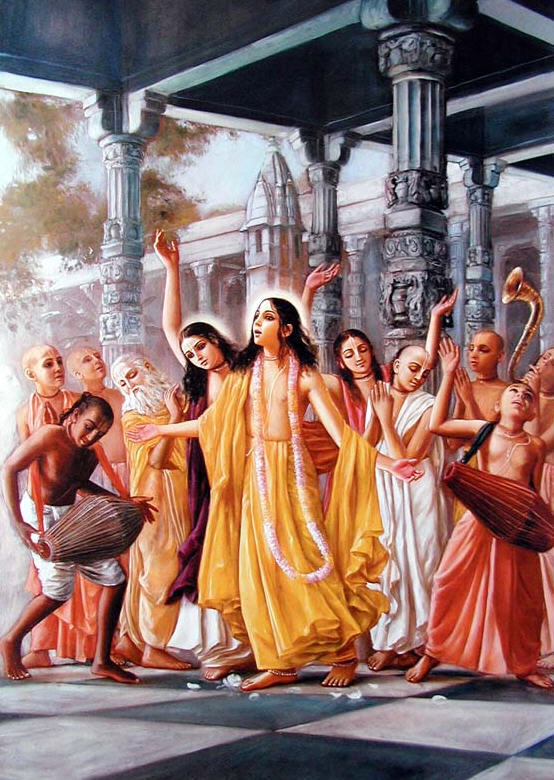
Every year at Jagannatha Puri, Lord Jagannatha's chariot began its slow journey down the broad sandy road toward the Gundicha temple, pulled by the temple servants called gaudas while King Pratparudra himself swept the road ahead with a golden-handled broom. Sri Chaitanya Mahaprabhu came every year to dance in front of that chariot, and it is inside one particular year's description of that dancing, recorded by Krishnadasa Kaviraja Goswami in the thirteenth chapter of Chaitanya-charitamrita's Madhya-lila, that Shubhananda Dvija steps, briefly, out of a list of names and into an actual scene.
Seven Groups for One Dance #
Mahaprabhu did not dance alone. According to the chapter's own summary, he divided his assembled sankirtana party into seven separate groups, with two mridanga drums in each: fourteen mridangas sounding together along the road. For the first group, he appointed Damodara Svarupa as chief singer and gave Advaita Acharya the position of dancer. He then organized a second group and made Srivasa Thakura its chief singer (Madhya 13.38). The text goes on to name the men who sang the response to Srivasa Thakura's lead: "Gangadasa, Haridasa, Sriman, Shubhananda and Sri Rama Pandita," while Nityananda Prabhu himself was appointed to dance in that same group (Madhya 13.39). This is the only scene in the entire Gaudiya canon that places Shubhananda among other devotees by name, doing a specific thing: singing in Srivasa Thakura's own party, with Nityananda Prabhu dancing in front of him.
Mahaprabhu moved between all seven groups as they sang, and, the tradition holds, was mystically present in each of them at once, so that every group felt certain he was dancing with them alone. As the chariot moved on, the groups eventually merged into one tumultuous, combined kirtana, with the Lord dancing in the middle of all of it. It is somewhere within that larger, converging roar of drums and voices that the specific moment involving Shubhananda takes place.
The Foam That Fell From His Mouth #
Dancing before Jagannatha's cart, Mahaprabhu passed into a state of ecstasy so overwhelming that foam appeared at the corner of his mouth, one of the recognized bodily signs of transcendental bhava that Chaitanya-charitamrita records again and again through his life. Krishnadasa Kaviraja Goswami gives what happened next in a single couplet: "That foam, taking it, Shubhananda drank. A relisher of the mellow of Krishna-prema, he was very fortunate" (sei phena lañā śubhānanda kaila pāna / kṛṣṇa-prema-rasika teṅho mahā-bhāgyavān, Madhya 13.110).
The two words Krishnadasa Kaviraja chooses to describe him are worth sitting with. Kṛṣṇa-prema-rasika means something more specific than simply "devoted": a rasika is a connoisseur, someone with a trained, discerning taste for a particular flavor, and here the flavor is prema, love of Krishna in its most intense, ecstatic form. Mahā-bhāgyavān, "very fortunate," is the author's own verdict on the act: not disgust or surprise at a devotee drinking another man's saliva, but the opposite, envy almost, that Shubhananda alone among the crowd was positioned, and had the boldness, to take that particular prasada. In the world Krishnadasa Kaviraja Goswami is describing, whatever falls from Mahaprabhu's own body in a state of divine ecstasy is not ordinary matter at all.
One Verse, Remembered #
Nothing else is recorded of how Shubhananda came to be standing close enough to Mahaprabhu to do this, what he felt in the moment, or what became of him afterward. He is not shown speaking, and no later chapter returns to him. What survives is this one couplet, plus his place, a few chapters earlier, as one of the five singers responding to Srivasa Thakura in that same festival's dancing. For a great many of the devotees who followed Chaitanya, this is the ordinary shape of the historical record: not a biography, but a single, sharply remembered gesture, set down because someone who was there thought it was worth remembering.