Table of Contents
- 1. Quick Facts About Bhakta Salabega
- 2. Chapter One: The Chariot That Would Not Move
- 3. Chapter Two: Who Was Bhakta Salabega?
- 4. Chapter Three: A Birth Between Two Worlds
- 5. Chapter Four: The Wound That Opened the Door to Bhakti
- 6. Salabega's Journey to the Lord
- 7. Chapter Five: The Mother Who Gave Him Krishna's Name
- 8. Chapter Six: The Devotee Outside the Temple, But Not Outside Mercy
- 9. Chapter Seven: Vrindavan, Bhajans and the Pull of Puri
- 10. Chapter Eight: The Prayer That Made the Lord Wait
- 11. Chapter Nine: Salabega's Samadhi on Bada Danda
- 12. Chapter Ten: Ahe Nila Saila and the Songs of Salabega
- 13. For Devotees Today: What Salabega Teaches Us
- Lord Jagannath sees the heart
- Obstacles can deepen devotion
- The Lord responds personally
- Devotion should make us humble, not proud
- Rath Yatra belongs to the world
- 14. Shastra & Sampradaya: Gaudiya and ISKCON Understanding
- 15. Questions Devotees Ask: Frequently Asked Questions About Bhakta Salabega
- 16. Conclusion: When the Lord Waits
- 17. Continue Your Journey with Lord Jagannath
- 18. More From the Jagannath Story Universe
- 19. References and Source Notes
In Short
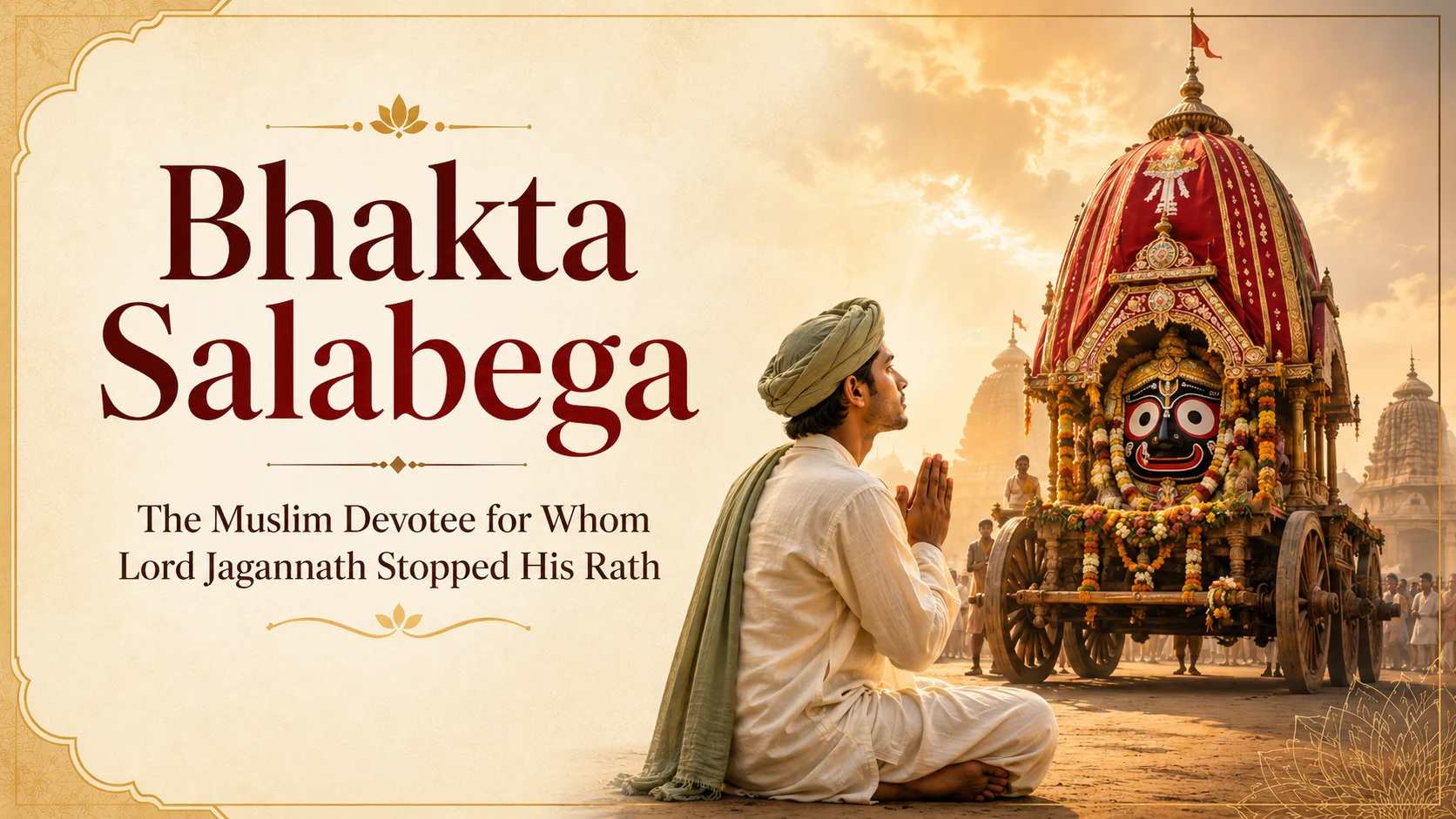
Bhakta Salabega was a 17th-century Muslim-born Odia devotional poet and great devotee of Lord Jagannath. Traditional accounts say he was the son of Mughal Subedar Lalbeg and a Brahmin mother. After being healed through prayer to Krishna/Jagannath, he became deeply devoted to Lord Jagannath, though he was not allowed to enter the Puri temple. His most famous pastime says Lord Jagannath's Nandighosa chariot stopped near Balagandi on Bada Danda until Salabega arrived for darshan.
Quick Facts About Bhakta Salabega
Tap a card to reveal the answer
Who was Bhakta Salabega?
Tap to reveal ✦
A 17th-century Odia devotional poet and devotee of Lord Jagannath.
Why is he famous?
Tap to reveal ✦
Devotional tradition says Lord Jagannath's chariot stopped until Salabega arrived for darshan.
Which chariot stopped?
Tap to reveal ✦
Nandighosa, the chariot of Lord Jagannath.
Where did it stop?
Tap to reveal ✦
Near Balagandi on Bada Danda, the Grand Road of Puri.
Which festival is connected?
Tap to reveal ✦
Often called Rath Yatra generally; Odisha Review sources specifically mention the Return Car Festival, or Bahuda Yatra.
His famous bhajan?
Tap to reveal ✦
Ahe Nila Saila, among other Jagannath and Krishna songs.
Was Salabega Muslim?
Tap to reveal ✦
He was Muslim by birth, traditionally described as the son of Lalbeg and a Brahmin mother.
The main lesson?
Tap to reveal ✦
Lord Jagannath accepts sincere devotion beyond external identity.
Chapter One: The Chariot That Would Not Move
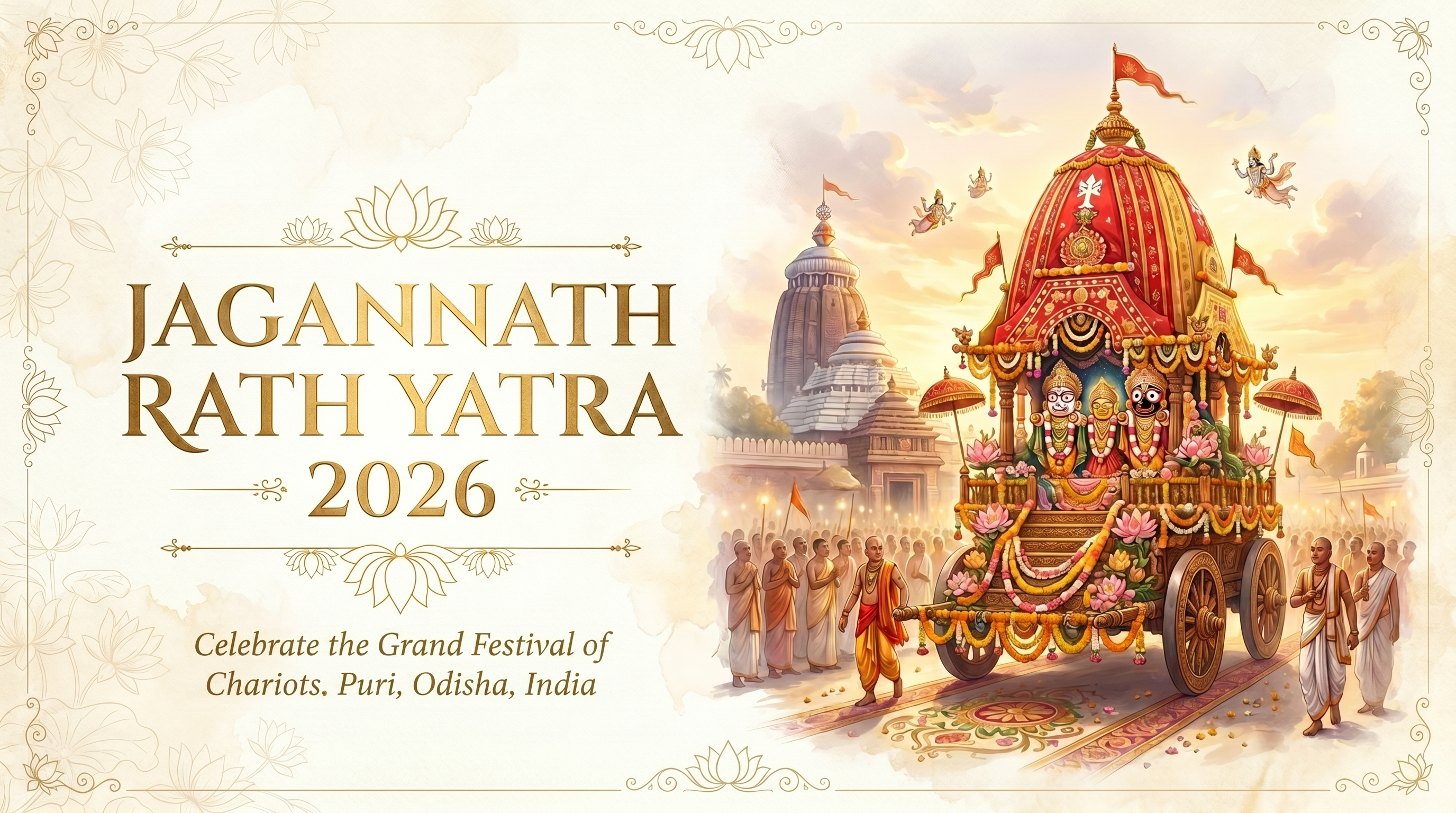
On the Grand Road of Puri, Lord Jagannath's chariot is not just a chariot. For devotees, it is a moving temple. The ropes are not just ropes. They are the hope of thousands of hands trying to serve the Lord. The wheels are not just wheels. They carry mercy through the streets.
Yet in the memory of Odisha, there is one moment when the Lord's chariot did not move.
Not because the wheels were weak. Not because the road was empty. Not because the people lacked strength. The chariot waited because a devotee was still on the way.
His name was Salabega.
He was not a king. He was not a priest. He was not allowed to enter the temple because of his birth. But his longing was so intense that Lord Jagannath, the Lord of the Universe, waited for him on the road.
That is why the story of Bhakta Salabega is remembered every year when Lord Jagannath's chariot pauses near his samadhi. It is a story that says: the Lord may be the master of the universe, but He is conquered by love.
Chapter Two: Who Was Bhakta Salabega?
Bhakta Salabega, also written as Salabeg, is one of the most beloved devotional poets of Odisha. Odisha Review describes him as a poet who devoted his life to Lord Jagannath and places him in the first half of the 17th century. Some accounts place his birth around 1607–1608, based on the work of Nilamani Mishra. [1]
Salabega is remembered for his prayers and songs to Lord Jagannath and Krishna. His bhajans are still sung by devotees in Odisha. His poetry is not only literature; it is longing put into words. It carries the voice of someone who was outside the temple walls but inside the Lord's compassion.
This contrast makes his life unforgettable. Externally, he was Muslim by birth. Socially, he was not accepted as qualified to enter the Jagannath Temple. Spiritually, however, his heart was fixed on Jagannath. His story teaches that the Lord does not measure devotion by external label. Jagannath sees the heart.
Chapter Three: A Birth Between Two Worlds
According to Odisha Review, Salabega was the son of Mughal Subedar Lalbeg. The traditional account says that Lalbeg, during one of his military journeys, encountered a young widowed Brahmin woman at Dandamukundapur and forcibly took her as his wife. Salabega was born from this union. [1]
This placed Salabega between two worlds. From his father came a Muslim social identity and the world of Mughal military power. From his mother came a hidden stream of devotion to Krishna and Jagannath.
The beginning of Salabega's life was not simple. It carried pain, social complexity and identity struggle. That is part of why his story touches people even today. Not everyone begins spiritual life from an easy place. Many people carry wounds, labels, confusion and a complicated past. Salabega shows that none of these can stop the Lord's mercy.
In fact, the Lord often enters through the very places where we feel most broken.
Chapter Four: The Wound That Opened the Door to Bhakti
As Salabega grew older, he is said to have entered military life. Odisha Review records that he joined his father's campaigns and was once severely wounded in battle. Another source notes that some accounts describe the crisis as an incurable illness, while others describe it as a battlefield injury. In both versions, the meaning is the same: Salabega reached a point where human strength could not save him. [1][2]
His body was weak. His confidence was broken. The world of weapons and power could not give him shelter.
At that moment, his mother gave him the advice that changed his life.
She told him to remember Krishna.
To a wounded soldier, this may have sounded too simple. But in bhakti, the simple instruction often opens the deepest door. Call the Lord. Chant His name. Take shelter.
Traditional accounts say that Salabega followed his mother's advice and was miraculously healed. That healing became the turning point of his life. He wanted to know the Lord who had saved him. From his mother, he learned that Lord Jagannath of Puri is Krishna Himself.
The name Jagannath began to pull him like an invisible rope.
Salabega's Journey to the Lord
Tap each milestone to walk with him
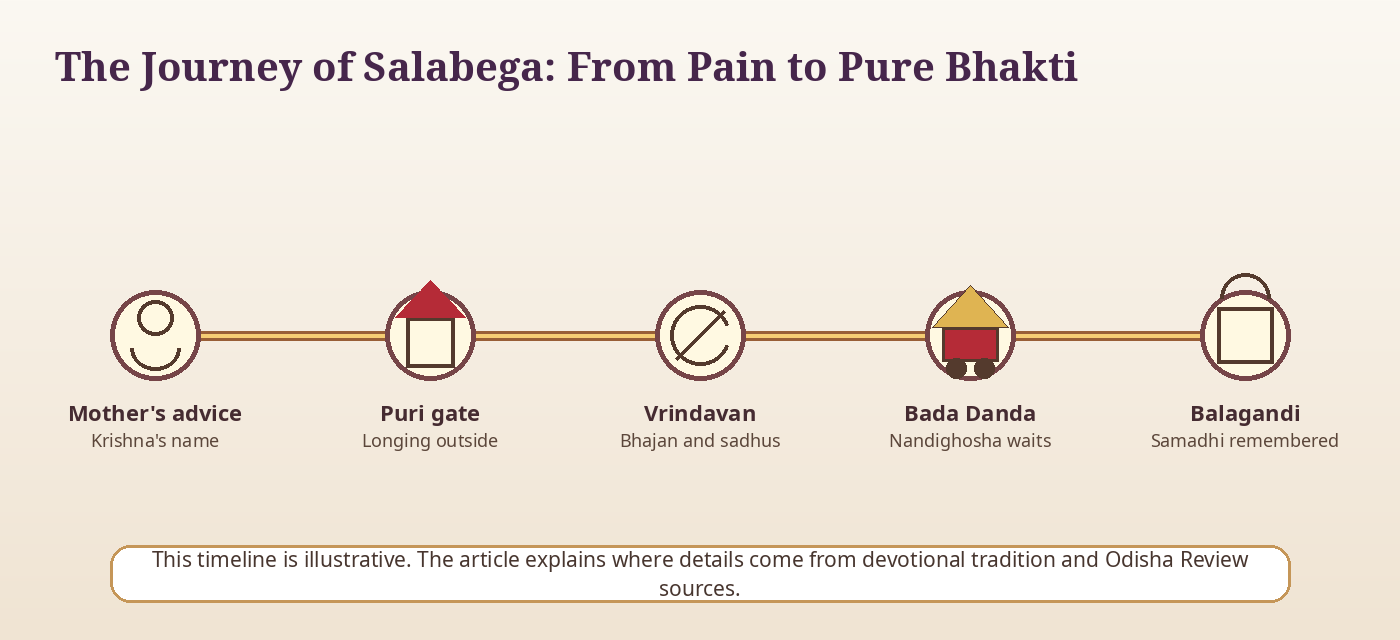
Salabega joined his father's military campaigns and was severely wounded — some accounts say a battlefield injury, others an incurable illness. Either way, he reached the point where human strength could not save him.
His Brahmin mother, who had suffered deeply herself, carried within her a treasure greater than status: remembrance of the Lord. She told her dying son to remember Krishna — and traditional accounts say he was miraculously healed.
Healed and grateful, Salabega went to Puri longing to see the Lord who had saved him. But he was refused entry into the Jagannath Temple because of his Muslim birth. The doorway closed — yet his heart did not.
Though denied entry, his devotion was answered through Lord Jagannath's manifestation as Patitapabana — "the savior of the fallen" — at the Lion Gate. From Bada Danda, the Grand Road, Salabega could still receive darshan.
Salabega travelled to Vrindavan and lived in the association of sadhus, reciting bhajans in honor of Lord Krishna. He never saw Jagannath as separate from Krishna — his songs move between Puri and Vraja, the Lord on the chariot and the cowherd boy with the flute.
When the chariot festival neared, Salabega set out for Puri. On the way he fell ill. The festival was near, the distance impossible. Helpless once again, he prayed that Lord Jagannath would wait for him on Nandighosa until he could arrive.
According to the legend preserved in Odisha Review, on the day of the Return Car Festival the Nandighosa chariot did not move — despite ropes, crowds and strength — and remained still until Salabega arrived in Puri and received darshan. Then, and only then, the chariot moved.
The spot where the chariot waited became Salabega's place of bhajan, and his samadhi still stands on the Grand Road near Balagandi. Every year, Lord Jagannath's chariot pauses there in memory of the tender relationship between the poet and his Lord.
Chapter Five: The Mother Who Gave Him Krishna's Name
In many devotional lives, the first guru appears quietly. In Salabega's life, that guide was his mother.
She did not give him social protection. She did not give him a place in the temple. She gave him the name of Krishna.
This is one of the most tender parts of the story. A mother who had suffered deeply carried within her a treasure greater than status: remembrance of the Lord. When her son was suffering, she gave him that treasure.
For readers today, this is a powerful lesson. Spiritual culture survives not only through books and institutions, but through homes, prayers, songs, prasadam, grandparents, mothers, fathers and one sincere person telling another, "Remember Krishna. Call Jagannath. He will hear you."
Salabega's later poetry carries that same feeling. He does not write like a distant philosopher. He writes like a child calling out. He writes like a patient saved from death. He writes like a traveler afraid of missing the Lord.
His helplessness became his strength.
Chapter Six: The Devotee Outside the Temple, But Not Outside Mercy
After his recovery, Salabega went to Puri with the desire to see Lord Jagannath. But he was refused entry into the temple because of his Muslim birth. [1]
This could have broken him.
He had come to see the Lord who saved him. The doorway closed.
Many people would become bitter. Salabega did not. He did not stop loving Jagannath because he could not enter the temple. He did not reduce God to the gate that blocked him. Instead, his longing became deeper.
Odisha Review records that although Salabega was denied entry into the temple, his devotion was answered through Lord Jagannath's manifestation as Patitapabana at the Lion Gate. From Bada Danda, the Grand Road, he could still receive darshan. [2]
Patitapabana means the savior of the fallen. This name is central to Salabega's story. When someone is not considered qualified by society, Jagannath appears as the Lord who still gives mercy. When the devotee cannot cross the threshold, the Lord's compassion crosses it.
Salabega's worship did not depend on physical access alone. He had darshan through longing. He had service through song. He had temple within the heart.
Chapter Seven: Vrindavan, Bhajans and the Pull of Puri
After being refused entry, Salabega went to Vrindavan. Odisha Review notes that he lived there in the association of sadhus, reciting bhajans in honor of Lord Krishna. Later, he returned to Puri with a strong desire to see the Rath Yatra of Lord Jagannath. [1]
This part of the story connects Jagannath with Krishna of Vrindavan. Salabega did not see Jagannath as separate from Krishna. He identified Lord Jagannath with Sri Krishna. His songs move between Puri and Vrindavan, between the Lord on the chariot and the cowherd boy of Vraja.
In Vrindavan, he absorbed the sweetness of Krishna bhakti. He heard kirtan, lived near sadhus and remembered the land of Krishna's flute. But his longing for Jagannath remained.
When the time of the chariot festival came, he wanted to return to Puri.
For Salabega, Rath Yatra was everything. He could not enter the temple, but during Rath Yatra Lord Jagannath comes out. The Lord who is normally behind the temple doors rides on the chariot and gives darshan to all.
So Salabega began the journey back.
But on the way, he fell ill.
The festival was near. The distance felt impossible. His body wanted to run toward the Lord but could barely move. Once again, Salabega was helpless. Once again, helplessness became prayer.
Chapter Eight: The Prayer That Made the Lord Wait
Salabega prayed that Lord Jagannath would wait for him.
Odisha Review's 2014 article preserves the mood of his prayer, where Salabega begs the Lord to remain on Nandighosa until he can arrive and see Him. The article then says that, according to the legend, on the day of the Return Car Festival, Nandighosa did not move and remained still until Salabega arrived in Puri. [3]
This detail is important for accuracy. Many devotees generally call it the Rath Yatra story of Salabega. That is understandable because Bahuda Yatra is part of the Rath Yatra festival cycle. More precisely, Odisha Review describes the event during the Return Car Festival, or Bahuda Yatra, when Lord Jagannath returns toward Srimandir.
Imagine the scene.
The ropes are pulled. The crowd is ready. The chariot of Jagannath stands in the middle of Bada Danda.
But Nandighosa does not move.
Strength fails. Procedure fails. The Lord is waiting.
Far away, Salabega is coming. Weak, delayed, perhaps weeping, perhaps chanting, perhaps thinking he has missed the chance of his life. But Jagannath has heard.
When Salabega finally arrives and receives darshan, the waiting ends. The chariot moves.
The world sees a miracle. The devotee sees mercy.
This is why the story is loved so deeply. It tells every sincere soul: even when you are late, weak, far away or outside the gate, do not stop calling. The Lord of the Universe can stop His Rath for love.
Chapter Nine: Salabega's Samadhi on Bada Danda
The place where the chariot stopped became connected forever with Salabega. Odisha Review states that the place where the car remained stationary for Salabega was later used by him for composing many bhajans in honor of Lord Jagannath, and that his samadhi still stands on the Grand Road in Puri near Balagandi. [1]
Another Odisha Review source records that every year the chariot of Lord Jagannath stops there for a while in memory of the tender relationship between the poet and his Lord. [2]
This continuing pause is powerful. It means Salabega is not remembered only in books. He is remembered in the living movement of Rath Yatra itself. The Lord's chariot pauses where the devotee's longing once made the Lord wait.
For pilgrims walking on Bada Danda, this place becomes a lesson written into geography. The road itself says: bhakti is not forgotten.
Chapter Ten: Ahe Nila Saila and the Songs of Salabega
Salabega is also remembered through his songs. His famous bhajan Ahe Nila Saila remains one of the most loved prayers to Lord Jagannath. Odisha Review notes that Salabega composed numerous devotional songs, though not all have survived. Many are prayers and hymns to Lord Jagannath and Krishna. Some describe Krishna-lila, Radha and the gopis, and the vatsalya mood of mother Yashoda. [2]
His songs are not cold poetry. They are cries of dependence. They carry humility, longing and confidence that the Lord saves those who surrender.
The main point is simple: Salabega did not merely believe in Jagannath. He sang to Him. He turned pain into prayer and prayer into poetry.
"People may see birth, background, language, status or past mistakes. Jagannath sees bhakti."The lesson of Bhakta Salabega
For Devotees Today: What Salabega Teaches Us
Salabega's story is not only history. It is a mirror. Many people feel they are standing outside something: outside acceptance, outside purity, outside spiritual qualification, outside the confidence to approach God. Salabega shows that no external condition can stop sincere prayer from reaching the Lord.
Lord Jagannath sees the heart
People may see birth, background, language, status or past mistakes. Jagannath sees bhakti.
Obstacles can deepen devotion
The closed temple gate did not close Salabega's heart. Instead, his longing became stronger.
The Lord responds personally
In the story, Jagannath does not remain a distant deity. He waits. He stops. He gives darshan. He accepts love.
Devotion should make us humble, not proud
Salabega never used his story to claim superiority. His songs carry a mood of surrender. He calls himself lowly, yet never doubts Jagannath's mercy.
Rath Yatra belongs to the world
When Jagannath comes out on His chariot, the Lord of the temple becomes the Lord of the road. The Lord worshiped by priests also gives darshan to travelers, outsiders, the poor, the forgotten and the longing.
Shastra & Sampradaya: Gaudiya and ISKCON Understanding
For Gaudiya Vaishnavas and ISKCON devotees, Salabega's story fits beautifully with the teachings of Krishna bhakti.
In the Bhagavad-gita, Krishna teaches that He accepts a simple offering when it is given with love and devotion. The essential principle is not external display but bhakti. [8]
Srila Prabhupada also explains in his purport to Bhagavad-gita 9.32 that devotional service is not restricted by material social distinctions when a person sincerely takes shelter of the Lord. [9]
This is why Salabega's story is not an exception to bhakti philosophy. It is an illustration of it.
Lord Jagannath is Krishna, and Krishna is bhava-grahi: He accepts the mood of devotion. Salabega may have stood outside the temple, but his heart was inside the Lord's remembrance. Jagannath may have been seated on Nandighosa, but His attention was fixed on His devotee.
For Nandgram Dham readers, this story connects with three major themes: Lord Jagannath is the Lord of the Universe, not the property of one community. Rath Yatra is the Lord's public mercy, where He comes out to bless everyone. And pure devotion is stronger than social identity, distance and physical limitation.
Questions Devotees Ask: Frequently Asked Questions About Bhakta Salabega
Bhakta Salabega was a 17th-century Odia devotional poet and great devotee of Lord Jagannath. He was Muslim by birth and is remembered for his heartfelt songs to Jagannath and Krishna.
He is called a Muslim-born devotee because traditional accounts describe him as the son of the Mughal Subedar Lalbeg. Despite that social identity, his heart became fully devoted to Lord Jagannath.
According to devotional tradition, Salabega was delayed while returning to Puri and prayed that Lord Jagannath would wait for him. Nandighosa, the chariot of Lord Jagannath, did not move until Salabega arrived and received darshan.
The chariot connected with the story is Nandighosa, the chariot of Lord Jagannath.
People commonly call it a Rath Yatra story, but Odisha Review accounts specifically mention the Return Car Festival, also known as Bahuda Yatra.
Salabega's samadhi or memorial is traditionally remembered on Bada Danda, the Grand Road of Puri, near Balagandi.
Odisha Review records that Lord Jagannath's chariot stops there for a while during the car festival in memory of the tender relationship between Salabega and Lord Jagannath.
Ahe Nila Saila is one of Salabega's most famous devotional songs to Lord Jagannath. It is deeply loved in Odisha and is often sung as a prayer of surrender to the Lord.
Traditional accounts say Salabega was not allowed to enter the temple because of his Muslim birth. Yet his devotion was answered through Lord Jagannath's mercy as Patitapabana, visible from outside the Lion Gate.
Patitapabana means the savior of the fallen. In Jagannath devotion, this name expresses the Lord's special mercy toward those who feel unqualified or excluded.
The main lesson is that Lord Jagannath accepts sincere devotion beyond external identity. Birth, status and social distance cannot stop the Lord from hearing a sincere devotee.
Salabega identified Lord Jagannath with Sri Krishna. His songs often glorify Jagannath and Krishna, and many are connected with Krishna-lila, Vrindavan and the moods of bhakti.
Conclusion: When the Lord Waits
The story of Bhakta Salabega is unforgettable because it reverses what people expect.
The devotee waits for God. But here, God waits for the devotee.
Salabega could not enter the temple, but Jagannath came onto the road. Salabega was delayed, but Jagannath did not move. Salabega was judged by birth, but Jagannath answered his heart.
This is the mercy of the Lord of the Universe.
For anyone who feels far away from spiritual life, Salabega's story whispers hope: keep calling. For anyone who feels unqualified, it says: offer your heart. For anyone who thinks the Lord is too distant, it says: Jagannath can stop His Rath for love.
May Bhakta Salabega's longing awaken in us a small drop of sincere devotion to Lord Jagannath, Lord Balabhadra and Devi Subhadra.
Continue Your Journey with Lord Jagannath
To learn more about Lord Jagannath's meaning, origin, pastimes, devotees, Rath Yatra, Mahaprasad and Gaudiya Vaishnava significance, read our complete guide. You can also join Nandgram Dham satsang, kirtan, Bhagavad Gita study, prasadam seva and Jagannath festivals to deepen your connection with Lord Jagannath and Krishna bhakti.
Read the Complete Guide to Lord Jagannath →References and Source Notes
- Odisha Review, October 2015. "Bhakta Salabeg." Records Salabega as a devotional poet of Odisha, places his life in the first half of the 17th century, identifies him as the son of Mughal Subedar Lalbeg, and narrates the chariot-stopping tradition. magazines.odisha.gov.in/Orissareview/2015/Oct/engpdf/1-2.pdf
- Dr. Subas Pani. "Songs of Salabega." Orissa Review, June 2004. Discusses Salabega's songs, denial of temple entry, Patitapabana darshan from Bada Danda, identification of Jagannath with Krishna, and the chariot stop near Balagandi. magazines.odisha.gov.in/Orissareview/jun2004/englishpdf/salabega.pdf
- Dr. Mohammed Yamin. "Salabega: A Renowned Saint Poet of Odisha." Odisha Review, June 2014. Discusses Salabega's parentage, historical questions around Lalbeg, the Return Car Festival/Bahuda tradition, Nandighosa stopping, Patitapabana, and Salabega's position in Odia devotional literature. magazines.odisha.gov.in/Orissareview/2014/Jun/engpdf/141-145.pdf
- Shree Jagannatha Temple Administration. "Mahaprabhu Shree Jagannatha." Official temple website explaining the meaning and glory of Mahaprabhu Shree Jagannatha. shreejagannatha.in/mahaprabhu-shree-jagannatha
- Shree Jagannatha Temple Administration. "Bahara Bedha / Outer Periphery." Official temple source mentioning Patitapabana at the eastern gate area. shreejagannatha.in/outer-periphery
- Bhagavad-gita As It Is 9.26. Krishna accepts offerings made with love and devotion. vedabase.io/en/library/bg/9/26
- Bhagavad-gita As It Is 9.32. Srila Prabhupada explains that devotional service is not restricted by material social distinctions. prabhupadabooks.com/bg/9/32
The illustrations on this page are original devotional artwork created for Nandgram Dham. They are illustrative, not historical photographs.