Freed from one attachment, Bilvamangala walked straight into a test of the same weakness. The sources agree that somewhere on the road to Vrindavana, before he had gone very far in his new life, his eyes settled on another woman's beauty and his old habit of mind reasserted itself immediately.
A Second Fall, Almost #
The accounts differ on the details. One version has him stopping at a well to ask a young, newly married woman for water, then following her home once he could not stop looking at her. Another has him simply noticing a beautiful woman on the road and trailing her out of old habit. In the fullest telling, attributed to Srila Narayana Maharaja, the woman's husband — mistaking Bilvamangala for a genuine holy man — welcomed him as a guest and even promised, before knowing what was being asked, to grant whatever he requested. What Bilvamangala asked for, in every version of the story, was not the woman herself but her hairpin.
"These Eyes Are My Enemy" #
Srila Prabhupada told this part of the story in the plainest terms: Bilvamangala asked the woman, "Mother, will you give me your hair pin?" and then, in Prabhupada's words, "took the hair pin and pushed in the eyes: 'Oh, these eyes are my enemy.' Since then he became blind." Other retellings add more detail — that he addressed her respectfully as "Mother" to signal his intent was not what it appeared, that he asked for two hairpins rather than one, and that he explained himself out loud before acting, reasoning that if a flute cannot sound without bamboo, his lust could not survive without the eyes that kept feeding it.
The sources this project consulted are consistent that Bilvamangala blinded both eyes, not one — though the tradition is old enough, and has passed through enough retellings, that this project cannot rule out other versions existing elsewhere that say otherwise. What is consistent everywhere is the reasoning behind the act: not despair, and not a punishment inflicted on himself for its own sake, but a deliberate, almost surgical decision to remove the one sense organ that kept betraying his own resolve. Having taken vows of renunciation, he judged that eyes which could not stop finding beautiful faces in strange women had no further use to him.
Blindness as the End of an Old Life #
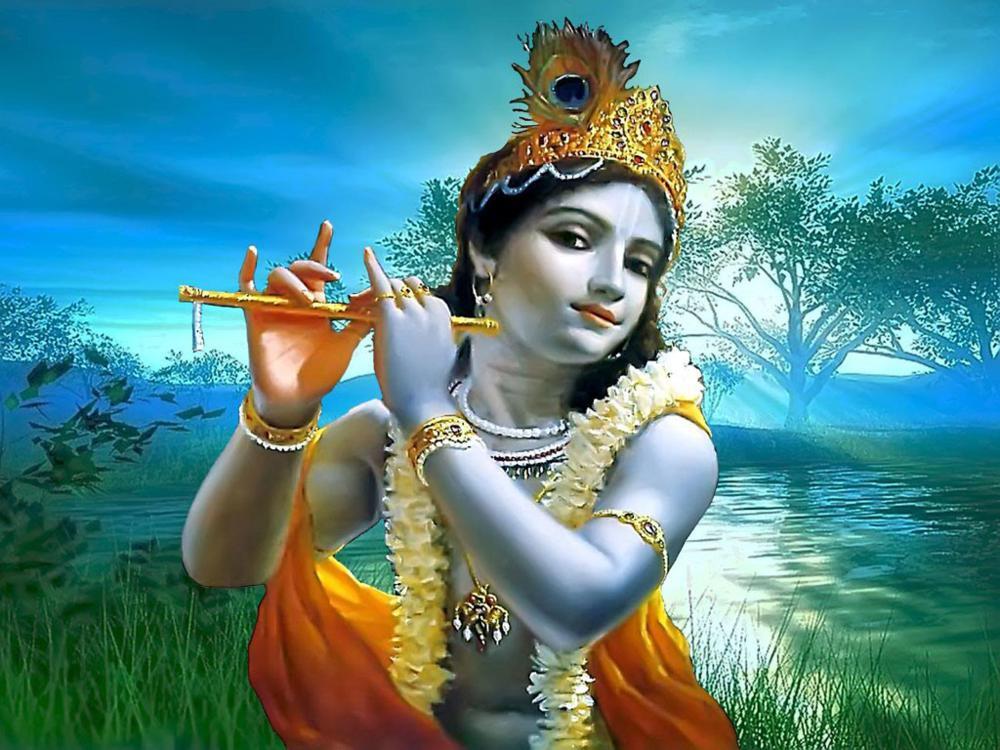
The self-blinding closes the story of Bilvamangala the brahmana householder undone by lust, and opens the story of Bilvamangala the blind devotee whom Krishna Himself would not leave unattended. Physically helpless on an unfamiliar road, he pressed on toward Vrindavana anyway, chanting as he went — and what happened next, one of the most tender and often-illustrated pastimes associated with him, is told on Krishna as His Guide. The rebuke that pushed him this far is told in full on The Rebuke That Changed His Life.
Why This Story Endures #
Vaishnava writers have never told the self-blinding of Bilvamangala as a story about self-hatred. It is told, instead, as an extreme illustration of a very ordinary teaching: that the senses, left unchecked, will keep finding their way back to old habits no matter how sincere a person's intentions are, and that real vairagya (renunciation) sometimes calls for decisive, uncomfortable action rather than repeated good intentions. Srila Prabhupada's own retelling makes a point of framing what came immediately after the blinding, not the blinding itself, as the real payoff: "in that blindness he was worshiping Krishna, and Krishna was coming to him." The act only matters, in other words, because of where it led.
It is also worth being honest about how thin the historical record actually is beneath a story this vivid. Nothing here can be checked against an independent record of Bilvamangala's life — no inscription, no dated manuscript colophon, nothing outside devotional memory itself. The story is preserved because generations of Vaishnavas found it worth preserving and retelling, in slightly different words each time, not because it can be verified the way a modern biography can. That does not make it less important to the tradition; Sri Chaitanya Mahaprabhu Himself, as the next chapter of Bilvamangala's story shows, took the man's poetry seriously enough to carry it home from South India by hand.