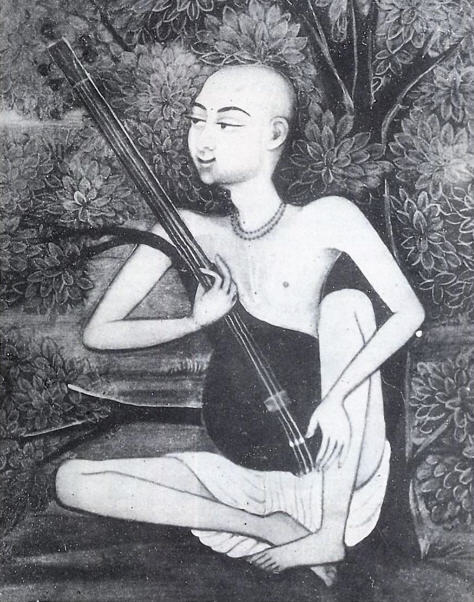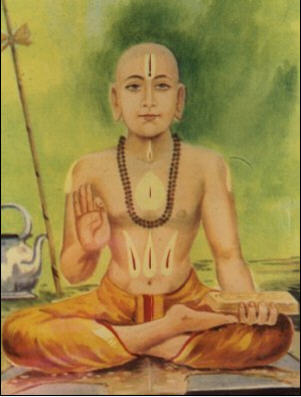
Srila Bilvamangala Thakura
Poet-Saint Who Composed Sri Krishna-karnamrita
Also known as Vilvamangala, Lilasuka, Lilashuka, Leelasuka Bilvamangala, Bilvamangala Swami, Bilvamangala Thakkura
“O my Lord, the transcendental body of Krishna is very sweet, and His face is even sweeter than His body. But His soft smile, which has the fragrance of honey, is sweeter still.”
Sri Krishna-karnamrita, verse 92 — quoted by Sri Chaitanya Mahaprabhu Himself (Chaitanya-charitamrita, Madhya 21.136)
Srila Bilvamangala Thakura is remembered for one of the most extreme conversion stories in Vaishnava tradition: a wealthy brahmana so consumed by lust for a courtesan named Cintamani that a single rebuke from her broke his attachment completely, after which he blinded himself so his eyes could never again pull him away from Krishna, and spent the rest of his life composing Sri Krishna-karnamrita, verses so sweet that Sri Chaitanya Mahaprabhu Himself later carried a copy of them out of South India and never tired of hearing them recited.
Exactly when Bilvamangala lived is not settled. Modern scholarship places the text of Krishna-karnamrita anywhere from the ninth to the fifteenth century, and even Srila Prabhupada, describing this story to a visitor in 1969, first said the poet lived "seven hundred years" earlier and then, when a guest suggested the fourteenth century, corrected himself mid-sentence to say Bilvamangala came "some time before." What is not in doubt is the depth of devotion his verses carry, or the affection the Gaudiya Vaishnava tradition has always shown them.
| Detail | Description |
|---|---|
| Also called | Vilvamangala, Lilasuka (Lilashuka) |
| Lived | Disputed — estimates range from the 9th to the 14th century |
| Birthplace | South India (Kerala tradition and Srila Prabhupada's own purport point to different regions) |
| Teacher named in tradition | Somagiri |
| Chief work | Sri Krishna-karnamrita |
| Famous for | The Cintamani story, self-blinding, and Krishna's appearance to him as a cowherd guide |
A Brahmana Undone by Cintamani #
Sources agree that Bilvamangala was born into a respectable, well-off brahmana family somewhere in South India and grew up learned and pious. They also agree that at some point, as a young man, he fell hopelessly under the spell of a courtesan named Cintamani, and that this attachment cost him everything — his studies, his family duties, and by some accounts a wife and household he had already been given. He kept visiting her by night, spending down his family's wealth to do it, until the obsession reached the point that even his own father's death barely registered with him. The night everything changed is told in more detail on Early Life and Attachment to Cintamani: a flooded river crossed on what turned out to be a floating corpse, a compound wall scaled by grabbing what turned out to be a live snake, and a soaked, exhausted brahmana arriving at his beloved's door in the middle of the night.
The Rebuke, the Blinding and a Blind Man's Guide #
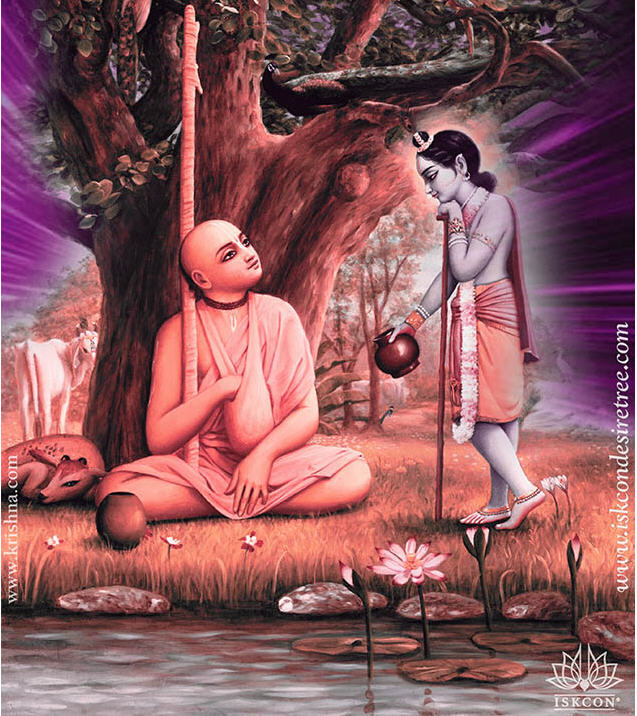
It was Cintamani herself who ended it. Seeing the state he had reduced himself to for her sake, she turned his own desperation back on him: if he felt even a fraction of this attraction for Krishna, she said, his life would actually mean something. Srila Prabhupada told the story simply — "immediately he came to his senses." What Bilvamangala did with that awakening is remarkable even by the standards of Vaishnava renunciation: on the road to Vrindavana, catching himself drawn to another woman's beauty, he asked her for a hairpin and gouged out his own eyes rather than let his gaze become his undoing again. The fuller account, including how differently various sources describe this moment, is on The Rebuke That Changed His Life and Renunciation and the Gouged Eyes. Blind and travelling alone, he did not travel unaided — tradition holds that Krishna Himself came to him in the form of an ordinary cowherd boy, walked with him, fed him, and gave him the personal association his eyes could no longer see, a pastime told on Krishna as His Guide.
Sri Krishna-karnamrita #
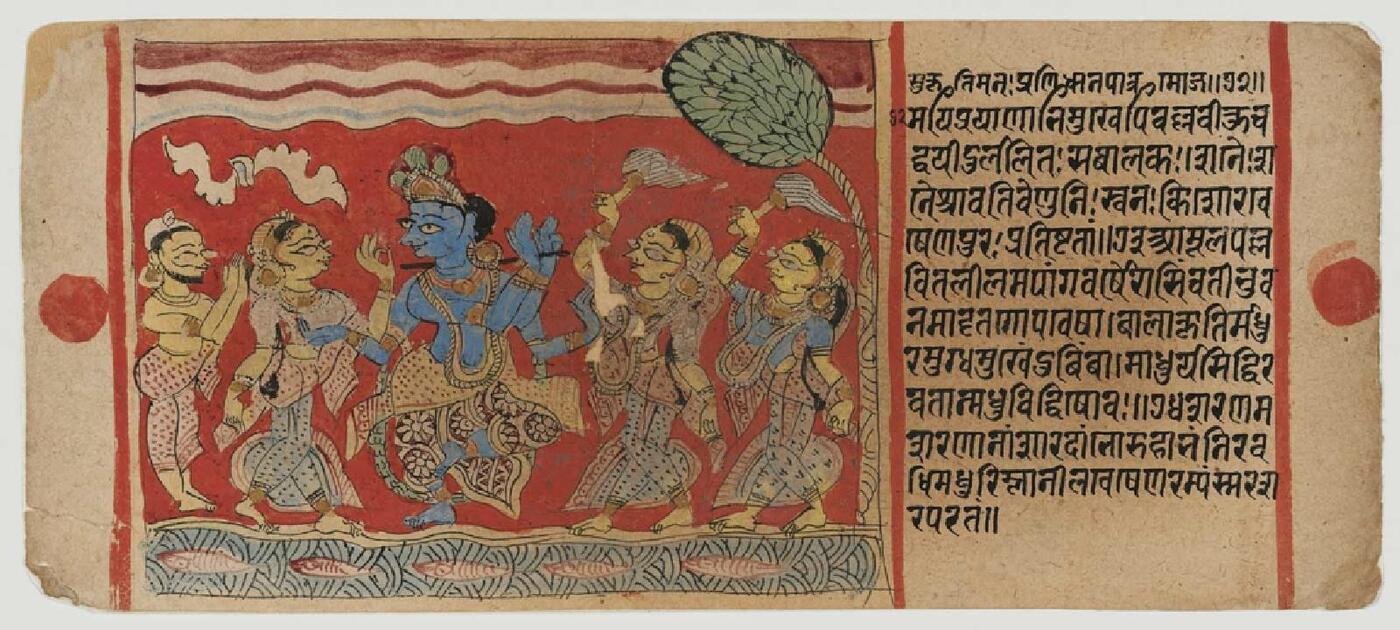
Out of these years came Sri Krishna-karnamrita ("nectar for the ears, about Krishna"), a collection of Sanskrit verses in praise of Krishna's beauty and boyhood pastimes that Gaudiya Vaishnavas have treasured ever since. Krishnadasa Kaviraja Goswami — himself the author of Sri Chaitanya-charitamrita — wrote a commentary on it called Sarangarangada, and another commentary was composed by Chaitanya Dasa Goswami. The book's contents, its two differing recensions, and some of its most famous individual verses are covered on Sri Krishna-karnamrita.
Cherished by Sri Chaitanya Mahaprabhu #
Bilvamangala's importance to the Gaudiya Vaishnava tradition rests heavily on one historical fact recorded in Chaitanya-charitamrita itself: during His tour of South India, Sri Chaitanya Mahaprabhu found a manuscript of Krishna-karnamrita, had it copied at once out of sheer joy, and carried it back to Bengal, where He gave it to Ramananda Raya and was long remembered for how much He loved hearing its verses recited. Srila Prabhupada quoted individual verses from it often in his own lectures and purports. The full textual trail through Chaitanya-charitamrita is laid out on Legacy and Influence on Chaitanya Mahaprabhu.
One Bilvamangala, or Two? #
Modern scholars are honestly divided on whether "Bilvamangala" and "Lilasuka" name one person or two. Some sources treat Lilasuka Bilvamangala as a single figure, the name Lilasuka simply being what his teacher Somagiri called him for his skill at describing Krishna's madhurya-lila. Others argue that an earlier philosopher named Bilvamangala, writing perhaps as early as the ninth century, is a different person from a later Kerala-born poet of the twelfth or thirteenth century who took the name Lilasuka — and that the Krishna-karnamrita text we have today may be the later poet's work, or a blend of both. This project has not tried to resolve that dispute; it is reported here exactly as the sources leave it, unresolved.
Songs in the Vaishnava Song Book #
This site's own Vaishnava Song Book carries 3 songs attributed to Srila Bilvamangala Thakura — see the full author page here.
Scriptural evidence
santv avatārā bahavaḥ paṅkaja-nābhasya sarvato-bhadrāḥ
kṛṣṇād anyaḥ ko vā latāsv api prema-do bhavati
Word for word
santu—let there be; avatārāḥ—incarnations; bahavaḥ—many; paṅkaja-nābhasya—of the Lord, from whose navel grows a lotus; sarvataḥ-bhadrāḥ—completely auspicious; kṛṣṇāt—than Lord Krishna; anyaḥ—other; kaḥ vā—who possibly; latāsu—on the surrendered souls; api—also; prema-daḥ—the bestower of love; bhavati—is
"There may be many all-auspicious incarnations of the Personality of Godhead, but who other than Lord Sri Krishna can bestow love of God upon the surrendered souls?"
From the purport: Purport excerpt: "This quotation from the writings of Bilvamangala Thakura is found in the Laghu-bhagavatamrita (1.5.37)."
Krishnadasa Kaviraja Goswami opens Chaitanya-charitamrita's praise of Krishna's supremacy with a line from Bilvamangala, a measure of how highly the tradition already regarded him.
Frequently asked
When was Srila Bilvamangala Thakura born?
Srila Bilvamangala Thakura appeared Uncertain — estimates range from the 9th to the 14th century (disputed) in South India (Kerala tradition and Srila Prabhupada's own purport name different regions).
When and where did Srila Bilvamangala Thakura disappear?
Srila Bilvamangala Thakura disappeared Not recorded in any source found for this project at Not specifically recorded (tradition implies his later years were spent around Vrindavana).
What are the main pastimes of Srila Bilvamangala Thakura?
Dedicated pages on this site cover: Early Life and Attachment to Cintamani, The Rebuke That Changed His Life, Renunciation and the Gouged Eyes, Krishna as His Guide, Sri Krishna-karnamrita, Legacy and Influence on Chaitanya Mahaprabhu.