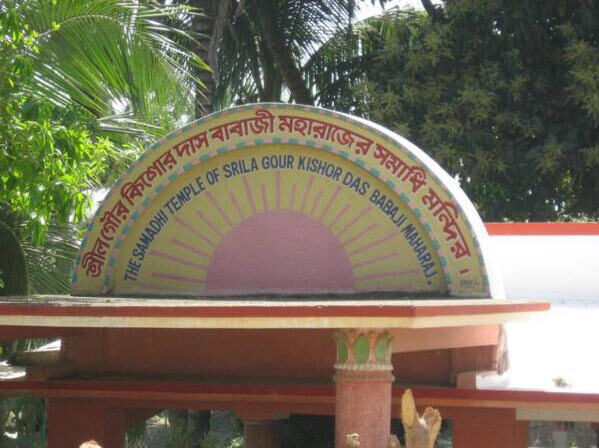
Srila Gaura Kishora Dasa Babaji disappeared from this world on 17 November 1915, at Nabadwip — his own seventy-seventh birthday, and, both gaudiyahistory.iskcondesiretree.com and gosai.com agree, the day of Utthana Ekadashi. Beyond the events described below, very little more is documented about him with any confidence.
| Disappeared | 17 November 1915, his 77th birthday, on Utthana Ekadashi |
| Place | Nabadwip |
| Samadhi relocated | Roughly sixteen years later, after flooding of the Ganges |
| Disciple's self-invested sannyasa | 1918, before a photograph of Gaura Kishora Dasa Babaji |
A Contest Over His Samadhi #
His body was placed in a samadhi tomb at Nabadwip, but according to gaudiyahistory.iskcondesiretree.com, flooding of the Ganges some sixteen years later forced it to be moved. Several local babajis are said to have pressed competing claims to be the one to handle the sacred body. Bhaktisiddhanta Sarasvati, by this account, settled the matter by declaring himself the only genuine disciple of "Paramahamsa Babaji Maharaja" and setting a test of personal purity that none of the rival claimants was willing to meet before a police inspector called in to keep order; the other babajis, the account says, withdrew without a word, and Bhaktisiddhanta reestablished the samadhi within the grounds of Sri Chaitanya Matha at Mayapur, where it remains.
Sannyasa Before a Photograph #
Three years after Gaura Kishora Dasa Babaji's disappearance, in 1918, Bhaktisiddhanta Sarasvati took a step without real precedent in Vaishnava practice: rather than receive the sannyasa order of formal renunciation from a living preceptor, he sat down before a photograph of his guru and, in Wikipedia's phrasing (drawing on Ferdinando Sardella's academic study Modern Hindu Personalism), "invested that order upon himself." Some scholars of Vaishnavism, per the same Wikipedia article's citation of June McDaniel's The Madness of the Saints, have treated the formal validity of this self-administered sannyasa as a contested question. Within the Gaudiya Math and the later ISKCON lineage descending from Bhaktisiddhanta Sarasvati, by contrast, the act has never been in dispute; it is remembered as an act of fidelity to a guru who had already left the world, taken in the conviction that Gaura Kishora Dasa Babaji's sanction did not require his physical presence. Both readings are reported here without adjudicating between them.
A Life That Left Few Records #
Almost nothing else about Srila Gaura Kishora Dasa Babaji can be stated with documentary confidence — no writings of his own survive, no photograph beyond the one venerated by his disciple, and no contemporary record independent of the reminiscences later gathered by his followers. This thinness is not primarily a gap in research; it reflects the kind of life he lived. He sought no following, built no institution, and by every account actively discouraged the personal attention that might have generated a fuller record. What remains is what his one acknowledged disciple, Bhaktisiddhanta Sarasvati, carried forward — a place in the guru-parampara set out on this site's guru-parampara chart, and a manner of renunciation that later Gaudiya Vaishnavas, down to Srila Prabhupada, continued to hold up as an example.