Sources agree on the season of Gauridasa Pandit's disappearance and disagree, in small but real ways, on almost everything else about it. That disagreement is reported here honestly rather than smoothed over.
When and Where #
Bhaktisiddhanta Sarasvati Thakura's Anubhasya, Stephen Knapp's biographical page, and the Gaudiya History site all place Gauridasa Pandit's disappearance on Shukla Ekadashi in the month of Shravana, with no year given by any of them. One further source consulted for this page gives the date as Shukla Dvadasi - the twelfth day of the waxing moon, one day later than Ekadashi - rather than Ekadashi itself; this page cannot resolve that day's difference and reports it rather than silently picking a side.
The place is a harder question still. Ambika Kalna's own temple tradition, and most sources consulted for this page, treat Ambika Kalna as the obvious place - it is where he lived, where his Deities are, and where his "sripat" (a term Gaudiya Vaishnavas use for a saint's sacred residence) remains, in the words of one source, "extremely well known." But one biographical account states plainly that Gauridasa Pandit spent his final period doing bhajana at Dhira Samira Kunja in Vrindavana, and that his samadhi tomb stands there today, inside the compound of the Shyama-Raya Temple. No source consulted for this page reconciles these two pictures - a lifelong resident of Ambika Kalna who never left, against an elderly devotee who went to Vrindavana for his last years of bhajana - and this page does not attempt to invent a reconciliation. Both traditions are reported; readers should treat the question of exactly where Gauridasa Pandit passed away as open.
Twenty-Two Descendants, by Name #
What is not in question is the size of the household Gauridasa Pandit left behind. Bhaktisiddhanta Sarasvati Thakura's Anubhasya lists more than twenty of his descendants by name, headed by an eldest son known as Bada Balarama and a youngest named Raghunatha, whose own sons were Mahesha Pandita and Govinda. A daughter, Annapurna, is also named. Among the other names on that same list is a "Hridaya-chaitanya" - very likely the same devotee remembered elsewhere as Gauridasa Pandit's foremost disciple, the one renamed Hridaya Chaitanya after the pastime described on establishing-deity-worship-at-kalna, which would mean that disciple and blood family were, in this case, close enough to appear on the same family register - itself a small but telling sign of how completely Gauridasa Pandit's household and his devotional service to Nityananda Prabhu had merged into one thing.
A Line That Reaches Baladeva Vidyabhushana #
Hridaya Chaitanya's own line carried Gauridasa Pandit's legacy further than Ambika Kalna itself. His most important disciple was Shyamananda Prabhu, one of the devotees credited with establishing Gaudiya Vaishnavism in Odisha, and the pancharatrika-diksha line that runs from Shyamananda Prabhu through Rasikananda Goswami and Nayanananda Goswami to Radha Damodara Goswami eventually reaches Baladeva Vidyabhushana, the scholar whose Govinda-bhashya secured the Gaudiya sampradaya's standing at Jaipur in 1718. Traced that way, a straight line of formal initiation runs from a Bengali householder's demanding love for Nityananda Prabhu at Ambika Kalna to one of the most consequential philosophical defenses the Gaudiya Vaishnava tradition ever mounted - two centuries and several generations later. Narottama Dasa Thakura's own stop at Ambika Kalna, on his way to the Kheturi festival, is covered in more detail on connection-to-krishnadasa-kaviraja-goswami.
Ambika Kalna Today #
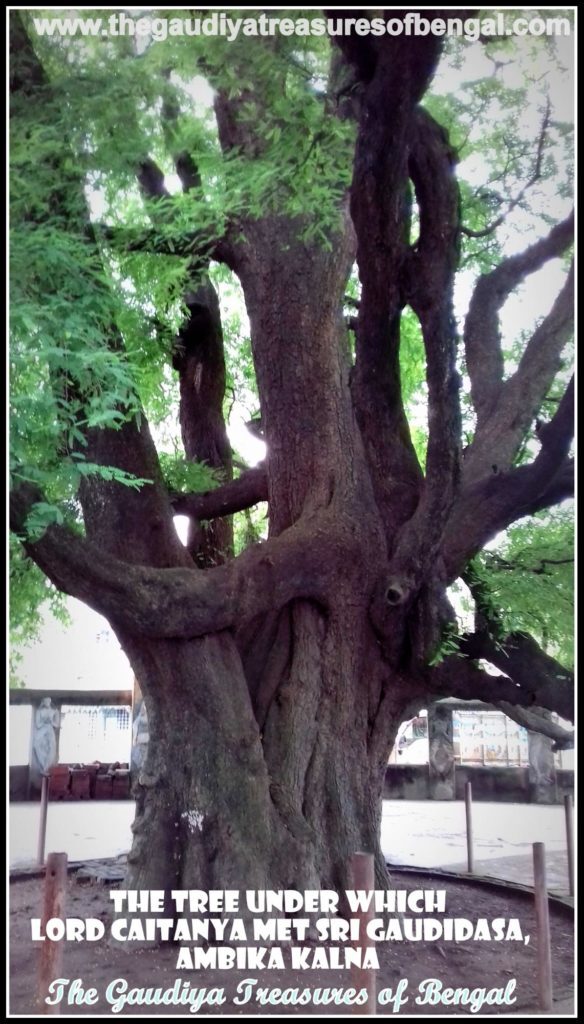
The temple at Ambika Kalna remains an active Gaudiya Vaishnava pilgrimage site, still commonly reached by train from Howrah or by road from Mayapur. The original Gaura-Nitai Deities are still worshiped there, though - by local tradition, on account of the pastime in which they once ran off to join a kirtana - pilgrims today are given only a brief glimpse of them, a "jhalak darshan" lasting a few seconds, rather than an extended darshan. The tamarind tree under which tradition says Mahaprabhu and Gauridasa Pandit once met still stands in front of the temple, and lotus footprints preserved beneath it are shown to visitors as a physical trace of that meeting. A handwritten Bhagavad-gita attributed to Mahaprabhu and an oar said to be his gift to Gauridasa Pandit are also still kept at the temple. Whatever remains unresolved about the exact circumstances of his disappearance, the household, the Deities, and the disciples Gauridasa Pandit left behind at Ambika Kalna have carried his name, largely intact, across five centuries.