Every source agrees that Hemalata was a daughter of Shrinivasa Acharya, the preacher who, together with Narottama Dasa Thakura and Shyamananda Pandit, carried the writings of the Six Goswamis out of Vrindavana into Bengal. Beyond that one point of agreement, the record of her birth family becomes less certain, not more, the closer it is studied.
| Detail | Description |
|---|---|
| Father | Srila Shrinivasa Acharya |
| Mother, this account | Ishvari, also called Draupadi, Shrinivasa's first wife |
| Mother, alternate account | Gauranga-priya, also called Padmavati, Shrinivasa's second wife |
| Sisters | Krishna-priya and Kanchana, also called Yamuna |
| Brother or half-brother | Gati Govinda |
| Family's base | Jajigram, with close ties to Vishnupura (Bishnupur) |
Two Accounts of Her Mother #
Shrinivasa Acharya's own history lays out his family in some detail: he married Ishvari, also called Draupadi, daughter of a Jajigram brahmana named Gopala Chakravarti, and after the early deaths of the sons from that marriage, took a second wife, Gauranga-priya, also called Padmavati. That account names Hemalata, along with her sisters Krishna-priya and Kanchana, as children of the first marriage, and gives Gati Govinda, born to Gauranga-priya, as Hemalata's half-brother rather than her full brother. A separate source, an account of Bengal's Vaishnava holy places, instead names Gauranga-priya (called there Padmavati) as Hemalata's own mother, which would make Gati Govinda her full brother rather than a half-brother. The version given on Shrinivasa Acharya's own page is followed here, since it draws on more sources.
A Household Divided Between Two Towns #
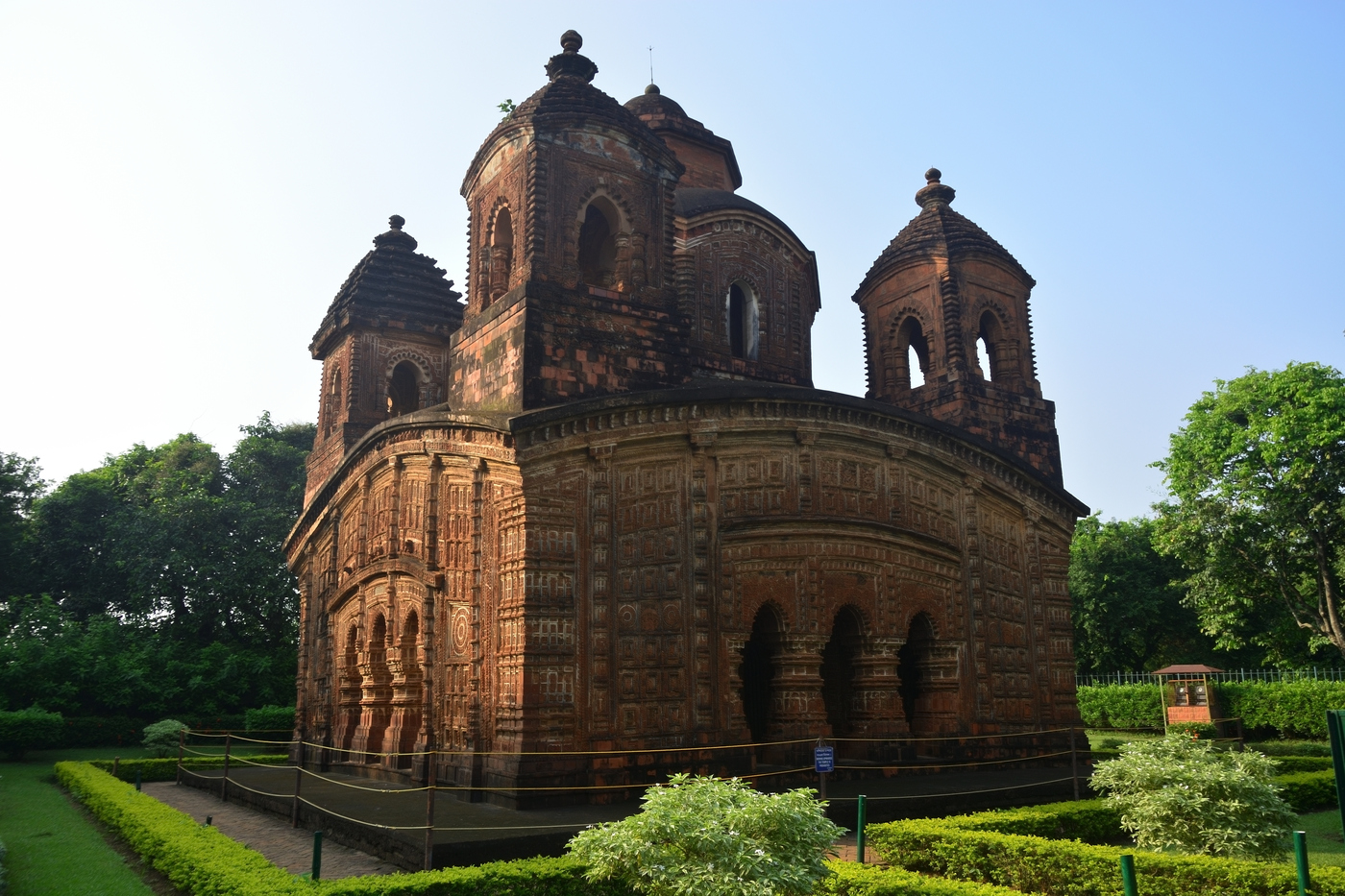
Whichever account of her mother is right, Hemalata grew up in a household that was, for its time, unusually mobile and unusually learned. Shrinivasa Acharya's own home was Jajigram, but the most famous turn of his life, the conversion of the bandit-king Vira Hambira, gave him a second home in Vira Hambira's land of Vishnupura, today's Bishnupur in Bankura district, which the king's support turned into a major center of Vaishnava worship, art, and architecture. At least one source describes a house of Hemalata's still standing in Vishnupura, next to a samadhi there said to be her father's, which suggests that at least part of her adult life was spent in that town, not only in Jajigram. By the time she reached adulthood, she could teach Vaishnava philosophy with enough authority to gather her own following. What she did with that learning is told in Guru by the Order of Mahaprabhu.
Not Counted Among Her Father's Own Disciples #
One specific and telling detail survives about how Hemalata's bond with her father was understood in the tradition: she was not formally counted among Shrinivasa Acharya's initiated disciples, precisely because she was his own blood relation. Diksha, formal initiation, is understood in Gaudiya Vaishnavism to set up a particular kind of bond between guru and disciple, and the tradition treats a father's direct initiation of his own child as standing outside that pattern, whatever informal teaching may have passed between them at home. This mattered later, because it meant that whatever authority Hemalata went on to hold as a guru had to rest on something other than a simple inheritance of her father's initiating line. What that something was, and how far it reached, is where her own story truly begins.