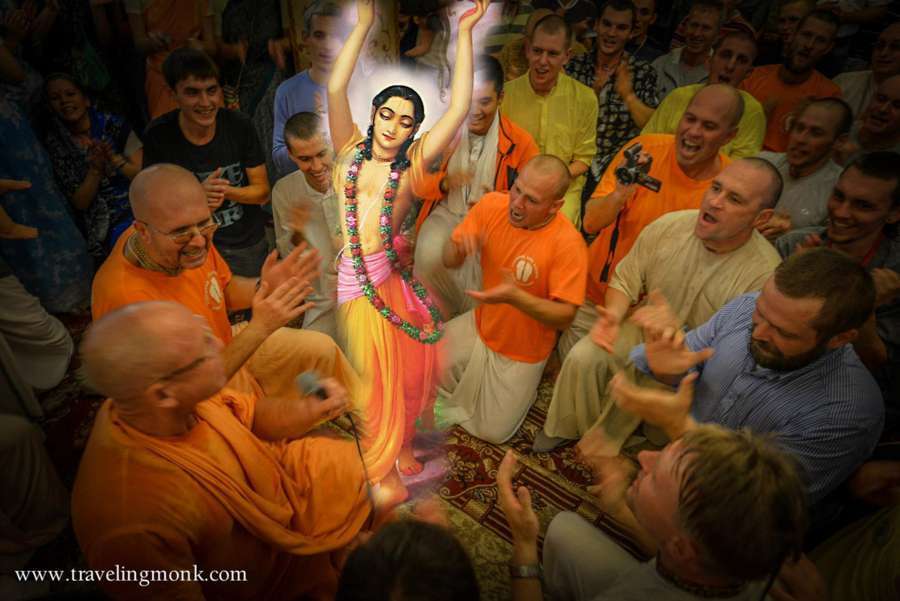
Narottama's arrival back at Kheturi after years away was itself an occasion for celebration. His father and uncle had both passed away by then, and the family estate had come to his cousin Santosh Datta, who greeted Narottama with the same joy the whole town felt at his homecoming. Narottama initiated Santosh into the Radha-Krishna mantra, and Santosh, wanting to build something lasting, asked for and received Narottama's blessing to construct a temple at Kheturi. The complex that followed was substantial for its time — a temple, a storehouse, a kirtana hall, residential quarters for visiting devotees, a bathing pond, and a flower garden — and its dedication, timed to coincide with the appearance day of Chaitanya Mahaprabhu on the full moon of Phalguna, grew into the event now remembered as the Kheturi Mahotsava.
| Detail | Description |
|---|---|
| Location | Kheturi, on the Padma River, Bengal |
| Patron | Raja Santosh Datta |
| Presiding | Jahnava Devi, consort of Nityananda Prabhu |
| Installation rites | Performed by Srinivasa Acharya |
| Deities installed | Six: Gauranga, Vallabhi-kanta, Krishna/Vrajamohana, Radha-ramana, and Radha-kanta |
| Also present | Shyamananda Prabhu, and Vaishnavas gathered from across Bengal and Odisha |
Six Deities and a Sea of Devotees #
Word of the festival went out to Vaishnavas across Bengal and beyond, and traditional accounts describe an extraordinary gathering: Jahnava Devi arriving from Kharadaha with her own party, Shyamananda Prabhu from Nrisimhapura in Odisha, Narahari Sarkara and Raghunandana from Shri Khanda, Acyutananda from Shantipura, Hridaya Chaitanya from Ambika Kalna, and dozens of other named devotees besides. Santosh Datta arranged boats to ferry the arriving guests across the river and palanquins to carry them into Kheturi itself, where separate lodging was found for everyone. Srinivasa Acharya performed the abhisheka and installation rites for the six Deities amid days of preparation — gateways decorated with banana leaves and auspicious symbols, and stores of grain, ghee, milk, and vegetables gathered on a scale later compared, in the Bhakti-ratnakara, to the legendary Rajasuya sacrifice. After the installation, and again the following evening for Chaitanya Mahaprabhu's own appearance ceremony, Jahnava Devi had the assembled Vaishnavas play with colored powder in a mood recalling Holi. Narottama himself led much of the kirtana that ran through both nights, and the Bhakti-ratnakara — the principal traditional source for this event — describes the devotees as feeling that Chaitanya Mahaprabhu Himself had appeared within the sankirtana to join them, along with Nityananda Prabhu, Advaita Acharya, and their own eternal associates.
Healing a Divided Family of Devotees #
The festival's significance went beyond its size or its Deity installations. In the decades since Chaitanya Mahaprabhu's disappearance, different communities of His followers had drifted toward different emphases — those who had known Him personally in Navadvipa related to Him in the intimate moods of His youth, while the followers of the Six Goswamis, who knew Him chiefly as the renounced sannyasi of His Puri years, related to Him with more reverence and distance. At Kheturi, under Jahnava Devi's presidency and the shared leadership of Narottama, Srinivasa Acharya, and Shyamananda Prabhu — later remembered together as the first generation of acharyas after the Six Goswamis — these separate streams of devotees sat, sang, and took prasadam together as one community for three days before dispersing to their own homes. It is this act of drawing a scattered movement into a shared identity, as much as the temple or the Deities themselves, that makes the Kheturi Mahotsava one of the pivotal events in the early history of Gaudiya Vaishnavism (see Literary and Musical Legacy).