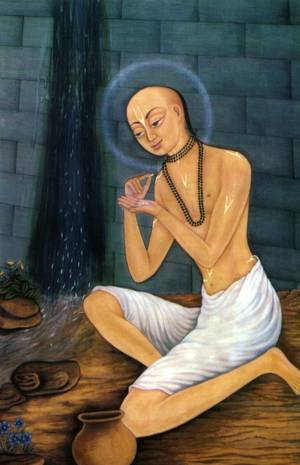
For roughly forty years, Radha-kunda was the whole of Raghunatha Dasa Goswami's visible world. His bhajana-kutir, the simple hut where he lived and worshipped, still stands on the bank of the kunda and continues to draw pilgrims today. Within its walls he kept a discipline that later Vaishnava writers have recorded in almost arithmetical detail, precisely because its extremity was itself considered instructive.
| Detail | Description |
|---|---|
| Residence | A simple bhajana-kutir beside Radha-kunda, still standing and visited today |
| Daily chanting | Around sixty-four rounds of japa, roughly 100,000 holy names |
| Daily obeisances | About 1,000 to Radha-Krishna and 2,000 to the Vaishnavas of Vraja, embracing each one |
| Bathing | Three times daily in Radha-kunda |
| Sleep | Under ninety minutes; some days none at all |
| Spiritual identity | Held by tradition to serve Radharani eternally as the manjari Rati-manjari |
A Schedule Without Rest #
Alongside his own worship of the Govardhana-sila Sri Chaitanya Mahaprabhu had given him, Raghunatha kept up the practice he had begun at Puri of speaking about the Lord's pastimes — several hours a day, by tradition, devoted entirely to describing Mahaprabhu's years at Jagannatha Puri to the gathered residents of Vraja. What sleep and eating he allowed himself shrank rather than grew as the years passed. Even before he reached Radha-kunda, Sri Chaitanya-charitamrita already records him spending more than twenty-two of every twenty-four hours in chanting and remembrance; at Radha-kunda, by every later account, that discipline only deepened. He kept, too, the same single torn cloth and patchwork wrapper he had worn since his earliest days at Puri, never once, across four decades, adopting anything more comfortable.
Grief as a Path of Love #
Each loss among his own teachers marked a further reduction. After Sri Chaitanya Mahaprabhu's disappearance he is remembered as living on little more than fruit and milk; after Sanatana Gosvami's disappearance, a single leaf-cup of buttermilk every day or two; and when Rupa Gosvami himself finally passed from the world, Raghunatha Dasa is said to have given up eating and drinking altogether. The Vrajavasis who saw him in this condition reportedly wept at how visibly he was wasting away — yet tradition insists this was never self-neglect for its own sake, but grief transmuted, deliberately and consciously, into an ever more complete offering of the body he had already renounced twice over.
Tears Beside the Water #
What is remembered above all from these years is not austerity as hardship but austerity as intimacy — long hours of solitary weeping beside Radha-kunda and on Govardhana Hill, poured out in continuous japa and in hearing and reciting scripture. Tradition also credits him with a practice called manasi-seva, serving Radha and Krishna in meditation within a spiritual body dedicated entirely to that purpose, carried on quietly alongside the external worship anyone passing his hut could see. Even his rest, Gaudiya Vaishnava teachers have long said, was never truly rest at all: an eternal associate of the Lord, they hold, continues to serve even while the body outwardly sleeps.
A Kunda Named for the Days That Followed #
Radha-kunda itself was not an arbitrary choice of residence. Sri Chaitanya Mahaprabhu had identified the lake during His own visit to Vraja as the place where Radha and Krishna once bathed together, and for a devotee whose entire theology centered on service to Radharani specifically, no other spot in Vrindavana could have suited him as well. It was from exactly this place, and this state of heart, that Raghunatha Dasa Goswami wrote the prayers gathered afterward as his Stavavali, described in full in Literary Works and the Stavavali — verses that read, even now, less like composed poetry than like a private diary of longing that happened to survive.