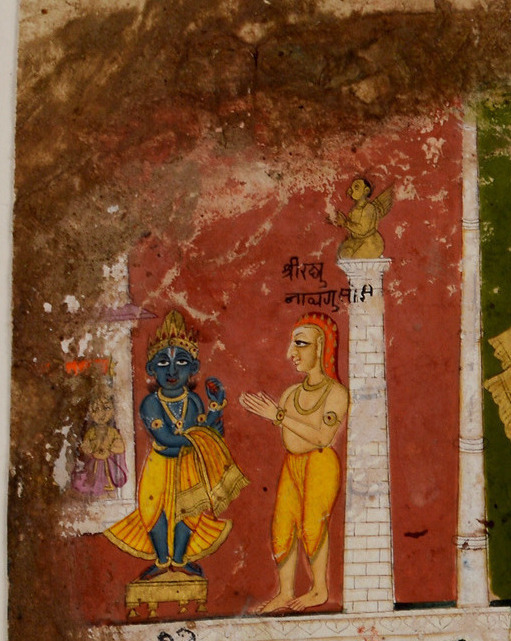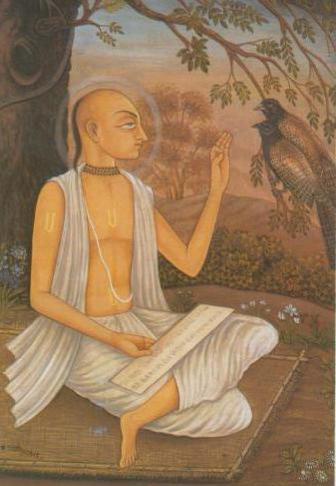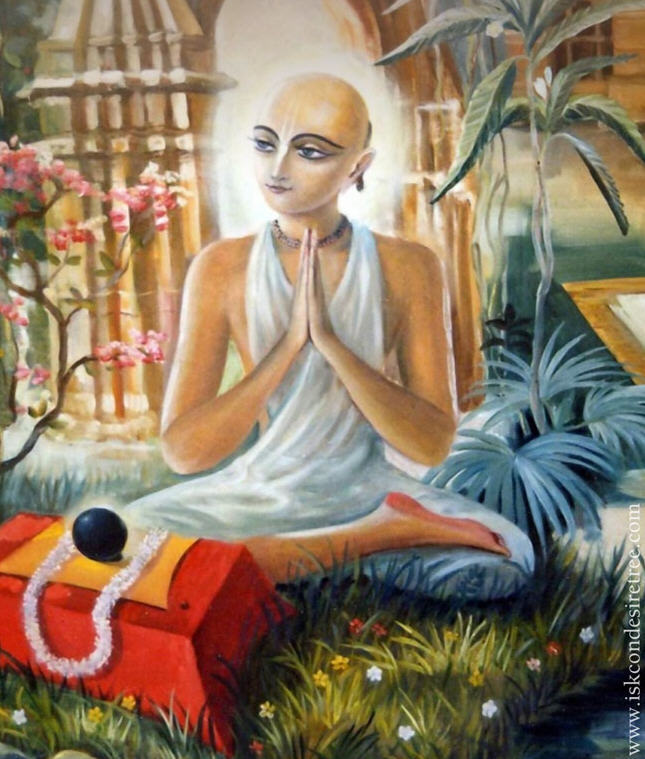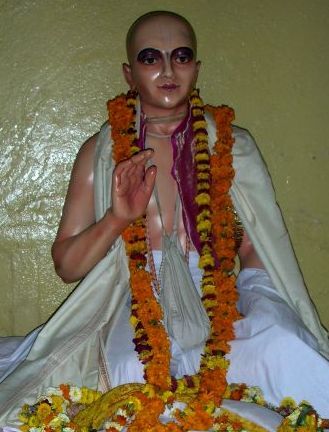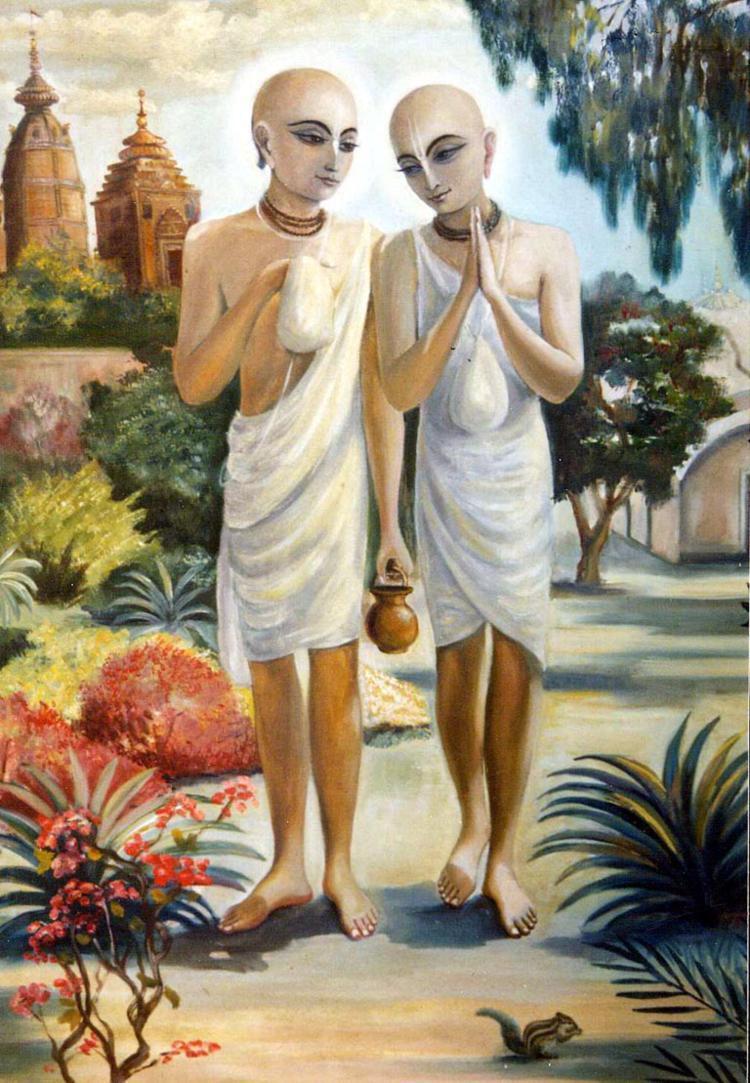
Srila Sanatana Gosvami
Eldest of the Six Goswamis of Vrindavana and the Ideal Spiritual Master
Also known as Sanatana Gosvami, Sanātana Gosvāmī, Sakara Mallika (his name at the court of Hussain Shah)
“The living entity's constitutional position is to be an eternal servant of Krishna, because he is the marginal energy of Krishna and a manifestation simultaneously one with and different from the Lord, like a molecular particle of sunshine or fire.”
Sri Chaitanya Mahaprabhu's own instruction to Sanatana Gosvami at Varanasi, Sri Chaitanya-charitamrita, Madhya-lila 20.108-109.
Srila Sanatana Gosvami was the eldest of the Six Goswamis of Vrindavana and, by his own younger brother's testimony, the one among them accepted as spiritual master. Born into a family of Karnataka-brahmana lineage that had settled for generations in Bengal, he rose to one of the most senior posts in the court of an independent Muslim sultan before giving it up entirely at Sri Chaitanya Mahaprabhu's word. What followed - a desperate prison escape, two months of personal instruction at Varanasi, and roughly four decades of searching, writing and begging in Vrindavana - made him, in Srila Prabhupada's own description, "the ideal spiritual master," the Goswami through whom the lost pastime-places of Krishna's Vraja were rediscovered and given to the world.
| Detail | Description |
|---|---|
| Full name | Sanatana Gosvami |
| Born | c. 1488, Bengal (his exact birthplace is disputed among Naihati, Bakla-Chandradvipa/Fateyabad in Jessore, and Ramakeli) |
| Family | Eldest of three brothers - Rupa (scholar and poet) and Anupama/Vallabha (father of Jiva Gosvami) |
| Court post | Sakara Mallika, a senior ministerial post under Nawab Hussain Shah of Bengal |
| Diksha-guru | Vidyavacaspati (Madhusudana Vidyavacaspati), a brother of Sarvabhauma Bhattacharya |
| Chief works | Hari-bhakti-vilasa, Brihad-bhagavatamrita, Brihad-vaishnava-toshani (Dasama-tippani), Krishna-lila-stava |
| Disappeared | Traditionally dated 1558, beside the Radha-Madana-mohana temple, Vrindavana |
A Family of Scholars in Bengal #
According to the Bhakti-ratnakara's account of the family's lineage, Sanatana's forefathers were Karnataka brahmanas who migrated to Bengal generations before his birth, eventually settling near the Ganges. His father, known as Kumaradeva or Mukunda, served as an official under the Sultan of Gauda and raised three sons - Sanatana the eldest, Srila Rupa Gosvami in the middle, and Anupama (also called Vallabha) the youngest - who would later be remembered as the family that gave Gaudiya Vaishnavism its greatest theologians. Even as children the three brothers were said to be absorbed in bhakti-bhava, naming the forests where they played after Vraja's own twelve forests and calling their favorite ponds Radha-kunda and Shyama-kunda, long before they had any outward reason to do so. One account describes a young Sanatana dreaming that a radiant brahmana boy placed a Srimad-Bhagavatam in his hands, waking in joy, and then meeting that same boy - Krishna Himself, disguised - during his morning worship soon after. This childhood, and the family's own unsettled history in Bengal, is told fully in Birth and Early Life in Bengal.
Ministers Under Hussain Shah #
When their father died, family circumstance pushed the two elder brothers into government service under Bengal's independent Sultan, Hussain Shah. Sanatana was given the post remembered as Sakara Mallika, generally understood as a senior ministerial or treasury office, while Rupa served as Dabira Khasa, the Sultan's private secretary - a pairing of titles confirmed directly by Sri Chaitanya-charitamrita and by Srila Prabhupada's own purport to it, though the exact duties of each Muslim title are not always described the same way by secondary writers. Sri Chaitanya-charitamrita later quotes a verse from Kavi-karnapura's Chaitanya-chandrodaya-nataka describing Sanatana as "a most important minister in the government of Hussain Shah... a most brilliant gem in that assembly," who still kept his heart, like "a deep lake covered with moss," full of devotional feeling beneath a courtier's exterior. Both brothers used their position to study Nyaya and Vedanta under the logician Vidyavacaspati, brother of the Puri pandit Sarvabhauma Bhattacharya, and their learning drew scholars from across India even while they served at court, a period covered fully in Service as Minister to Hussain Shah.
The Meeting at Ramakeli #
In 1514, as Sri Chaitanya Mahaprabhu passed through Gauda on His way toward Vrindavana, the two brothers - still known by their court names - arranged to meet Him secretly by night at Ramakeli, afraid of what open association with a Hindu ascetic might cost them at a Muslim court. The full scene of that meeting, their extraordinary humility before the Lord, and His response to it is told in The Meeting at Ramakeli, one of the tradition's most beloved episodes. It was here that Mahaprabhu gave them the names by which the tradition has known them ever since - Rupa and Sanatana - and it was Sanatana who, in that same encounter, tactfully persuaded the Lord not to continue toward Vrindavana followed by the enormous crowd then traveling with Him.
Imprisonment and the Long Road to Varanasi #
Rupa's resignation from court was accepted; Sanatana's was not. When he refused to accompany Hussain Shah on a campaign against Orissa, the Sultan had him thrown in prison. What followed - a jailer bribed with thousands of gold coins, a river crossed by night, a would-be robber turned unlikely helper, and a final hard walk to Varanasi - is told in full in Imprisonment and Escape, one of the best-attested and most dramatic episodes in the entire Chaitanya-charitamrita.
Sambandha-jnana at Varanasi #
Reunited with Sri Chaitanya Mahaprabhu at the home of Chandrasekhara Acharya, Sanatana received, over roughly two months, the most systematic explanation of Gaudiya Vaishnava theology the Lord is recorded to have given anyone - the constitutional position of the living entity, the three divisions of sambandha, abhidheya and prayojana, and a first synopsis of what would become the Hari-bhakti-vilasa. This teaching, recorded across Sri Chaitanya-charitamrita Madhya-lila 20 through 24, is covered at length in The Instruction at Varanasi.
Madana-mohana and Four Decades in Vrindavana #
Sent onward to Vrindavana with the charge of recovering Krishna's forgotten pastime-places, Sanatana settled into a life of such extreme simplicity that it became well known among his own godbrothers. He established the worship of the Deity of Madana-mohana - the first of Vrindavana's principal temples founded by any of the Six Goswamis - and for the better part of four decades wandered the villages of Vraja on foot, living on begged wheat flour baked into bati bread and turning down every comfort his former rank might easily have supplied. The fuller story of the Deity's discovery, the temple built for Him, and Sanatana's daily life of begging and Govardhana parikrama is told in Arrival in Vrindavana and Madana-mohana, one of the tradition's most cherished records of a life of chosen poverty.
Books, Disappearance and Legacy #
Sri Chaitanya Mahaprabhu had charged Sanatana, among other duties, with writing down the scriptural foundation for Vaishnava conduct and theology, and he met that charge with four major Sanskrit works - Hari-bhakti-vilasa, Brihad-bhagavatamrita, Brihad-vaishnava-toshani and Krishna-lila-stava, his own long devotional poem, all covered in Hari-bhakti-vilasa and Other Works. Sri Chaitanya-charitamrita records that the Lord "empowered Srila Rupa Gosvami and Sanatana Gosvami with the nectar of His mercy to carry out this work in Vrindavana," language that shows how central Sanatana's work became to the young Gaudiya tradition's survival. Rupa Gosvami himself, by Srila Prabhupada's account, accepted his elder brother as his own spiritual master, and Srila Prabhupada elsewhere calls Sanatana "the ideal spiritual master, for he delivers one the shelter of the lotus feet of Madana-mohana." Sanatana Gosvami disappeared from this world in Vrindavana, traditionally dated to 1558; his samadhi still stands beside the Radha-Madana-mohana temple he founded, and his final years and lasting influence are told in Final Days and Disappearance.
Scriptural evidence
vande 'nantādbhutaiśvaryaṁ
śrī-caitanya-mahāprabhum
nīco 'pi yat-prasādāt syād
bhakti-śāstra-pravartakaḥ
Word for word
vande — I offer my respectful obeisances; ananta adbhuta aiśvaryam — possessing unlimited, wonderful opulences; śrī-caitanya-mahāprabhum — unto Śrī Caitanya Mahāprabhu; nīcaḥ api — even a person in the lowest status of life; yat-prasādāt — by whose mercy; syāt — may become; bhakti-śāstra-pravartakaḥ — a propounder of the scriptures of devotional service.
Let me offer my respectful obeisances unto Sri Caitanya Mahaprabhu, who has unlimited, wonderful opulences. By His mercy, even a person born as the lowest of men can spread the science of devotional service.
The invocatory verse opening the Chaitanya-charitamrita chapter devoted to Sri Chaitanya Mahaprabhu's instruction of Sanatana Gosvami at Varanasi.
What Srila Prabhupada said
"Vande rupa-sanatanau raghu-yugau sri-jiva-gopalakau. This is a prayer offering obeisances to the six Gosvamins, direct disciples of Lord Caitanya... From Vrindavana they were dispatched after the disappearance of the Gosvamins. They left so many books, handwritten, that when they were dispatched it was a full cartload, a big cartload, you see. Just imagine how many books they wrote. They were great scholars."
Six Gosvamis Lecture, Sri Sri Sad-gosvamy-astaka — Lecture, 1968-11-18, Los Angeles
- Sri Chaitanya-charitamrita, Madhya-lila, Chapter 1 (Bhaktivedanta VedaBase)
- Sri Chaitanya-charitamrita, Madhya-lila, Chapter 20 (Bhaktivedanta VedaBase)
- Sri Chaitanya-charitamrita, Madhya-lila, Chapter 24 (Bhaktivedanta VedaBase)
- Sri Chaitanya-charitamrita, Adi-lila 1.47 (Bhaktivedanta VedaBase)
- Sanatana Goswami - Gaudiya History
- Wikipedia: Sanatana Goswami
- Six Gosvamis Lecture, Sri Sri Sad-gosvamy-astaka, Los Angeles, November 18 1968
- Bhagavad-gita 6.25-29 Lecture, Los Angeles, February 18 1969
Disciples
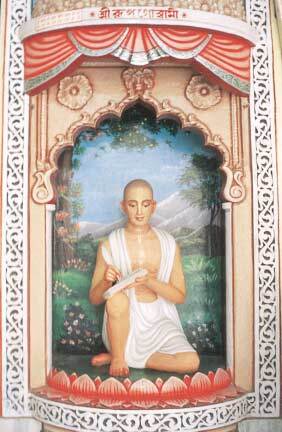
Frequently asked
When was Srila Sanatana Gosvami born?
Srila Sanatana Gosvami appeared c. 1488, Bengal in Bengal (sources vary between Naihati, Bakla-Chandradvipa/Fateyabad in Jessore, and Ramakeli).
Who was the guru of Srila Sanatana Gosvami?
The spiritual master of Srila Sanatana Gosvami was Sri Chaitanya Mahaprabhu.
When and where did Srila Sanatana Gosvami disappear?
Srila Sanatana Gosvami disappeared Traditionally 1558 at Vrindavana, beside the Radha-Madana-mohana temple.
What are the main pastimes of Srila Sanatana Gosvami?
Dedicated pages on this site cover: Birth and Early Life in Bengal, Service as Minister to Hussain Shah, The Meeting at Ramakeli, Imprisonment and Escape, The Instruction at Varanasi, Arrival in Vrindavana and Madana-mohana, Hari-bhakti-vilasa and Other Works, Final Days and Disappearance.