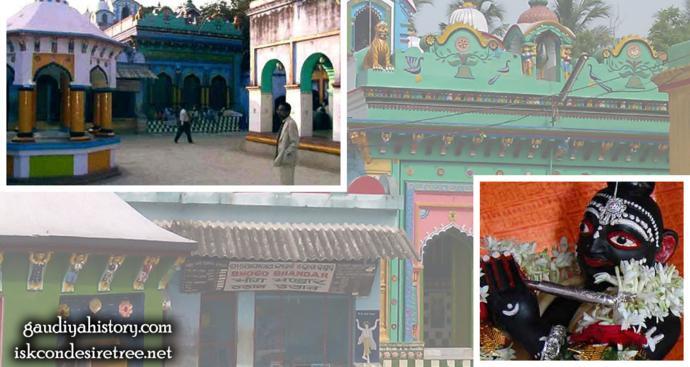
After decades spent preaching across Odisha, Rasikananda's own departure from the world is remembered as deliberate and unhurried — a final act of devotion rather than an illness or accident that overtook him.
| Detail | Description |
|---|---|
| Date | First day of the bright fortnight of Phalguna, Sakabda 1574 (1652 AD) |
| Place | Kshira-chora Gopinatha Temple, Remuna, Odisha |
| Companions | Seven disciples, whose samadhis stand beside his own |
| Sons | Radhananda, Krishna-Govinda, Radha-Krishna |
| Works | Shyamananda-shataka, Bhakta-Bhagavatashtaka, Kunjakeli-dvadashaka |
A Quiet Departure From Santa #
Shortly before his disappearance, Rasikananda left the village of Santa without announcement and walked, together with seven of his disciples, toward Remuna — chanting kirtana the entire way, according to the Bhakti-ratnakara. Arriving at the town, he spent time discussing Krishna-katha with the local devotees and asked them to begin sankirtana before he entered the temple of Kshira-chora Gopinatha.
Merging Into Kshira-Chora Gopinatha #
At the temple, tradition says, Rasikananda touched the Deity's lotus feet and then entered into His eternal shelter — understood by his followers as a merging into the Deity itself. His seven companions are said to have left their own bodies at the same spot. Their flower samadhis, along with Rasikananda's own, still stand in the temple courtyard at Remuna, and an annual twelve-day festival beginning the day after Shiva-chaturdashi in the month of Magha continues to mark his disappearance there; Gaudiya Vaishnavas observe the day generally by singing the bhajana "Je anilo prema dhana." Srila Prabhupada himself confirms the location in his own writing: his purport to Chaitanya-charitamrita Madhya 4.12 notes that "within the temple the samadhi tomb of Rasikananda Prabhu, the chief disciple of Shyamananda Gosvami, can still be found," and his purport to Madhya 1.97 records that, generations later, care of the same temple had passed to Shyamsundara Adhikari, "a descendant of Rasikananda Murari." The Bhakti-ratnakara of Narahari Chakravarti remains the principal traditional source behind most of what is recorded of these final days.
Sons, Writings, and a Living Legacy #
Rasikananda left behind three sons — Radhananda, Krishna-Govinda, and Radha-Krishna — whose descendants continued to serve the Radha-Govinda Deity at Gopiballabhpur, a service tradition holds continues to the present day at the pilgrimage site still known as Sripat Gopiballabhpur. He also left a small body of his own writing, including the Shyamananda-shataka in praise of his guru, the Bhakta-Bhagavatashtaka, and the Kunjakeli-dvadashaka. A later descendant, Vishvambharananda Deva Goswami, is remembered as the author of the Ashtikya-darshana.
His disciplic line reached further still. Generations after him, within the same line of initiation — Rasikananda to his disciple Nayanananda Goswami, and Nayanananda to Radha-Damodara Goswami — Radha-Damodara Goswami accepted as his own disciple the scholar who would become Baladeva Vidyabhusana, the Gaudiya Vaishnava acharya whose Govinda-bhashya later secured the sampradaya's philosophical standing at the royal court of Jaipur. From a prince who gave up caste privilege to preach the holy name without distinction, in other words, ran a line that helped give Gaudiya Vaishnavism its formal place among the schools of Vedanta.