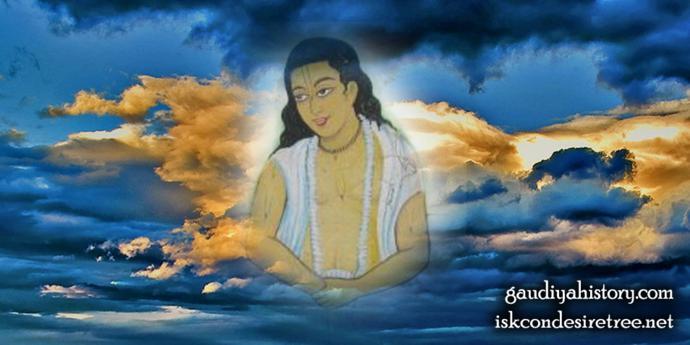
Before Rasikananda could become anyone's guru, he first had to find his own — and the traditional account of how that happened is one of the best-loved episodes in his story. It also cannot be told without first saying something about the man who became his guru, because Shyamananda Pandit's own path to that role is itself part of what makes Rasikananda's later mission make sense.
Shyamananda Pandit's Own Path to Vrindavana #
Shyamananda Pandit was born Duhkhi Krishnadasa, the son of a family of milkmen in Bengal, and took his first initiation, receiving the name Krishnadasa, from a renunciant named Hridaya Chaitanya, himself a disciple of Gauridasa Pandita of Ambika Kalna. Restless for deeper training, Krishnadasa travelled on to Vrindavana and took shelter of Jiva Goswami, who taught him the philosophy and devotional practice of the Gaudiya sampradaya and, in time, gave him the name by which history remembers him — Shyamananda. In Vrindavana he became close companions with two other students of Jiva Goswami — Narottama Dasa Thakura and Shrinivasa Acharya — and when Jiva Goswami judged the three of them ready, he sent them back east to carry the Goswamis' writings and preach the teachings of Chaitanya Mahaprabhu in Bengal and Odisha. Shyamananda took up his own field of preaching in Odisha, and it was there, in the village of Rohini, that he found his own foremost disciple.
That Shyamananda himself was not born into a brahmana family matters for understanding what came next: Sri Chaitanya Mahaprabhu had taught that whoever knows the science of Krishna can serve as a guru, regardless of birth, and Srila Prabhupada's purport to Chaitanya-charitamrita Madhya 8.128 names Rasikananda directly as a standing example of that teaching — noting that Rasikananda accepted initiation from Shyamananda even though Shyamananda "was not born in a caste brahmana family."
A Voice From the Sky #
According to the traditional account, Rasikananda was meditating alone in Ghantashila, anxious to find a spiritual master, when he heard a voice from an unseen source tell him plainly: "You need be anxious no longer. Your guru is Shyamananda, and you will meet him very shortly." That night he could not sleep, repeating his future guru's name until, toward dawn, he fell into a dream in which Shyamananda himself appeared and told him, "Don't worry any longer, for you will meet me this very day."
Meeting at Dawn #
At first light, Rasikananda kept watch on the path, and before long he saw Shyamananda approaching — surrounded by disciples such as Kishora Dasa, dancing in a state of absorption, chanting the names of Chaitanya and Nityananda. Rasikananda fell at his feet; Shyamananda lifted him up, embraced him, and gave him and his wife, Shyamadasi, initiation into the Radha-Krishna mantra. Rasikananda gave himself so completely to his guru's service afterward that biographers describe him becoming, within a short time, Shyamananda's foremost disciple — the one who best absorbed and carried forward what Shyamananda had to teach.
Entrusted With the Govinda Deity at Gopiballabhpur #
Shyamananda's own worship centered on a Deity of Govinda that had come down through Rasikananda's own family; when Shyamananda gave the Deity the name Gopi-vallabha Raya, the settlement that grew up around Its worship took the name Gopiballabhpur. Shyamananda placed the daily service of this Deity in Rasikananda's hands, and biographers describe the young disciple's care of Govindaji as so complete and so absorbed that it charmed the older devotees who watched him serve. It was from this base — as pujari first, preacher second — that Rasikananda began the work covered in Spreading the Faith in Odisha.