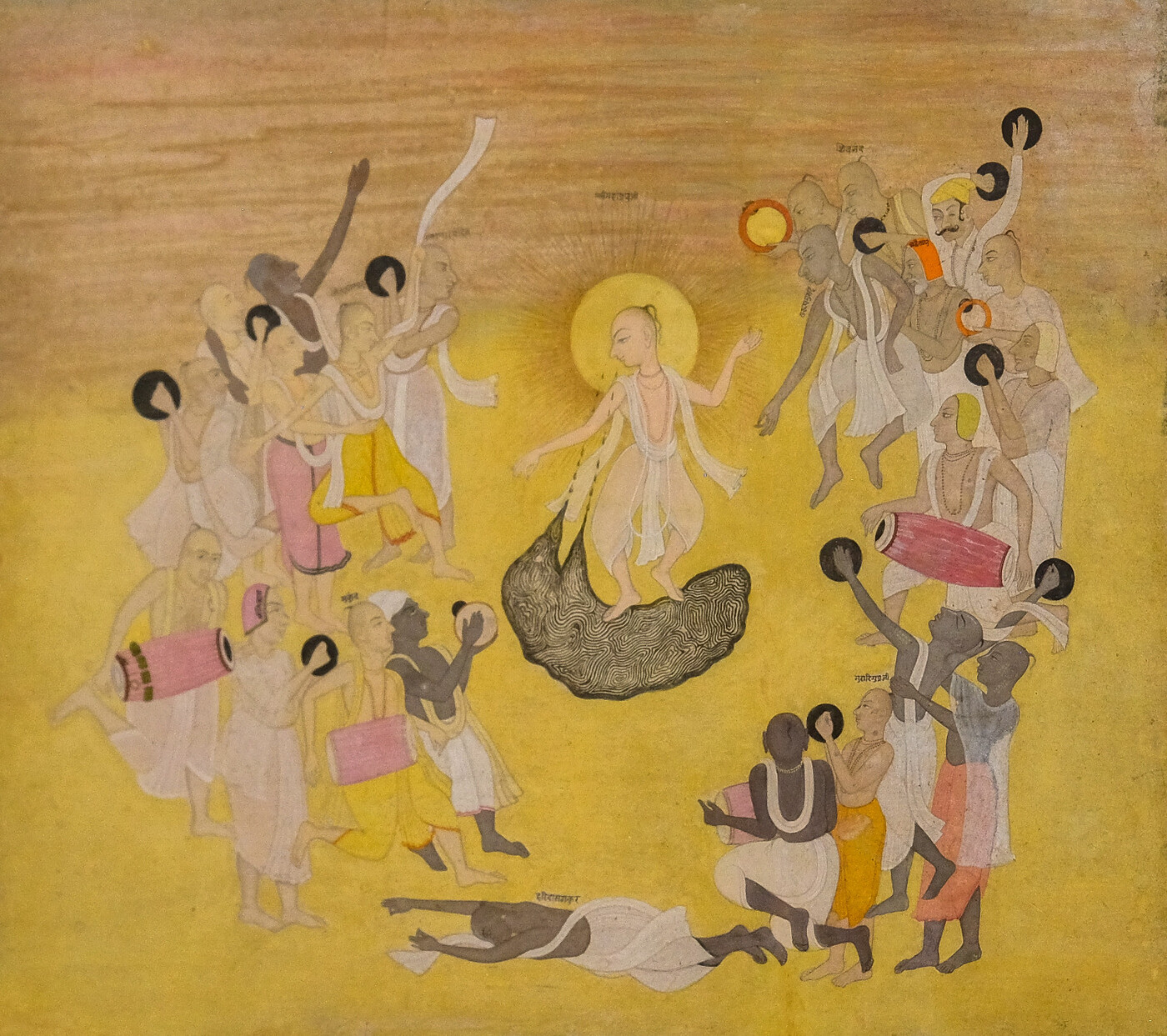
When Nityananda Prabhu kicked Shivananda Sena in loving anger, his nephew Shrikanta walked away in protest — and learned something at Sri Chaitanya Mahaprabhu's feet.
On the pilgrim road to, and at, Jagannatha Puri, during one of the annual Ratha-yatra journeys described in Chaitanya-charitamrita's Antya-lila (after c. 1516)
Every year, Srila Shivananda Sena led the devotees of Bengal on the long walk to Jagannatha Puri, arranging their lodging and paying every toll along the way. One year, delayed at a tax post while the rest of the party went ahead, he could not arrange a residence in time, and Nityananda Prabhu, hungry, and displeased at the disorder, kicked him in anger before Shivananda even arrived. It is one of the best-known moments in Sri Chaitanya-charitamrita's account of that pilgrimage. What is less often told is what it did to a boy standing nearby who loved Shivananda Sena very much: his nephew Shrikanta.
Shivananda Sena himself took the kick as the highest mercy: he touched Nityananda Prabhu's feet, arranged a milkman's house as the Lord's residence within moments, and later told Nityananda directly that being chastised by Him was the fulfillment of his whole life (Antya 12.24-30). But "Shivananda Sena's nephew, Shrikanta, the son of his sister, felt offended, and he commented on the matter when his uncle was absent" (Antya 12.34). What he said, to whoever was near him, was blunt: "My uncle is well known as one of the associates of Sri Chaitanya Mahaprabhu, but Lord Nityananda Prabhu asserts His superiority by kicking him" (Antya 12.35).
It is a very human line: a young man unable yet to see chastisement as intimacy, reading only insult where his uncle read grace. Chaitanya-charitamrita does not soften it or apologize for him. It simply records that "after saying this, Shrikanta, who was only a boy, left the group and traveled on alone to the residence of Sri Chaitanya Mahaprabhu" (Antya 12.36), walking ahead of the whole pilgrim party, by himself, rather than staying with people whose devotion he had just quietly judged.
When Shrikanta reached the Lord's residence at Puri, he was still dressed for the road: wearing the shirt and coat (petangi) travelers wore, garments forbidden near the Deity or in an offering of obeisances. Govinda, the Lord's personal attendant, caught this immediately: "My dear Shrikanta, first take off these garments" (Antya 12.37). Before Shrikanta could respond, Sri Chaitanya Mahaprabhu intervened on his behalf: "Don't bother him. Let Shrikanta do whatever he likes, for he has come here in a distressed state of mind" (Antya 12.38). It is a small but telling instance of the Lord's own character: noticing a boy's inward state before anyone had told him anything was wrong, and choosing gentleness over correctness in that moment.
Once Shrikanta had settled, Sri Chaitanya Mahaprabhu "inquired from Shrikanta about all the Vaishnavas, and the boy informed the Lord about them, naming them one after another" (Antya 12.39), an ordinary, even pleasant exchange, a boy giving the Lord news of home. But it was the Lord's earlier remark, "he has come here in a distressed state of mind," that stayed with Shrikanta: "when Shrikanta Sena heard the Lord say 'He is distressed,' he could understand that the Lord is omniscient" (Antya 12.40). Having grasped that Sri Chaitanya Mahaprabhu already knew everything without being told, Shrikanta made a choice of his own: "As he described the Vaishnavas, therefore, he did not mention Lord Nityananda's kicking Shivananda Sena" (Antya 12.41).
That single omission is the real turning point of the episode. The same boy who had walked away from the party in protest, unable to see anything but injury in what Nityananda Prabhu had done, arrived at Sri Chaitanya Mahaprabhu's feet and chose silence about the very thing that had upset him, not because he was told to, but because being in the Lord's presence, and understanding that presence to be all-knowing, made the complaint feel small. Soon after, the rest of the devotees, Shivananda Sena among them, arrived and were received by the Lord in turn, and the pilgrimage went on as it always had: the incident absorbed rather than resolved, in the way many small frictions inside a loving family are.
śivānandera — of Śivānanda Sena; bhāginā — the sister’s son; śrīkānta-sena nāma — named Śrīkānta Sena; māmāra — of his maternal uncle; agocare — in the absence of; kahe — said; kari’ abhimāna — with an offended state of mind.
Śivānanda Sena’s nephew, Śrīkānta, the son of his sister, felt offended, and he commented on the matter when his uncle was absent.
eta bali' — saying this; śrīkānta — the nephew of Śivānanda Sena; bālaka — a boy; āge cali' yāna — went forward; saṅga chāḍi' — giving up their association; āge — forward; gelā — went; mahāprabhura sthāna — to the place of Śrī Caitanya Mahāprabhu.
After saying this, Shrikanta, who was only a boy, left the group and traveled on alone to the residence of Sri Chaitanya Mahaprabhu.
peṭāṅgi — shirt and coat; gāya — on the body; kare — performs; daṇḍavat-namaskāra — offering of obeisances; govinda kahe — Govinda said; śrīkānta — my dear Śrīkānta; āge — first; peṭāṅgi utāra — take off your shirt and coat.
When Śrīkānta offered obeisances to the Lord, he was still wearing his shirt and coat. Therefore Govinda told him, “My dear Śrīkānta, first take off these garments.”
From the purport: Purport excerpt: "One is forbidden to enter the Deity room or offer anything to the Deity while wearing a shirt or coat."
prabhu kahe — Śrī Caitanya Mahāprabhu said; śrīkānta — Śrīkānta; āsiyāche — has come; pāñā — getting; manaḥ-duḥkha — distress in the mind; kichu — anything; nā baliha — do not say; karuka — let him do; yāte — by which; ihāra — his; sukha — happiness.
As Govinda was warning Śrīkānta, Śrī Caitanya Mahāprabhu said, “Don’t bother him. Let Śrīkānta do whatever he likes, for he has come here in a distressed state of mind.”
vaiṣṇavera — of all the Vaiṣṇavas; samācāra — news; gosāñi — Śrī Caitanya Mahāprabhu; puchilā — inquired; eke eke — one after another; sabāra — of all of them; nāma — names; śrīkānta — the nephew of Śivānanda Sena; jānāilā — informed.
Sri Chaitanya Mahaprabhu inquired from Shrikanta about all the Vaishnavas, and the boy informed the Lord about them, naming them one after another.
Sri Chaitanya Mahaprabhu asks Shrikanta for news of the Vaishnavas, an ordinary exchange before the deeper turn in the next verse.
‘duḥkha pāñā āsiyāche’ — ei prabhura vākya śuni’ / jānilā ‘sarvajña prabhu’ — eta anumāni’
Word for word
duḥkha — unhappiness; pāñā — getting; āsiyāche — he has come; ei — this; prabhura — of Śrī Caitanya Mahāprabhu; vākya — statement; śuni’ — hearing; jānilā — could understand; sarva-jña prabhu — the Lord is omniscient; eta — this; anumāni’ — guessing.
When Śrīkānta Sena heard the Lord say “He is distressed,” he could understand that the Lord is omniscient.
śivānande — Śivānanda Sena; lāthi mārilā — (Lord Nityānanda) has kicked; ihā — this; nā kahilā — he did not say; ethā — here; saba — all; vaiṣṇava-gaṇa — devotees; āsiyā — coming; mililā — met.
As he described the Vaishnavas, therefore, he did not mention Lord Nityananda's kicking Shivananda Sena. Meanwhile, all the devotees arrived and went to meet the Lord.
Our editorial team comprises trained devotees and researchers of the Hare Krishna Movement, Kota, who follow this same disciplic tradition in daily practice. Every biography is carefully researched, fact-checked against Vedic scriptures, and cites its sources.
Reviewed by
Temple & Scriptural Research Team
Each biography undergoes a detailed review by our senior devotees and scriptural researchers to verify factual accuracy and ensure alignment with Vaishnava philosophy and Srila Prabhupada's teachings.