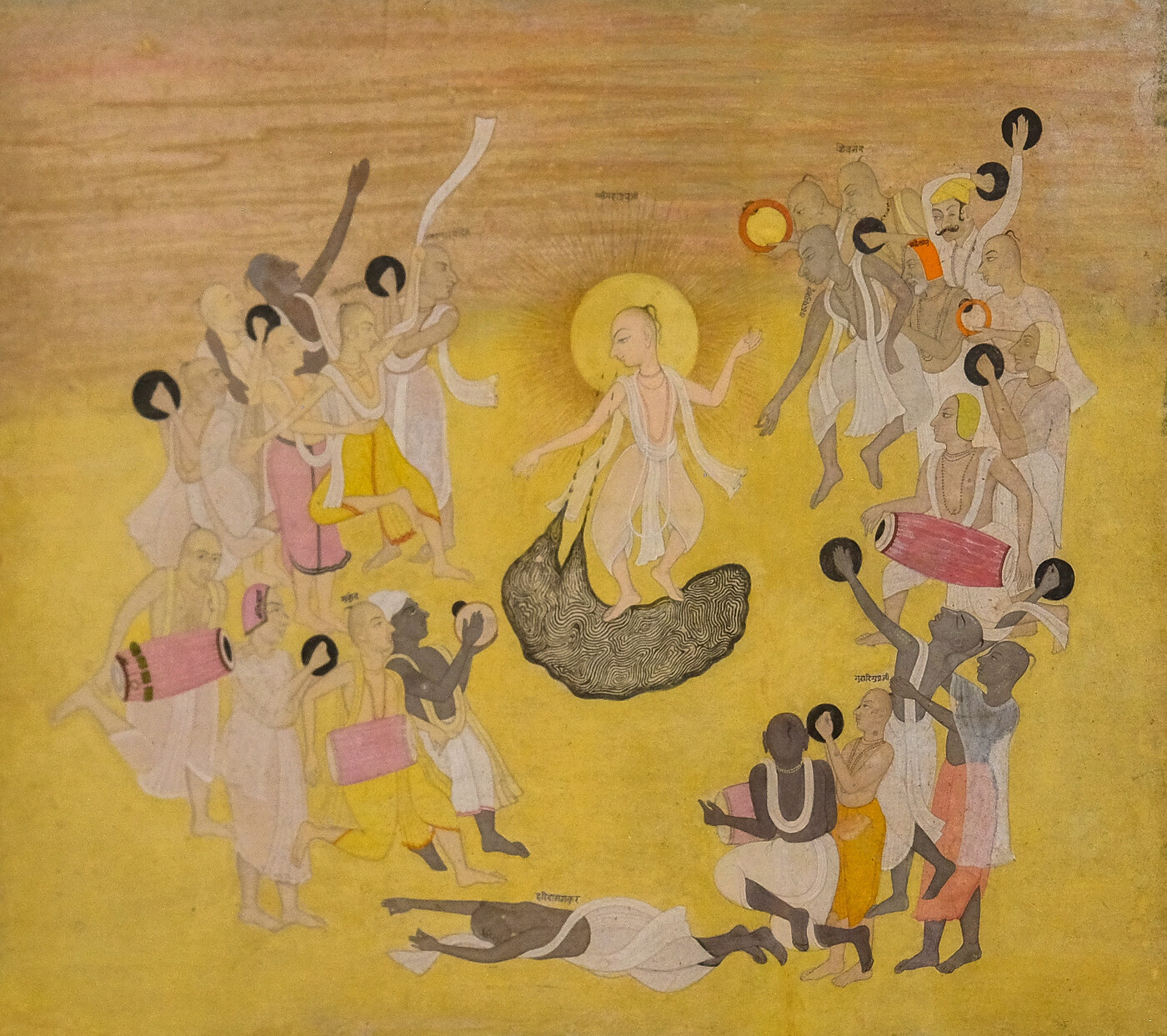
Three more times, in three different settings, Chaitanya-charitamrita lists this same personal servant among the devotees gathered around Sri Chaitanya Mahaprabhu at Jagannatha Puri.
Jagannatha Puri, Odisha — after 1510, during Mahaprabhu's sannyasa years
After Sri Chaitanya Mahaprabhu accepted the sannyasa order in 1510 and settled in Jagannatha Puri, most of His Bengali associates could see Him only once a year, when large parties travelled from Bengal for the four months of the rainy season. Shriman Pandita's name appears in Chaitanya-charitamrita three more times in connection with this later period, each time in the company of other named devotees rather than as the subject of his own story. But each mention adds a small, specific detail to what the torch-carrying episode in Navadvipa had already established about him.
Madhya-lila 10.83 places Shriman Pandita among a named group of devotees, alongside Damodara Pandit, who were "very pleased to hear" that Mahaprabhu was returning to Puri after a visit to Bengal. The verse immediately before it names another such group hearing the same news with joy, including Vakresvara Pandit and Gadadhara Pandit, which gives a sense of how many devotees, well known and obscure alike, were counted together in the same breath whenever Krishnadasa Kaviraja Goswami described the Puri community's mood. It is a small mention, one line among many in a chapter otherwise devoted to describing the Lord's journey, but it places Shriman Pandita among those close enough to that community to be named in a list of people whose personal happiness at the Lord's homecoming was worth recording.
The fullest of the three later mentions comes during the beda-kirtana pastimes described in Madhya-lila chapter 11, when Mahaprabhu personally introduced His devotees to a large gathering, calling out names one after another. In verse 89, Mahaprabhu names Shriman Pandita directly, standing between Raghava Pandit and Nandana Acharya on one side and Shrikanta on the other. Being singled out by name during a pastime built entirely around Mahaprabhu introducing His associates to newcomers is itself a mark of standing within the community: a servant obscure enough to leave no other record, yet known well enough to the Lord Himself to be named without hesitation in front of a crowd.
The most personal of the four total mentions comes from Antya-lila chapter 10, which describes Mahaprabhu accepting and tasting food that Bengali devotees carried to Puri as gifts. Shriman Pandita is named among the group of devotees, including Murari Gupta and Vasudeva Datta Thakura, who travelled together to Jagannatha Puri for this purpose (Antya-lila 10.9-11). Later in the same chapter, while distributing the food to those present, Mahaprabhu Himself says, "these are gifts given by Shriman Sena, Shriman Pandita and Nandana Acharya" (Antya-lila 10.122). It is a strikingly ordinary moment, a plate of food, a name spoken aloud, and it comes closer than anything else in the text to showing Shriman Pandita's devotion in its plainest form: something cooked and carried a long way, for no reason but that Mahaprabhu might eat it.
One further verse, Madhya-lila 13.39, names five singers at a Ratha-yatra kirtana, one of them called simply "Shriman." Chaitanya-charitamrita elsewhere uses "Shriman" both as a short form of Shriman Sena and of Shriman Pandita, and which of the two the shorter verse intends is not guessed at. It stands as exactly what it is: a small, unresolved detail in an already thin record, rather than a fact quietly assumed.
Scriptural sources for this pastime
আচার্যরত্ন, আর পণ্ডিত বক্রেশ্বর ।
আচার্যনিধি, আর পণ্ডিত গদাধর ॥ ৮২ ॥
acaryaratna, ara pandita vakresvara
acaryanidhi, ara pandita gadadhara
The verse immediately before Madhya-lila 10.83, naming another group of devotees who rejoiced at the same news, cited to show the size of the community counted together in this passage.
শ্রীরাম পণ্ডিত আর পণ্ডিত দামোদর । শ্রীমান্ পণ্ডিত, আর বিজয়, শ্রীধর ॥ ৮৩ ॥
srirama pandita ara pandita damodara
srimat pandita, ara vijaya, sridhara
raghava pandita, iha acarya nandana
srimat pandita ei, srikanta, narayana
Word for word
raghava pandita -- Raghava Pandita; iha -- here; acarya nandana -- Nandana Acharya; srimat pandita ei -- here is Shriman Pandita; srikanta -- Shrikanta; narayana -- and Narayana.
Here is Raghava Pandita, here is Nandana Acharya, there is Shriman Pandita, and here are Shrikanta and Narayana.
From the purport: Purport excerpt: "One who is intelligent understands that all the personal associates and devotees of Lord Sri Chaitanya Mahaprabhu are ever liberated."
Mahaprabhu Himself names Shriman Pandita while personally introducing His associates during the beda-kirtana pastime.
vasudeva-datta, murari-gupta, gangadasa
srimat-sena, srimat-pandita, akincana krsnadasa
murari, garuda-pandita, buddhimanta-khana
sanjaya-purusottama, pandita-bhagavan
suklambara, nrsimhananda ara yata jana
sabai calila, nama na yaya likhana
Vasudeva Datta, Murari Gupta, Gangadasa, Shriman Sena, Shriman Pandita, Akincana Krishnadasa, Murari, Garuda Pandita, Buddhimanta Khan, Sanjaya Purushottama, Bhagavan Pandita, Shuklambara Brahmachari, Nrisimhananda Brahmachari and many others joined together to go to Jagannatha Puri. It would be impossible to mention the names of them all.
The five singers who responded to the singing of Shrivasa Thakura were Gangadasa, Haridasa, Shrimana, Shubhananda and Sri Rama Pandita. Sri Nityananda Prabhu was appointed as a dancer.
Cited for the possible fifth mention of Shriman Pandita's name, rendered here simply as "Shriman," among singers at a Ratha-yatra kirtana; the identification is left unconfirmed rather than assumed, as noted on the acharya's own page.
Our editorial team comprises trained devotees and researchers of the Hare Krishna Movement, Kota, who follow this same disciplic tradition in daily practice. Every biography is carefully researched, fact-checked against Vedic scriptures, and cites its sources.
Reviewed by
Temple & Scriptural Research Team
Each biography undergoes a detailed review by our senior devotees and scriptural researchers to verify factual accuracy and ensure alignment with Vaishnava philosophy and Srila Prabhupada's teachings.