What is actually recorded of Sita Thakurani's daily religious life is more modest than the phrase "mother of the universe" might suggest. It helps to say plainly which parts of this picture are well documented and which are reasonable guesses.
| Detail | Description |
|---|---|
| Household worship | Ran the kitchen that fed the daily Deity worship of Lord Vishnu at Shantipura alongside Advaita Acharya |
| Hospitality | Personally cooked for Sri Chaitanya Mahaprabhu and for the many Vaishnava guests the household received |
| After Advaita Acharya's passing | Later biographical works describe her taking on real leadership within the Vaishnava community |
| Disciples | Prema-vilasa (vilasa 24) names two servants, Nandini and Jangali, whom she initiated with the krishna-mantra |
| A guru declined | Directed the young Virabhadra, Nityananda Prabhu's son, to seek a guru elsewhere rather than accepting the role herself |
| Legacy | Samadhi at Shantipura; Deities of the couple worshiped today at the Sitanath Advaita Mandir, Nabadwip |
The Kitchen Behind The Worship #
Sri Chaitanya-charitamrita's account of the meal Sita Thakurani cooked the day Mahaprabhu took sannyasa, told in full on Mother of All Vaishnavas, is framed by Srila Prabhupada, in his purport to that verse, as "the ideal householder's life": the wife cooks for the Deity, the husband offers the food in worship, and the household then feeds any guest who arrives, because "according to Vedic principles, there must always be a guest in a householder's house." That is what the sources actually support about Sita Thakurani's daily religious practice: not one dramatic episode, but the steady, everyday work of running a Vaishnava kitchen that fed both the Deities and a constant stream of visiting devotees at one of the movement's central households.
It is equally worth being clear about what is not confirmed for her specifically. Popular retellings of Bengali Vaishnava women's lives often describe activities like grinding rice by hand or personally tending a Tulsi plant, and both would fit naturally with what is known of her household and her era. But neither act is named for Sita Thakurani by name in the primary sources or in the biographical accounts available. Rather than turn a plausible guess into a fact, it is better to report what is actually written: that she cooked, that her cooking fed both the Deity and the Lord Himself, and that her home was known for its hospitality, and to leave the rest honestly unconfirmed.
Leadership After Advaita Acharya #
Jagadananda Das, in his survey of Gaudiya Vaishnava women saints, notes that Sita Thakurani "was a woman who, like her husband, lived a long life," and that "it is said she took some leadership responsibility after the death of her husband, but not much detail can be given about how she conducted herself in such a role." This claim traces to Bhakti-ratnakara and to a work called Prema-vilasa, neither of which has an independent English text available online the way Sri Chaitanya-charitamrita does. It is reported here as it survives in Jagadananda Das's summary of those texts, not from direct access to them.
Nandini and Jangali, Her Disciples #
Prema-vilasa (vilasa 24) records Sita Thakurani giving the krishna-mantra to two of her own servants, Nandini and Jangali. Gaura-ganoddesha-dipika (text 89) identifies that pair with Jaya and Vijaya, the gatekeepers of Vaikuntha, and the same discipleship is carried in Haridasa Dasa's Gaudiya-vaishnava-abhidhana and in the Sita-charitra of Lokanatha Dasa. Of the two, only Jangali has a story attached to her name: she is remembered for practicing bhajana alone in a forest full of wild animals, which is how she got that name. According to the legend Prema-vilasa preserves, the Muslim ruler of Bengal, hunting in that forest, saw Jangali and tried to assault her. She is said to have manifested a male form in response, so the astonished ruler could not tell whether he was looking at a man or a woman. Questioned separately by a woman and then by a man sent to examine her, she gave each an answer fitting what that person could perceive, and finally told the ruler, "Women see a woman, men see a man. But at no time have I ever been a man." The chastened ruler asked her forgiveness and built her a home in the forest, known afterward as Jangali Tota. This is a legend rather than a historical report in the ordinary sense, and one detail within it is disputed: some later sources hold that Jangali was in fact a male disciple who took a feminine name after initiation, rather than a woman whom the ruler was unable to identify. That question does not touch the discipleship itself, which is what matters here. Either way, it is a specific, independently recorded tradition, and it stands as real evidence that Sita Thakurani was accepted as a guru, with initiated disciples to show for it. Sri Chaitanya Mahaprabhu had already given the reason such a thing is possible: yare dekha, tare kaha 'krishna'-upadesha, amara ajnaya guru hana tara' ei desha, "instruct everyone you meet to follow the orders of Lord Krishna... in this way become a spiritual master" (Chaitanya-charitamrita, Madhya-lila 7.128). Srila Prabhupada explained that whoever understands Krishna consciousness perfectly can become guru, regardless of birth or gender.
The Guru She Declined To Be #
A separate story, preserved in Nityananda-vamsa-vistara, tells of Virabhadra, Nityananda Prabhu's son, coming to Sita Thakurani in search of a spiritual master after his own father's passing. She told him to look closer to home, pointing him toward Jahnava Mata, Nityananda Prabhu's widow, rather than accepting the role for herself. It is a small detail, but a telling one. It shows a woman others actively sought out as guru-qualified, who chose in this instance to send that trust elsewhere rather than claim it. Between this act and her acceptance of Nandini and Jangali as her own disciples, the honest picture is of someone the tradition saw as fit to guide others, without herself being recorded as any single person's formal disciple in turn. She and Advaita Acharya were husband and wife, not guru and disciple, and no source describes a formal initiatory relationship running either way between them.
Remembered At Shantipura And Nabadwip #
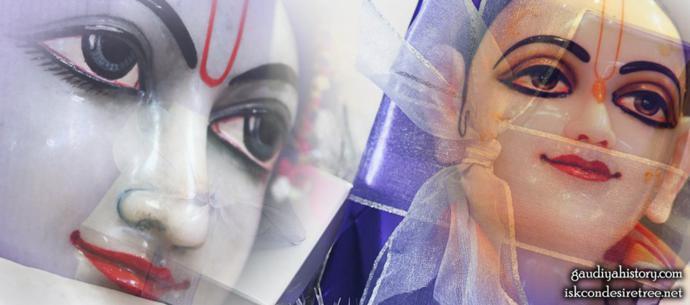
Sita Thakurani's samadhi stands today at Shantipura, beside Sri Advaita Acharya's own, part of a site still visited by pilgrims. Wooden Deities of the couple are worshiped at the Sitanath Advaita Mandir in Nabadwip, carved images of the two of them standing side by side much as the old accounts describe them living. The Gaudiya Vaishnava calendar marks her appearance day each year, though no source available could confirm the specific date with confidence, so none is given here. What endures without any doubt is simpler: a woman remembered, across five centuries of Gaudiya Vaishnava literature, not for whose wife she was, but for a kitchen that fed the Lord, a household that sheltered His movement, and at least one disciple who called her guru.