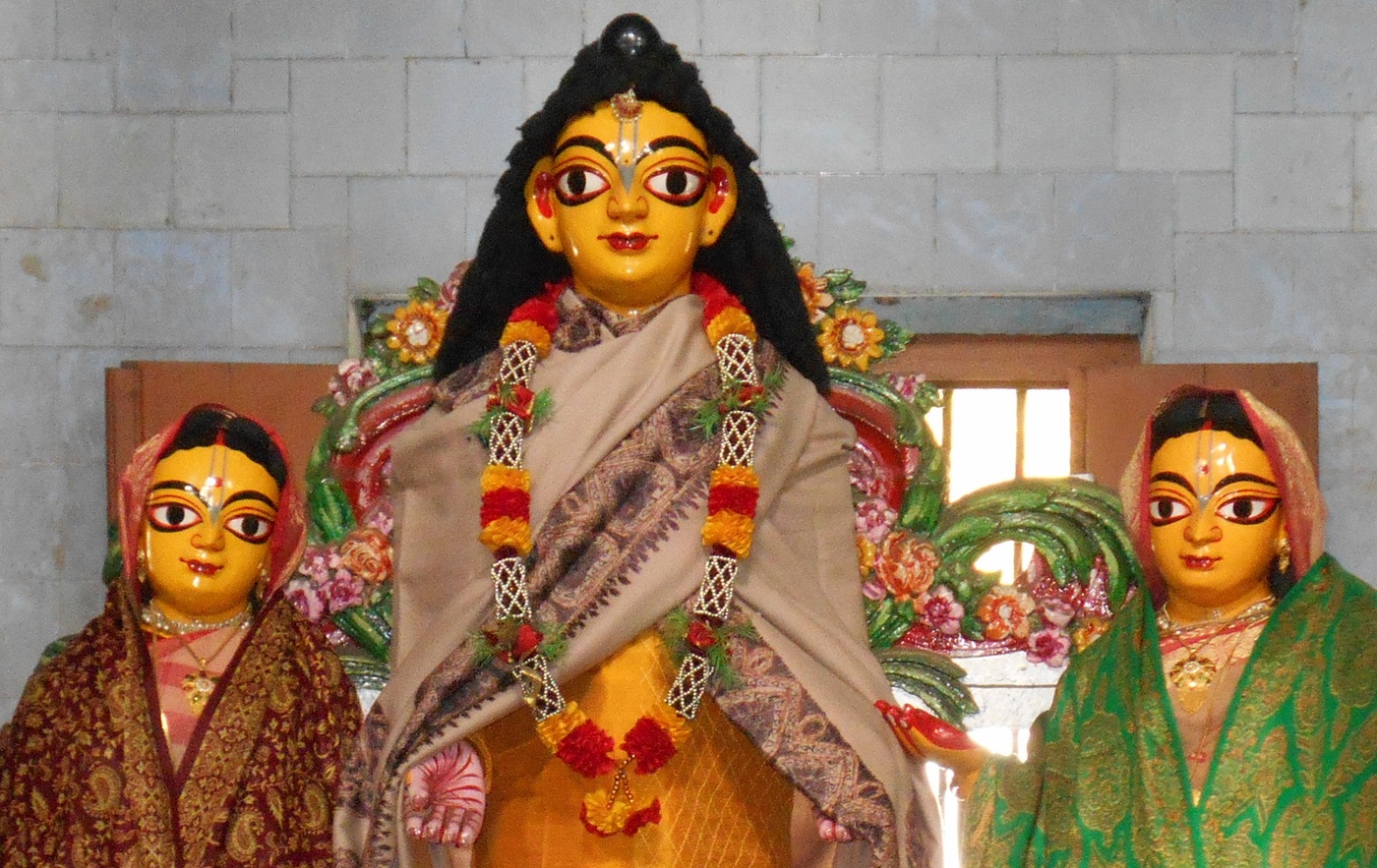
Srila Jahnava Mata
Consort of Nityananda Prabhu Who Led Gaudiya Vaishnavism After 1534
Also known as Jahnava Devi, Jahnavi Devi, Jahnava Thakurani, Ma Jahnava, Srimati Jahnava Devi
“Jahnava-devi, Lord Nityananda's wife -- she was acharya. She was controlling the whole Gaudiya Vaishnava community.”
Srila Prabhupada, Room Conversation, San Diego, 29 June 1972
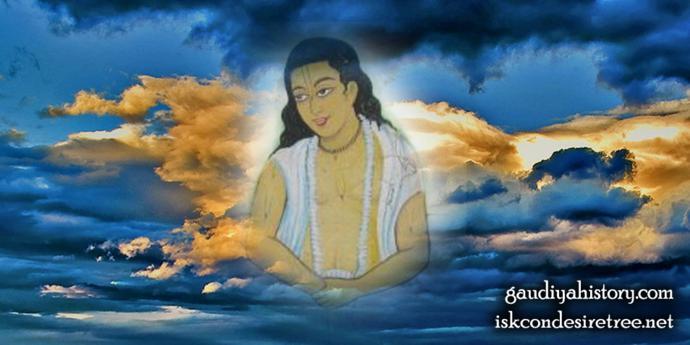
Srila Jahnava Mata, also known as Jahnava Devi, was the younger of the two wives of Nityananda Prabhu. In the decades after 1534, she became the acknowledged head of the entire Gaudiya Vaishnava movement. She held that position without any formal office and without any precedent for it in the society around her. Sixteenth-century Bengal did not expect a widow to lead anything, let alone a religious movement full of brahmana men. She led it anyway, and nothing in the record shows that anyone at the time disputed it. Srila Prabhupada himself said of her, plainly, that she "was acharya" and that she was "controlling the whole Gaudiya Vaishnava community."
| Detail | Description |
|---|---|
| Father | Suryadasa Sarakhela, accountant to the ruler of Gauda, of Shaligrama |
| Husband | Nityananda Prabhu (married alongside her elder sister, Vasudha) |
| Home | Khardaha, on the Ganges north of present-day Calcutta |
| Stepson and disciple | Virabhadra Gosvami (Virachandra), son of Vasudha |
| Role after 1534 | Diksha-guru and acknowledged head of the Gaudiya Vaishnava movement |
| Accepted her as shiksha-guru | Narottama Dasa Thakura, Shrinivasa Acharya, Shyamananda Prabhu — each of whom had taken formal diksha elsewhere |
| Her own diksha-guru | Not named in any surviving source |
| Disappearance | Shukla Navami, month of Vaishakha, at Vrindavana (year not established) |
A Daughter of the Sarakhela Family #
Jahnava was the younger daughter of Suryadasa Sarakhela, a Vaishnava of Shaligrama, near Navadwip. He had grown wealthy serving as an accountant to the Muslim government of Gauda. Her elder sister was Vasudha. Her uncle was Gauridasa Pandita, one of the twelve gopalas and among the most fervent of Nityananda Prabhu's followers. Another uncle, Krishnadasa Sarakhela, is named beside Suryadasa in the Chaitanya-charitamrita itself as a reservoir of love of Godhead. The exact year and place of Jahnava's own birth are not settled in the surviving sources. Birth and Family sets out those details honestly, along with a striking fact: the tradition identifies her, alongside Vasudha, with an eternal associate of Krishna in Vraja.
Marriage to Nityananda Prabhu #
Suryadasa gave both his daughters, Vasudha and Jahnava, to Nityananda Prabhu in marriage. Nityananda Prabhu's own account of the wedding tells that story in full, from Nityananda's side. The same story is told again here, from Jahnava's own side, on Marriage and the Two Wives of Nityananda Prabhu. After the wedding the family settled at Khardaha, which became the headquarters of the whole Bengal mission. Vasudha gave birth to a son, Virabhadra, and a daughter, Ganga Devi, and died not long afterward. Jahnava had no children of her own. She raised both of them as her own, and Virabhadra in particular became her most cherished disciple.
The Acharya of Gaudiya Vaishnavism After 1534 #
Chaitanya Mahaprabhu disappeared in 1534. Nityananda Prabhu, Advaita Acharya and Srivasa Thakura all followed him within a few years. The movement suddenly lost every figure it had been built around. Jahnava, Nityananda's widow, filled that vacuum. She was not a figurehead: she gave diksha, and the sources name the disciples. Srila Bhaktisiddhanta Sarasvati Thakura writes in his Anubhasya that "Virabhadra Gosani was the direct son of Srila Nityananda Prabhu and a disciple of Jahnava Devi" — a line Srila Prabhupada quotes in full in his purport to Chaitanya-charitamrita, Adi-lila 11.8. Bhakti-ratnakara (chapter 13) names two more: Srimati and Narayani, the daughters of Yadunandana Acharya, whom "Sri Jahnava happily accepted... as her disciples" on the day they married Viracandra. Prema-vilasa (vilasas 15 and 20) and Haridasa Dasa's Gaudiya-vaishnava-abhidhana carry the same. That is what her guruship meant in practice, and it is documented rather than inferred.
The other half is not documented, and it is better to say so than to fill the gap. No source names who gave Jahnava her own diksha. The record is simply silent on that point. What is recorded instead is the general order Sri Chaitanya Mahaprabhu gave to every one of His followers: yare dekha, tare kaha 'krishna'-upadesha, amara ajnaya guru hana tara' ei desha, "instruct everyone you meet to follow the orders of Lord Krishna... in this way become a spiritual master" (Chaitanya-charitamrita, Madhya-lila 7.128). Narottama Dasa Thakura, Shrinivasa Acharya and Shyamananda Prabhu, the three preachers who carried the second generation of the movement, accepted her as the foremost Vaishnava in all of Bengal and took her guidance as shiksha. Each of them, it should be said, had taken his formal diksha elsewhere: Narottama from Lokanatha Goswami, Shrinivasa from Gopala Bhatta Goswami, Shyamananda from Hridaya Chaitanya. Srila Prabhupada put the same distinction in his own way: Jahnava Devi "was accepted as" acharya, he said, "but she did not declare." The fuller story of how that came to be, including two direct statements from Srila Prabhupada on the subject, is told on Leading the Movement After 1534.
Presiding at the Kheturi Festival #
The clearest public sign of her standing came at the festival Narottama Dasa Thakura convened at Kheturi, an event already described from Narottama's side on The Kheturi Festival. Jahnava was invited, given the highest honor of the gathering, and asked on its opening day to take charge of the whole affair. She directed the kirtana and oversaw the worship of the six Deities installed there. She cooked the first offering with her own hands and ate only after every guest had been fed. The specific, sourced detail of what she said and did at Kheturi is gathered on Presiding at the Kheturi Festival.
Journeys to Vraja and the Deity of Jahnava Radhika #
More than once in her life Jahnava traveled from Bengal to Vrindavana. Rupa Goswami explained scripture to her there. Raghunatha Dasa Goswami, the most severe and reclusive of the Six Goswamis, spent a great deal of time showing her the ground at Radha-kunda. More than any other single person, she is credited with binding the Bengali wing of the movement to the Vrindavana wing, at a time when the two could easily have drifted apart. A Deity still worshipped today at Vrindavana's Gopinatha temple carries her name. The full account, with its specific stops and named devotees, is on Journeys to Vrindavana and Jahnava Radhika.
Disappearance and Worship Today #
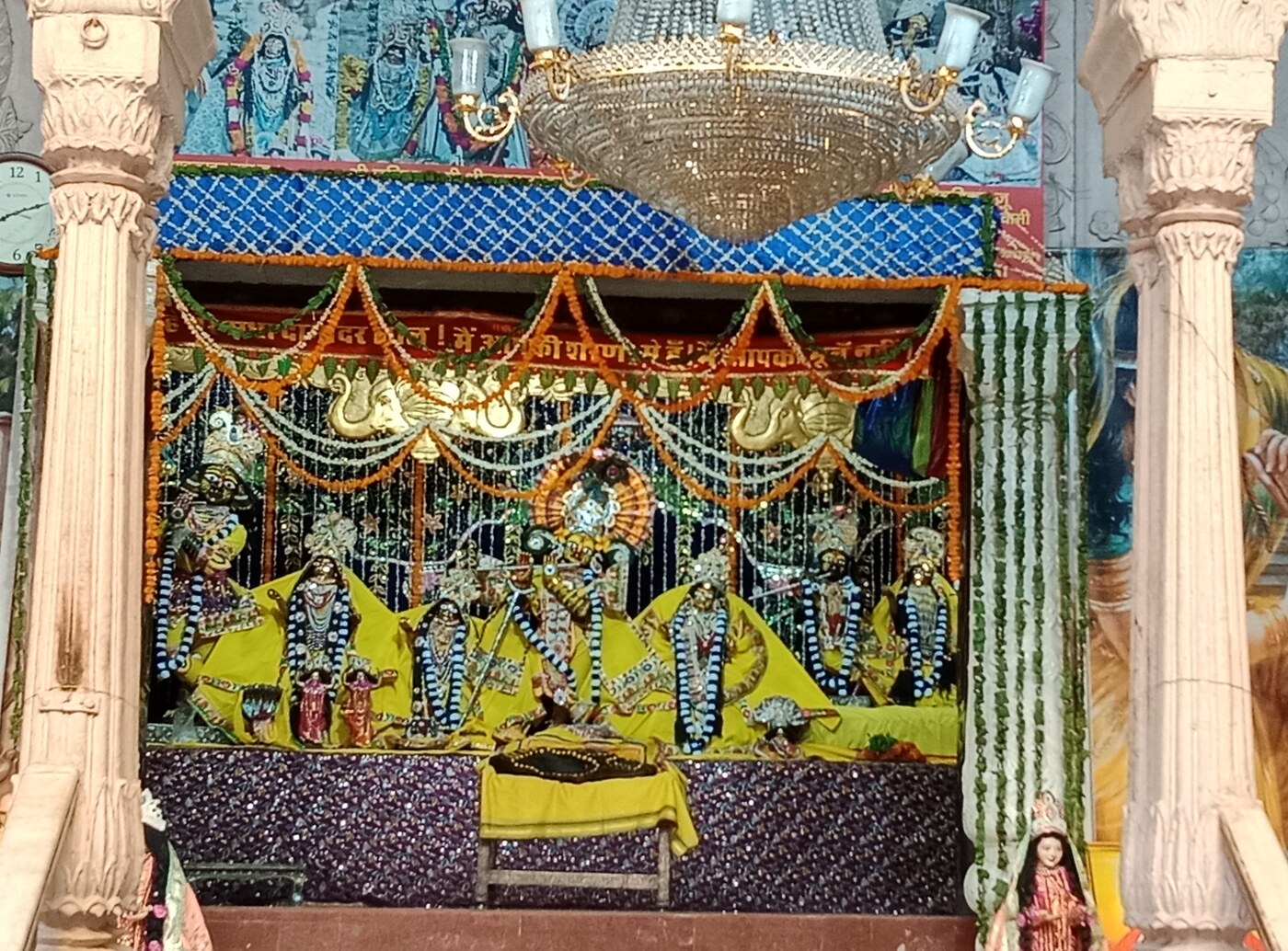
Jahnava Mata disappeared on the ninth day of the bright fortnight of Vaishakha, at Vrindavana. No surviving source recorded the exact year. She is worshipped today beside Nityananda Prabhu in temples throughout Bengal. At Ekachakra she stands, as a Deity, on the right-hand side of the Deity of Banka Raya. Gaudiya Vaishnavas do not usually describe her as a reformer, and she never presented herself that way. But the tradition has never looked away from what actually happened. In the middle of the sixteenth century, a woman held the acknowledged spiritual leadership of a movement of brahmana men. She initiated disciples, presided over its central assembly, and settled its most important institutional relationship. Chaitanya Mahaprabhu Himself gives the reason: the qualification for guru is knowledge of Krishna, and nothing else. "Whether one is a brahmana, a sannyasi or a shudra, he can become a spiritual master if he knows the science of Krishna," Chaitanya-charitamrita records Him teaching (Madhya-lila 8.128). Srila Prabhupada quoted this very verse when he was asked directly whether Jahnava Mata could really have been guru, a question taken up in full on Leading the Movement After 1534. The full detail of her worship today, and of his own comments on what her example means, is on Legacy and Worship Today.
- Sri Chaitanya-charitamrita, Adi-lila 11.21-40 (with Bhaktisiddhanta Sarasvati's Anubhasya)
- Sri Chaitanya-charitamrita, Adi-lila 13.61
- Jahnava Mata (Gaudiya History biography index)
- Jahnava Mata - Biography (excerpted from Shri Chaitanya: His Life & Associates, Bhakti Ballabh Tirtha Maharaj)
- Jahnava Mata (Dandavats, 20 May 2021)
- Radha Gopinath Temple, Vrindavan (Braj Ras)
- Room Conversation, 29 June 1972, San Diego
- Interview with Professors O'Connell, Motilal and Shivaram, 18 June 1976, Toronto
- Jahnava Devi
- Marriage to Vasudha and Jahnava (this site, Nityananda Prabhu)
- The Kheturi Festival (this site, Narottama Dasa Thakura)
- Sri Chaitanya-charitamrita, Adi-lila 11.8 (Bhaktisiddhanta Sarasvati's Anubhasya: "Virabhadra Gosani ... a disciple of Jahnava Devi")
- Female Diksa Guru — ISKCON GBC (historical examples, with Bhakti-ratnakara ch. 13 and Prema-vilasa vilasas 15 & 20)
Disciples
Frequently asked
When was Srila Jahnava Mata born?
Srila Jahnava Mata appeared Early 16th century (exact year unrecorded in primary sources; one secondary source gives 1509) in Shaligrama, near Navadwip, Bengal (the family home; one secondary source states Ambika Kalna).
When and where did Srila Jahnava Mata disappear?
Srila Jahnava Mata disappeared Shukla Navami, month of Vaishakha (year not established in the sources checked) at Vrindavana.
What are the main pastimes of Srila Jahnava Mata?
The pastimes covered here include: Birth and Family, Marriage and the Two Wives of Nityananda Prabhu, Leading the Movement After 1534, Presiding at the Kheturi Festival, Journeys to Vrindavana and Jahnava Radhika, Legacy and Worship Today.