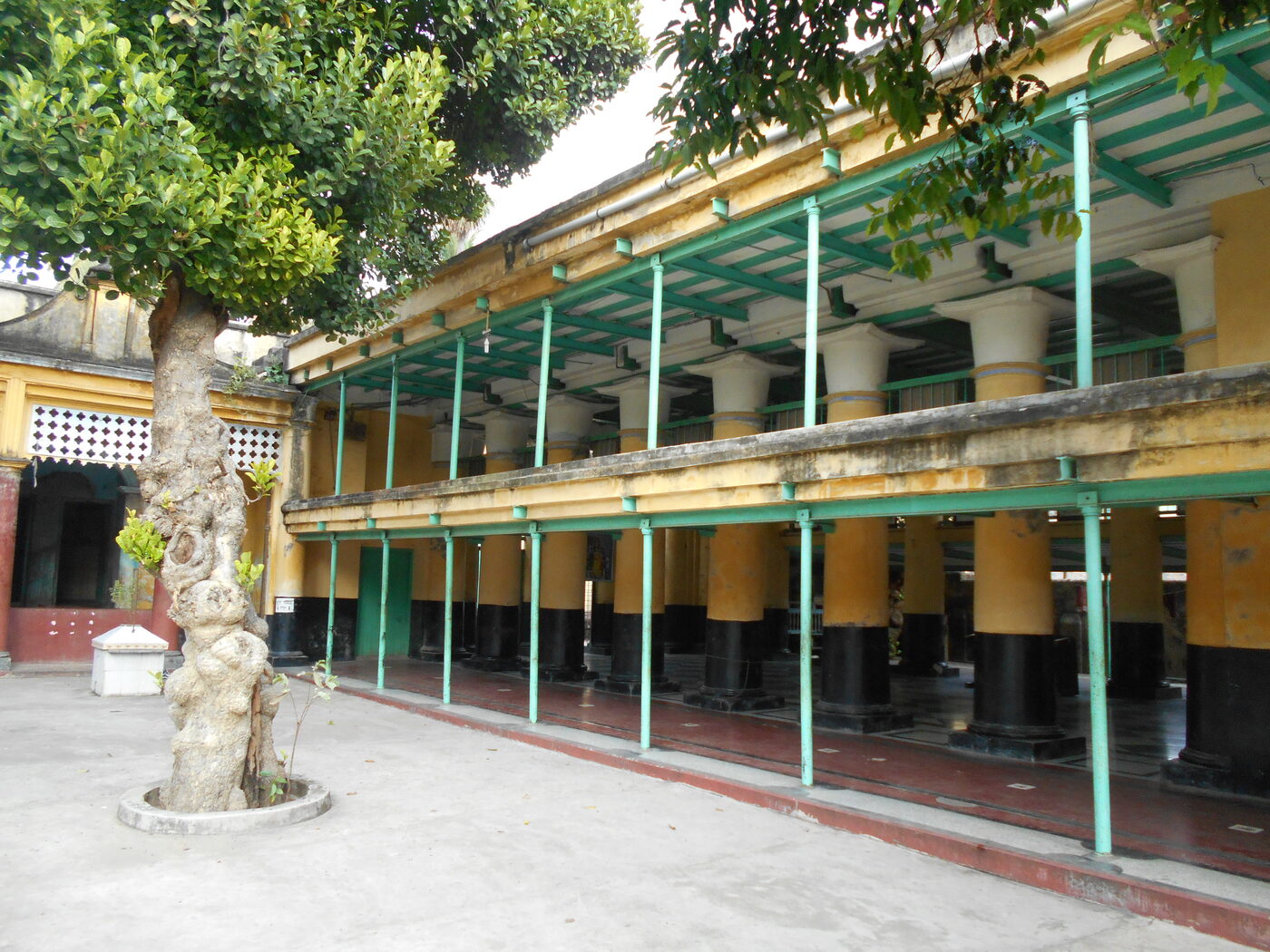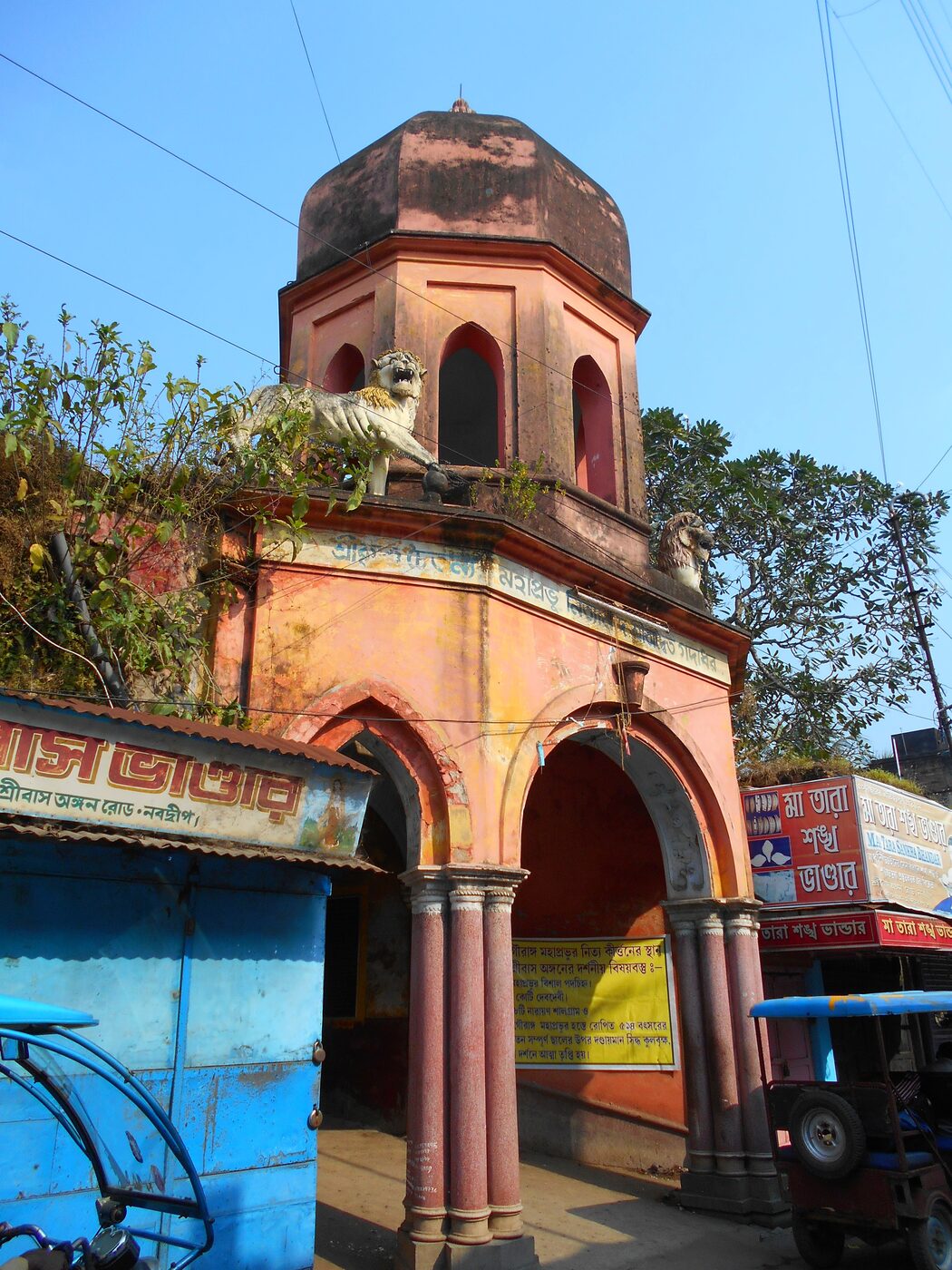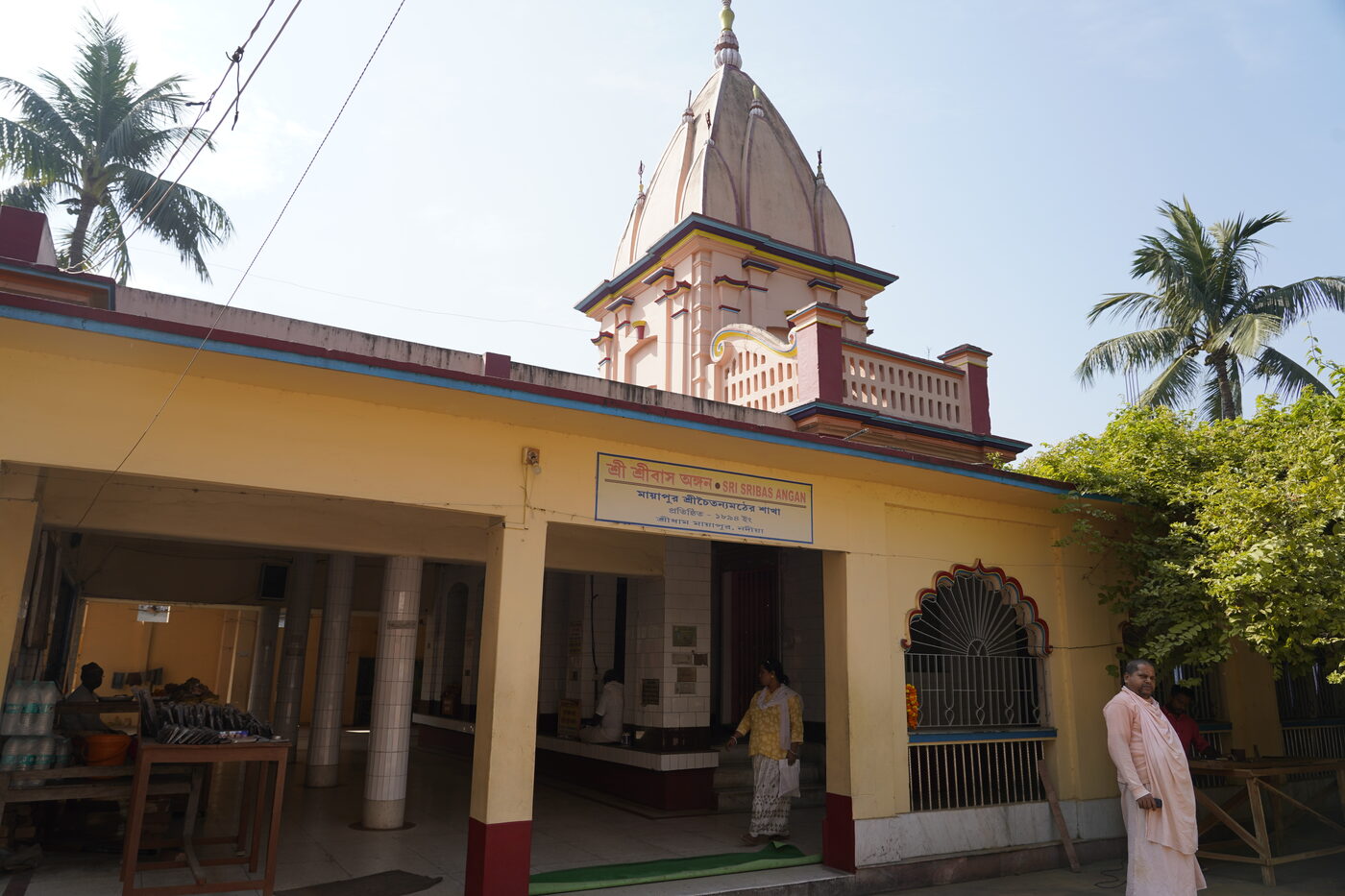
The house stood about two hundred yards north of Jagannatha Mishra's, on the same bank of the Ganges, and by the standards of that neighbourhood it was a substantial property: large rooms, a wall high enough to give privacy, gardens and groves. It is the wall and the door that matter to what follows. The Bengali word angan means courtyard, and Srivasa Angan — Srivasa's courtyard — is the name by which Gaudiya Vaishnavas know the place where their movement began.
A Year of Chanting Behind Closed Doors #
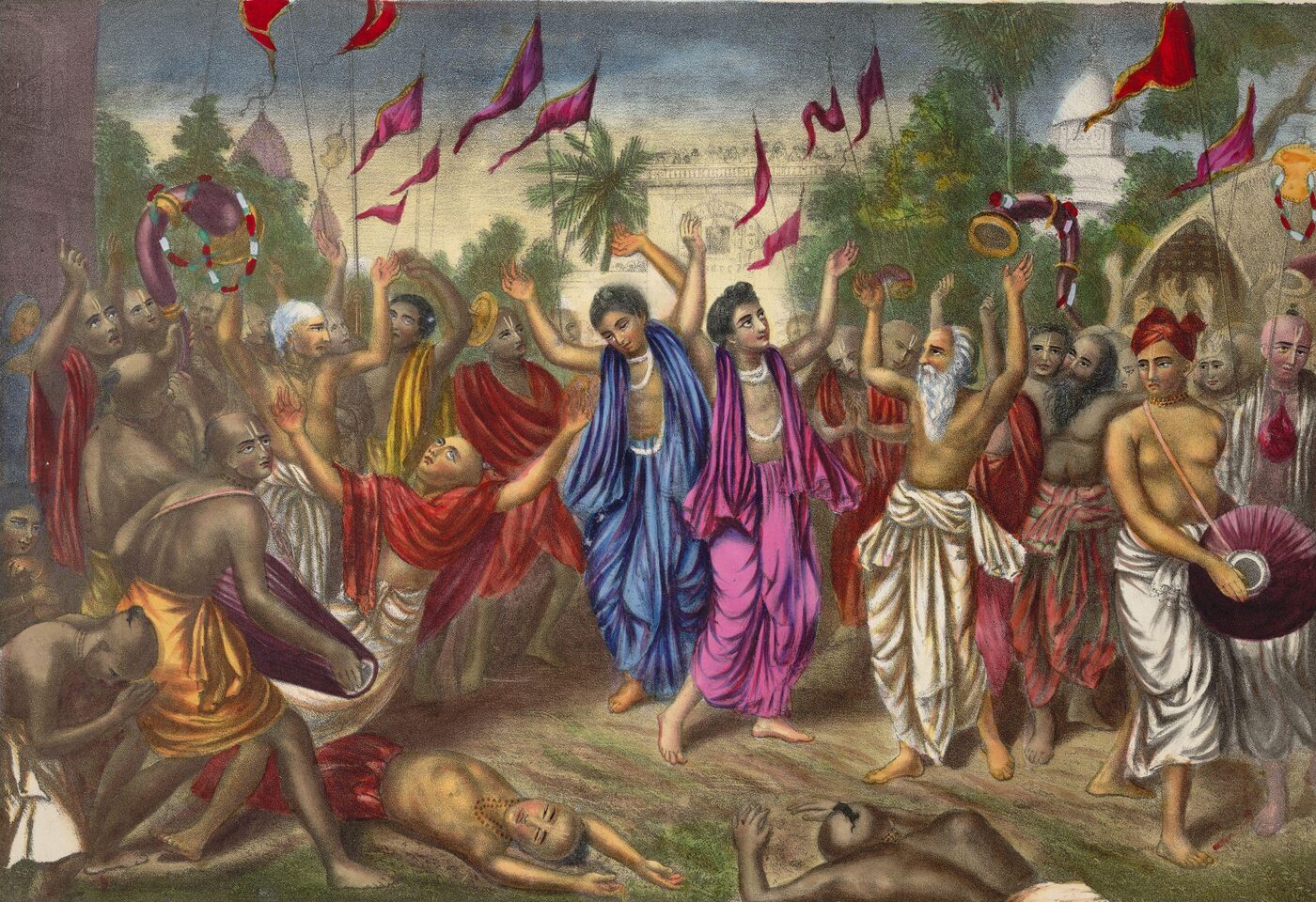
Krishnadasa Kaviraja states the essential fact in a single line: Chaitanya Mahaprabhu led congregational chanting of the maha-mantra at the house of Srivasa Thakura every night for one full year. Not occasionally, and not in public. Every night, for twelve months, before a word of it went into the streets.
The doors were shut. The Chaitanya-charitamrita says why, without embarrassment: the chanting was done behind closed doors so that unbelievers who came to make fun could not get in. It is worth sitting with that for a moment, because it is not the way religious movements usually like to remember their beginnings. The most influential devotional movement in the history of eastern India spent its entire first year as a private gathering in a walled compound, excluding the public, because the public thought it was ridiculous.
The Abhiseka of Sri Chaitanya Mahaprabhu #
What went on inside is described at length. Srivasa Thakura performed abhiseka — the ceremonial bathing by which a Deity is installed — upon Chaitanya Mahaprabhu Himself, who sat on a cot and manifested transcendental opulence; a householder brahmana formally worshipping his young neighbour as the Supreme Lord, in his own courtyard, with his own family watching.
The Six-Armed and Two-Armed Forms #
Shortly after that function Nityananda Prabhu arrived, and was shown first a six-armed form and then, at the end, the two-armed cowherd of Vrindavana in yellow cloth with the flute.
Twenty-One Hours of Continuous Ecstasy #
On another occasion the Lord remained in an unbroken ecstatic condition for twenty-one hours while the devotees watched.
The Mood of Lord Nrsimha #
On another, He asked Srivasa to read out the thousand names of Vishnu, took on the mood of Lord Nrsimha at a particular verse, and went out into the road with a club, terrifying the passers-by — then came back, threw the club away and sat down miserable, saying that He had frightened people and that frightening people is an offence, and had to be consoled by Srivasa.
Talk of Vrindavana and the Mango Festival #
There were nights when He asked Srivasa simply to keep talking about Vrindavana — the gopis drawn out of their houses by the flute, the seasons of the forest, the rasa dance — and to go on talking, and go on, until it was morning. And there was, for twelve months, a mango festival at the end of the chanting every single night.
Nityananda Prabhu in the Household #
Nityananda Prabhu lived in that house during this period, and Malini Devi looked after Him as she would a son. It was also on one of these nights, in the inner rooms while the chanting went on in the courtyard, that a child of the household died, and the family kept it silent until the kirtana had finished; that night is told here.
Wine and Tantric Paraphernalia at His Door #
The hostility this drew was serious. The Chaitanya-charitamrita says that the scoffers of Nabadwip, unable to get in, were burning up with envy and began to plan ways of making trouble for Srivasa Thakura in particular — not for Mahaprabhu, who was too well known and too well connected, but for the householder in whose compound the thing was happening.
The plan they settled on was aimed with some precision. A brahmana named Gopala Chapala, described as the chief of the scoffers and as a talkative man rough in his speech, went one night while the kirtana was going on and laid out on Srivasa Thakura's doorstep the complete paraphernalia for the worship of the goddess Durga, and set a pot of wine beside it. Anyone passing in the morning would draw the intended conclusion: that the great Vaishnava who would not eat or associate outside his own circle was in fact conducting tantric worship of Bhavani by night, wine and all. In the Nabadwip of that day the charge would have finished him socially, and it would have discredited everything that went on behind his wall.
How Srivasa Thakura Answered the Charge #
Srivasa Thakura opened his door in the morning, saw it, and did the one thing that made the accusation unusable. He sent for the respectable gentlemen of the neighbourhood — the brahmanas, the men of the higher castes, the people whose opinion the slander was designed to poison — and when they had assembled he told them, smiling, that he worshipped the goddess Bhavani every night; that the paraphernalia was there in front of them; and that now they could all understand his position. Nobody believed a word of it. The slander died in the courtyard where it was meant to have been born.
The Leprosy of Gopala Chapala #
Three days later Gopala Chapala was struck with leprosy. Sores broke out over his whole body and bled; the accounts describe him tormented by insects, in continuous pain, and finally driven out of the village to sit under a tree on the bank of the Ganges. There, one day, he saw Chaitanya Mahaprabhu passing and appealed to Him — on the grounds, as village relationships were reckoned, that he was the Lord's maternal uncle and the Lord was his nephew. Look, he said, at what has come upon me.
The Lord's answer is one of the hardest passages in the book. He refused. He addressed the man as sinful and envious of pure devotees, said He would not deliver him, and told him that he would be bitten by those germs for millions of years and that for the single offence of making Srivasa Thakura appear to be a worshipper of Bhavani he would fall into hellish life for ten million births. Only afterwards, in the same conversation, did He give the remedy, and the remedy was not His to give: Gopala Chapala had committed his offence at the feet of Srivasa Thakura, and he must go to Srivasa Thakura and beg his mercy, and if it was granted and he did not repeat the sin, he would be freed. He went. Srivasa Thakura gave it, and the man was released.
Offence at the Feet of a Devotee #
This is the episode the tradition points to when it teaches that offence against a devotee stands in a separate category from other sins — that it is the one fault the Lord declines to absolve on His own authority, and refers back to the person offended. Nor is Gopala Chapala the only case in the chapter: another brahmana who came to see the kirtana, found the door shut and could not get in, cursed the Lord in his frustration, and Krishnadasa Kaviraja records that anyone who hears of that curse is delivered from brahminical curses.
Chand Kazi and the Broken Mridanga #
There was official trouble as well, and it came to the same courtyard. When the chanting eventually moved into the streets and the whole of Nabadwip could be heard chanting the holy names to the sound of mridanga and hand cymbals, the smarta brahmanas complained to Chand Kazi, the local magistrate, that a new and un-Hindu religion was being introduced. The Kazi came in person to Srivasa Thakura's house, broke a mridanga there, and issued an ordinance forbidding street sankirtana on pain of confiscation and forcible conversion. The site kept the name Khol Bhanga Danga — the place where the drum was broken. The town panicked; the accounts say Srivasa laughed at the ordinance. What followed — the evening of ten thousand torches, the procession through every quarter of the city, the Kazi's own promise that none of his descendants would ever check the sankirtana movement — belongs to the story of Mahaprabhu rather than to this page.
Why the Year Behind the Wall Mattered #
What Gaudiya Vaishnavas take from Srivasa Angan is chiefly this. The sankirtana movement did not begin as a public campaign that later acquired a headquarters. It began as a year of nightly chanting among perhaps a few dozen people in a locked courtyard, in a house that belonged to a private householder who had a family, a reputation and neighbours, and who put all three at risk. When the doors were finally opened, what came out into the streets of Nabadwip had already been going for twelve months. The year behind the wall is why there was anything to bring out.