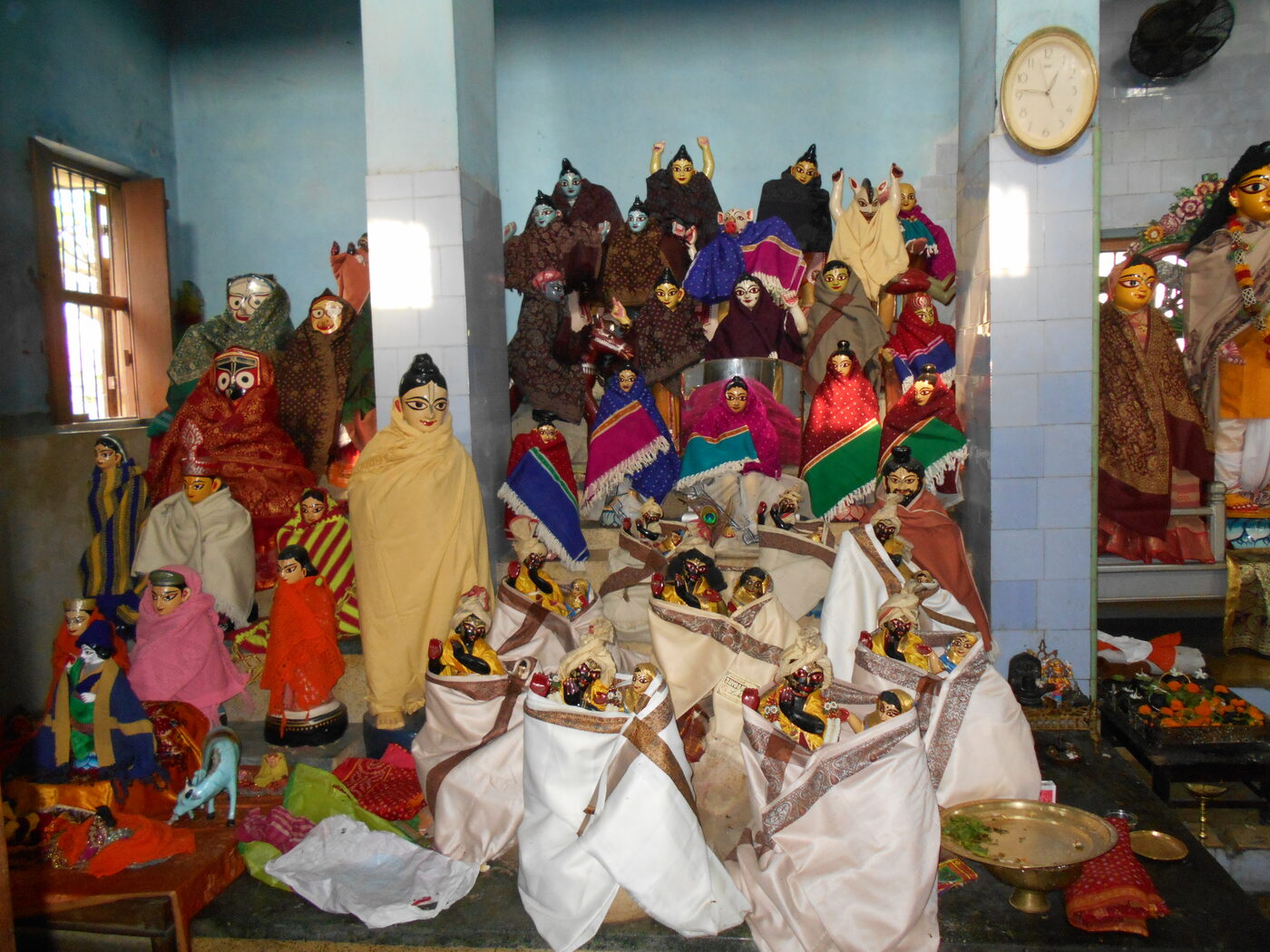
Srivasa Thakura came from Srihatta — the district of eastern Bengal known today as Sylhet — which is also the district that the family of Chaitanya Mahaprabhu came from. Upendra Mishra, the Lord's paternal grandfather, was a Srihatta brahmana, and it was his son Jagannatha Mishra who moved west to Nabadwip to study. Srivasa and his brothers made the same journey for a different reason. The accounts say they moved to the Ganges bank because they wanted the company of devotees, and Nabadwip, for all that its public reputation belonged to logicians, had a small Vaishnava circle worth crossing a province for.
| Detail | Description |
|---|---|
| Native district | Srihatta, known today as Sylhet |
| Father | Jaladhara Pandit, a Vedic brahmana |
| Place among sons | The second of five |
| Brothers at Nabadwip | Srirama Pandit, Sripati Pandit, and Srinidhi or Srikanta |
| Wife | Malini Devi, an intimate friend of Sachi Devi |
| Niece | Narayani, later the mother of Vrindavana Dasa Thakura |
| Identity | Narada Muni |
His Father, Brothers and Household #
The Gaudiya Vaishnava Abhidhana, citing the Prema-vilasa, names his father as a Vedic brahmana called Jaladhara Pandit and makes Srivasa the second of five sons. The brothers who lived with him at Nabadwip and shared his life in the movement were Srirama Pandit, Sripati Pandit, and a fourth whom the sources call either Srinidhi or Srikanta — an ordinary variation in the manuscripts, and one worth flagging rather than resolving. Krishnadasa Kaviraja treats the four of them as a single unit of the Chaitanya tree: Srivasa Pandit and Srirama Pandit are two celebrated branches, Sripati and Srinidhi are with them, and the four brothers together with their servants and maidservants are counted one great branch, whose sub-branches cannot be numbered. Of the household beyond the brothers, two people matter to the story. Srivasa's wife was Malini Devi, an intimate friend of Sachi Devi, who was in and out of the Mishra house constantly and who helped to nurse the infant Nimai. And his niece Narayani, a small girl during the sankirtana years, would grow up to be the mother of Vrindavana Dasa Thakura — the author of the Chaitanya-bhagavata, which is to say that the earliest full biography of Mahaprabhu was written by a man who had this household's memories in the family.
Srivasa was considerably older than Mahaprabhu — old enough to have been a settled and practising Vaishnava before the Lord was born, and old enough to give Him advice as a boy and be listened to. He and his brothers sang the names of Krishna, worshipped Krishna, and bathed in the Ganges three times a day. Krishnadasa Kaviraja's remark about the family is that they engaged fully in the Lord's service and knew no other god or goddess — which in the Bengal of that period was not a bland piety but a definite and slightly awkward social position.
A Vaishnava Circle in a Town of Logicians #
It is worth being clear about how the town saw them. Nabadwip in the 1480s was a great centre of Sanskrit learning, dominated by Nyaya — the school of formal logic — and by smarta ritualism: a place where a man's standing came from his ability to hold a position in debate or to conduct the prescribed observances correctly. A group of brahmanas who met at Advaita Acharya's house to read the Bhagavatam and chant the holy names aloud were not persecuted, exactly; they were simply not taken seriously. The little circle — Advaita Acharya, Srivasa and his brothers, Haridasa Thakura, Mukunda Datta, Murari Gupta, Shuklambara Brahmachari and a few others — met, read, chanted, and, according to the biographies, prayed with real urgency for the Lord to descend, because they could not see how anything short of that was going to change the age they lived in.
Knowing That the Lord Would Appear #
Srivasa is one of those the tradition credits with having sensed what was coming. Vrindavana Dasa Thakura records that by the strength of his devotion he understood that Krishna was going to appear in the house of Jagannatha Mishra, and that when the child was born the Vaishnavas of Nabadwip knew, as Advaita Acharya knew at Shantipura. But the biographies are careful to add that knowing did not survive contact with the child. The Lord's own concealing potency saw to it that the devotees who had recognised Him could not sustain the recognition: what filled their hearts instead was ordinary parental affection, without a trace of awe. Srivasa and Malini stood to Him, in practice, as a second father and mother.
Asking Nimai What Learning Is For #
He also scolded Him. There is an exchange preserved from the years when Nimai was a young scholar with a reputation and a certain amount of swagger about it, in which Srivasa asked Him what learning was for. Why do people study, he said — so that they may come to know what devotion to Krishna is. If a man's scholarship does not produce that, what has it done for him but consume his time. If You have really learned anything, begin worshipping Krishna now; that is what a life is for. Nimai laughed and answered that by their mercy it would certainly come about. It is the sort of conversation a self-assured young man has with an elderly neighbour, and the biographies keep it because of what happened next.
Recognising Prema After the Journey to Gaya #
What happened next was Gaya. Mahaprabhu went east in about 1508, took initiation from Isvara Puri, and came back a different person. Bhaktivinoda Thakura's summary is that He was no longer a contending logician, a wrangling ritualist or a criticising rhetorician; He fainted at the name of Krishna and behaved like a man possessed by something. Nabadwip's reading of this was the obvious one — a brilliant young man had broken down, whether from grief for his dead father or from something worse — and the town said so. Srivasa's reading was the other one. He had spent thirty years in the company of the Bhagavatam and knew what the symptoms of prema were supposed to look like when they were real, and he identified them. That judgement, made by an older man with something to lose, is the first thing the movement owed him.
The Four-Armed Form in His Deity Room #
The Chaitanya-bhagavata places the confirmation in his own house. Mahaprabhu came in one day, in ecstasy, and asked Srivasa whom it was that he worshipped and meditated upon, and told him to look now with his own eyes; and going into the little Deity room of the household He sat on the seat of Vishnu and showed a four-armed form with conch, disc, club and lotus. What He said then is the reason the house is remembered as it is: that having been called by their chanting and by the roaring of Advaita Acharya, He had left Vaikuntha and come down, with His eternal associates, and that Srivasa could now chant His glories without fear. Vaishnava readers take this as the founding charter of the sankirtana movement. It is at any rate the moment after which Srivasa Angan stopped being a private house.
Bhakta-tattva and the Fifth Place #
Gaudiya theology assigns Srivasa Thakura the fifth place in the Panca-tattva and defines it as bhakta — the pure devotee, as distinct from the Lord Himself, His expansion, His incarnation and His potency. Krishnadasa Kaviraja writes that the innumerable unalloyed devotees are headed by Srivasa Thakura; Kavi Karnapura identifies him as Narada Muni, his brother Srirama as Narada's friend Parvata Muni, and Malini Devi as Ambika, the nurse who suckled Krishna in Vraja. The point of reserving a place in the formula for a plain householder is taken up on the pages that follow, beginning with what happened in his courtyard.