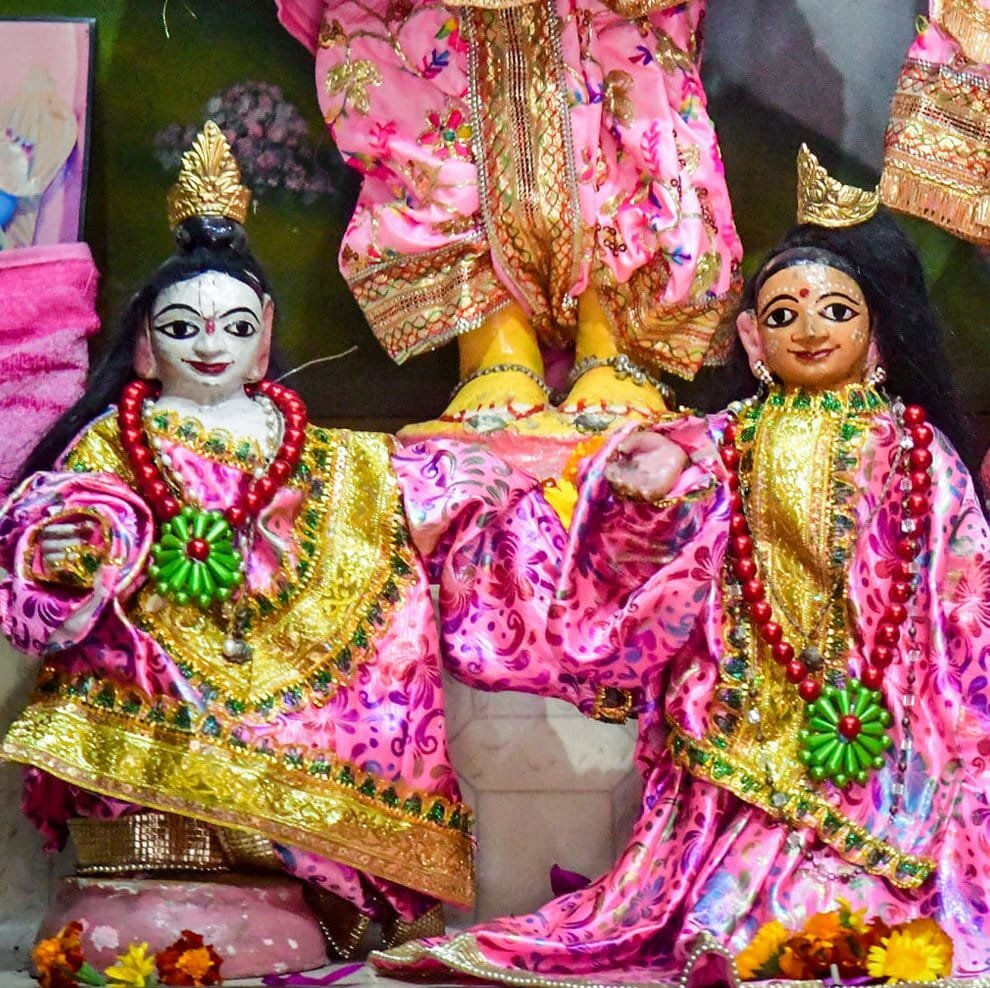
No source records the year Vasudeva Datta was born. None records the year, the place, or even the rough circumstances of his disappearance. In this, his story is very close to his brother's. Mukunda Datta's own page notes the same absence for him, except that Mukunda Datta's tradition at least places a disappearance day on the calendar, and a samadhi among the Sixty-Four Samadhis at Puri. For Vasudeva Datta, even that much is missing. What remains instead is a temple still standing, a name from beyond this lifetime, and one relationship worth examining more carefully than a single summary sentence usually allows.
| Detail | Description |
|---|---|
| Disappearance year | Not recorded |
| Disappearance place | Not recorded |
| Vraja identity | Madhuvrata, per Gaura-ganoddesha-dipika 140 |
| Paired identity | Mukunda Datta as Madhukantha |
| Enduring legacy | The Madana-gopala temple at Mamagachi |
| Documented spiritual connection | Yadunandana Acharya, priest and guru of Raghunatha Dasa Goswami |
The Priest He Sent Toward Vrindavana #
Among Vasudeva Datta's most important connections is one whose weight he probably never anticipated: his relationship to Yadunandana Acharya, the family priest of Raghunatha Dasa Goswami. Sri Chaitanya-charitamrita's Antya-lila tells how, on the night Raghunatha Dasa finally escaped his father's household for Jagannatha Puri, it was Yadunandana Acharya who made the opening possible. He arrived at the house on the pretext of needing help persuading a brahmana to resume temple service, walked Raghunatha out past the sleeping guards, and then let him go the rest of the way alone.
A Question of Two Wordings #
Krishnadasa Kaviraja Goswami introduces Yadunandana Acharya at exactly this point in the story with two back-to-back statements that reward a close reading. The first says that Yadunandana Acharya, "although born in a brahmana family, had accepted the mercy of Vasudeva Datta." The very next verse says that Yadunandana Acharya "had been officially initiated by Advaita Acharya." Read together, these two verses draw a real distinction. Advaita Acharya gave Yadunandana Acharya his formal diksha, while Vasudeva Datta gave him something the text calls mercy, not initiation.
Srila Prabhupada's own purport to an earlier verse, Adi-lila 10.41, sums up the same relationship more briefly, saying simply that "Vasudeva Datta initiated Sri Yadunandana Acharya, the spiritual master of Raghunatha dasa." Taken on its own, that sentence reads as a plain claim of diksha. Read against the fuller story three chapters later, in Antya-lila, it looks instead like a short summary of the more specific relationship Krishnadasa Kaviraja Goswami's own verses describe: mercy from Vasudeva Datta, formal initiation from Advaita Acharya. The page on Raghunatha Dasa Goswami already follows this more specific wording, describing Yadunandana Acharya as "himself a disciple of Advaita Acharya," and nothing here contradicts that. The other half of the same two verses still matters: whatever the precise nature of the bond, Krishnadasa Kaviraja Goswami himself records that Yadunandana Acharya had accepted Vasudeva Datta's mercy before he ever crossed paths with Raghunatha Dasa at all. Where the sources genuinely differ in their choice of words, both verses are shown here rather than picking one silently.
Madhuvrata of Vraja #
Kavi Karnapura's Gaura-ganoddesha-dipika, the traditional key to the Vraja identities of Mahaprabhu's associates, gives Vasudeva Datta a place in Krishna's own pastimes. He and Mukunda Datta, it says, were two singers in Vraja named Madhuvrata and Madhukantha, appearing in Chaitanya-lila as the Datta brothers who sang in Mahaprabhu's own company. It is a fitting identity for a man whose most remembered moments, a prayer that moved the Lord to tears, and a vow the Lord repeated three times so no one could doubt it, both rest entirely on the depth of a devotee's feeling rather than on anything he did or built.
A Brother Remembered Beside Him #
Vasudeva Datta's story keeps returning, again and again, to his brother, and that is not an accident of the record but a fact of it. Krishnadasa Kaviraja Goswami calls him "the nineteenth branch of the Chaitanya tree" in the very same chapter where Mukunda Datta appears as an earlier branch on the same tree, two names from one Chittagong household standing only a few verses apart in the text that has preserved them both. Two brothers, one wealthy family of physicians, and a friendship with the Lord that neither ever seems to have needed to explain or justify to anyone. That is what the record leaves behind, five hundred years later, in place of any date for when either of their lives actually ended.