The Gita Govinda names its own author only once, and cryptically: a poet from a village called "Kindubilva." Eight hundred years later, that one word is still the center of a genuine, unresolved dispute between two regions of India, and this page tries to lay out both sides honestly rather than pick a winner.
Two Villages, One Name #
West Bengal's claim rests on Kenduli village in the Birbhum district, on the banks of the Ajaya river. Sri Chaitanya-charitamrita itself, in Srila Prabhupada's purport, follows this identification, naming Jayadeva's birthplace as Birbhum and his parents as Bhojadeva and Vamadevi. The Gaudiya Vaishnava Abhidhana adds a devotional detail: that Jayadeva found his Radha-Madhava Deities in the waters of the Ajaya itself, and used to rest and worship at a Shiva temple nearby called Kusheshwar.
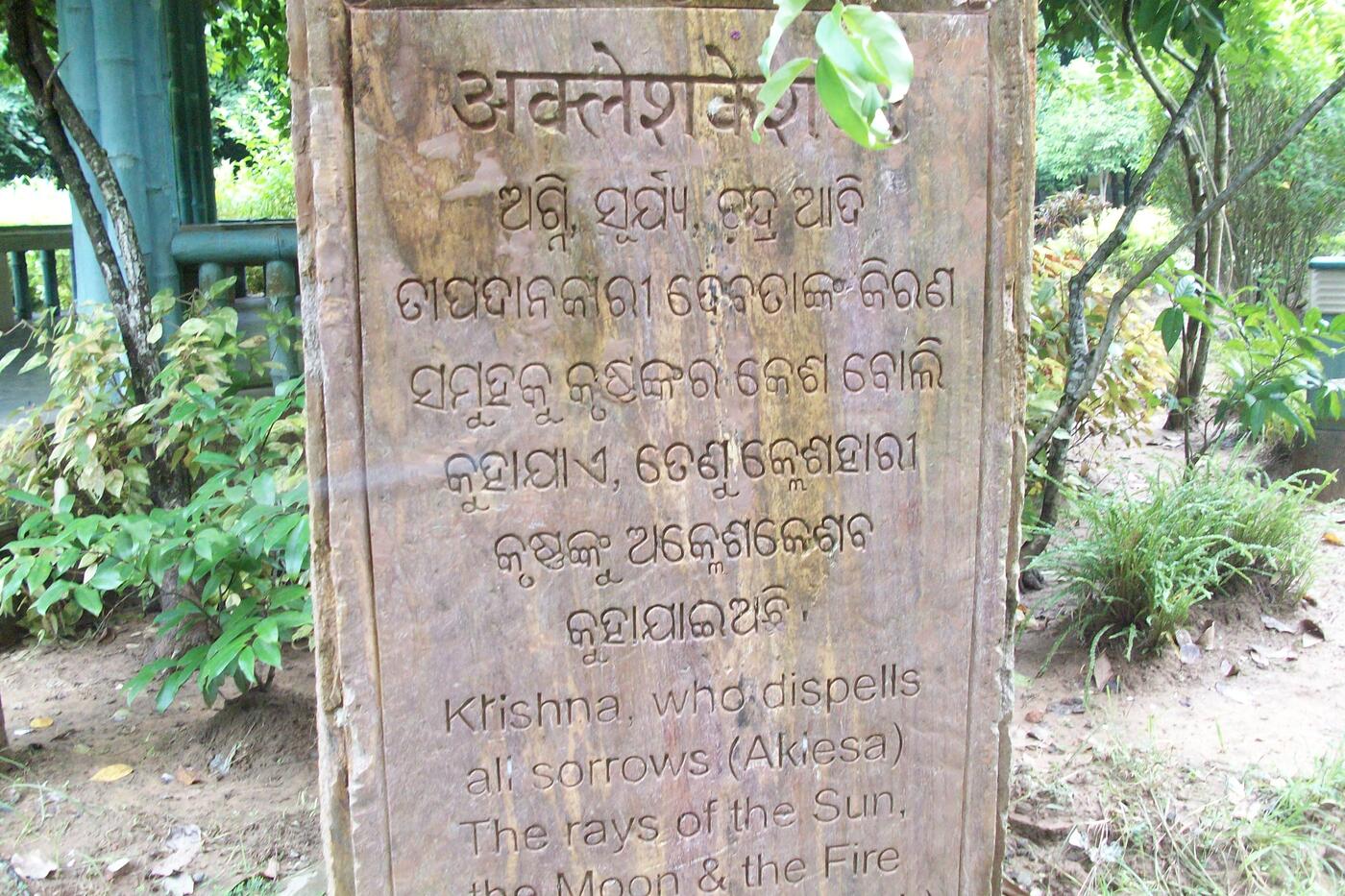
Odisha's claim rests on Kenduli Sasan, a village near Puri, and it is not a thin one. Temple inscriptions at the Lingaraja, Madhukeswara, and Simhachala temples — read and published by the scholar Satyanarayana Rajguru — describe a Jayadeva who taught, and may have studied, at a school in nearby Kurmapataka. The Odisha State Museum in Bhubaneswar alone holds some two hundred and ten Gita Govinda manuscripts, more than anywhere else in India, in forms ranging from ordinary palm leaf to ivory, bamboo, and paper, some shaped like a fish or a garland for ease of carrying. The earliest known commentary on the poem was written in Odisha, around 1190, only a few decades after the poem itself. Odisha's Jagannatha temple, moreover, has sung the Gita Govinda every night, without a documented break, since a time tradition places within Jayadeva's own lifetime.
Serious scholars on both sides have argued their case for well over a century, and the honest position is that the question remains open. This page follows the Bengal-focused strand of the story that Sri Chaitanya-charitamrita itself follows, since that is the account most directly relevant to Gaudiya Vaishnava tradition, while recording that the Odisha claim is substantial and unresolved.
A Life Near the Royal Court #
Whichever village he was born in, Jayadeva lived during the reign of Maharaja Lakshmana Sena of Bengal, and for a long stretch of his life he lived in Nabadwip, then Bengal's capital, not far from the royal palace. Later Gaudiya Vaishnava tradition, drawing on Srila Bhaktivinoda Thakura's Navadvipa-dhama-mahatmya, tells a specific story about how the two men came to know each other: Lakshmana Sena's court scholar, Govardhan Acharya, heard the Dasavatara-stotra — the same hymn to Krishna's ten incarnations, opening pralayo payodhi jale, that this temple's own song collection still preserves as Pralaya Payodhi Jale — and told the king who had written it. Curious, the king went to Jayadeva's house disguised as an ordinary visitor, recognized in him the bearing of a genuinely realized soul, and invited him to live in the palace.
How direct this royal connection really was is itself something sources disagree on. The Gaudiya account above describes Jayadeva as Lakshmana Sena's actual court poet, citing Ashutosh Deb's Bengali dictionary for the title. A different, independent strand of evidence — the preface to an old Calcutta edition of the Gita Govinda — instead ties Jayadeva to "the king of Orissa's" court, and notes only that a courtier of Lakshmana Sena's named Shridhar Das included several of Jayadeva's verses in his own poetry anthology, the Sad-ukti-karnamrta. That is consistent with Jayadeva being a famous poet whose verses were prized and anthologized at Lakshmana Sena's court, without settling whether he held a formal position there. Both readings agree that Jayadeva and Lakshmana Sena's court overlapped; they disagree on how official that link was.
Turning Away From the Palace #
Jayadeva, already living a renounced life, had no wish to move into royal opulence. According to the Gaudiya tradition, he asked instead to be allowed to live at Jagannatha Puri. Lakshmana Sena, disappointed but respectful, offered a compromise: a cottage in the nearby village of Champaka-hatta, known today as Champahati, a place he said suited a life of meditation, promising never to disturb him there again. It was at Champahati, tradition says, that Jayadeva received a vision — first of Radha-Madhava, and then of Their combined form as the golden, champa-flower-colored Gauranga Mahaprabhu, foretelling Sri Chaitanya Mahaprabhu's own appearance there centuries later. This vision, tradition holds, is also where Jayadeva was instructed to go on to Jagannatha Puri, the place where he would eventually write his masterpiece — an episode the next page picks up in full, alongside the story of his marriage to Padmavati.