No episode in Jayadeva's life is told and retold within Gaudiya Vaishnavism as often as this one — the day, tradition says, that Krishna Himself picked up where the poet had stopped.
A Line Too Bold to Write #
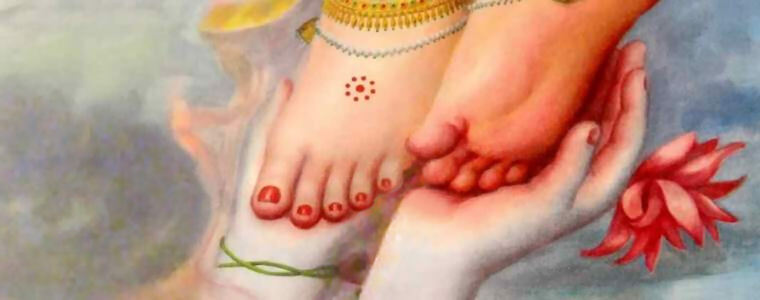
Working through what would become one of the Gita Govinda's most intimate passages, Jayadeva reached a verse in which Krishna, having wandered among the other gopis and wounded Radha, returns to beg Her forgiveness. The line Jayadeva wanted to write had Krishna ask Radha to place Her foot on His head — dehi pada-pallavam udaram, "give me the tender blossom of Your foot." He hesitated. To show the Supreme Personality of Godhead bowing before a gopi's foot felt, even to its own author, like it might diminish Krishna's position. Rather than force the line, Jayadeva set his palm leaf aside and left for his daily bath in the Ganges, planning to return to it, if at all, with a clearer mind.
Krishna Writes His Own Line #
According to the account preserved on gaudiyahistory.iskcondesiretree.com, Krishna did not wait for Jayadeva to decide. He appeared in the form of Jayadeva himself, sat down at the unfinished page, and wrote the line exactly as it stands today — in, tradition says, a hand indistinguishable from the poet's own. Before leaving, He also accepted prasadam that Padmavati served Him, believing without any reason to doubt it that her husband had simply come back early from his bath.
Padmavati Notices, Jayadeva Understands #
When the real Jayadeva returned home, he found the verse already completed — finished, moreover, in a way that read as though he himself had written it, though he knew he had not. His astonishment turned to understanding only when Padmavati mentioned, in passing, that he had already eaten. Realizing what had happened, Jayadeva is remembered as crying out in spiritual joy: Krishna Himself, he told her, had written this line and had taken prasadam from her hand. What might otherwise be treated as an unremarkable domestic detail — a wife serving her husband a meal — becomes, in this telling, the moment the miracle is confirmed, and Padmavati's small, matter-of-fact remark is what gives the whole story away.
A Verse Vaishnavas Take Seriously #
This story is not treated by Gaudiya Vaishnavas as a charming legend layered over an ordinary poem. Srila Prabhupada, in a 1977 conversation in Bhubaneswar with a film producer who wanted to adapt Krishna's pastimes for the screen, brought up this very verse unprompted, calling it "very confidential" — Krishna, he explained, is shown begging pardon at Radharani's feet, a depth of humility that outsiders easily mistake for ordinary romance between a man and a woman, when in fact it expresses the Lord's own theology of surrender to His devotee's love. Sri Chaitanya-charitamrita treats the poem's other intimate verses with the same seriousness: one verse from this same canto, in which Radha remembers Krishna's playfulness during the rasa dance, is quoted and explained in Antya-lila as a verse actually sung, in ecstasy, by Radharani Herself — which is to say that Sri Chaitanya Mahaprabhu and His associates read Jayadeva's poetry not as clever literature about Radha and Krishna, but as Radha and Krishna's own words.
How the Story Is Understood #
Read one way, the story simply explains why the verse sounds so right — so exactly like something Krishna would actually say — that Jayadeva himself could hardly believe he had written it. Read more carefully, it makes a doctrinal point Gaudiya Vaishnavism returns to constantly: that a devotee's hesitation to glorify Krishna's devotees, even when it seems to place the Lord in an apparently lower position, can itself be a kind of error, because in pure love there is no question of higher or lower position at all. Jayadeva's doubt was sincere and reverent, not casual, and the tradition's response is not to mock that doubt but to show Krishna Himself settling it, gently, without a word of reproach — by simply writing the line and having a meal at Padmavati's hand as if nothing unusual had happened. What this poem, and this way of reading it, meant to Sri Chaitanya Mahaprabhu Himself is a story that unfolds two full centuries after Jayadeva's own lifetime.