Near the close of Chaitanya-charitamrita, in its very last chapter, Krishnadasa sets down an account of his own physical condition that reads less like literary flourish than a plain medical report. "I am old and troubled by invalidity," he writes. "I am almost blind and deaf, my hands tremble, and my mind and intelligence are unsteady." A few verses later he goes further still, describing himself as afflicted by five kinds of disease at once, unable to properly walk or sit, and liable, he says, to die "at any time of the day or night."
Continuing Regardless #
What makes these lines remarkable is where Krishnadasa places them: not as an excuse to stop, but as a preface to explaining why he kept going. He tells his readers directly that he has "previously given an account of my inabilities" and asks them to hear, now, the reason he nevertheless continued to write. That reason was the order he understood himself to have received from Sri Madana-mohana - an order he says he could not, in good conscience, leave unmentioned, whatever it cost him in humility to disclose it.
A Drop From the Ocean #
Krishnadasa's sense of his own smallness was not limited to his body. Earlier in the same closing chapter he compares himself to a small red-beaked bird that drinks from the ocean to quench its thirst, taking in only the tiniest fraction of the water available - "so I have touched," he writes, "only a drop of the ocean of Sri Chaitanya Mahaprabhu's pastimes." A few lines later he goes further still, questioning whether he can even claim to be the book's author at all: "I infer that 'I have written' is a false understanding, for my body is like a wooden doll." Read together, these lines describe an old man who, even while completing the single most detailed biography of Chaitanya Mahaprabhu in existence, refused to credit himself with having written it in any ordinary sense.
Near the Radha-Damodara Temple #
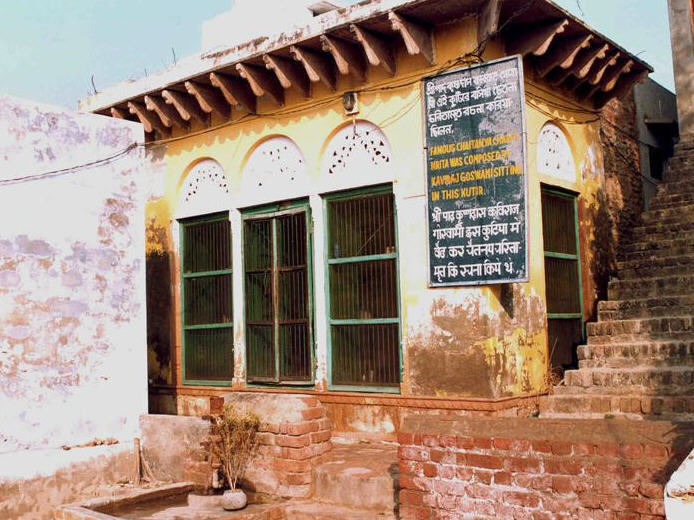
Vaishnava tradition places Krishnadasa's final years at or near the Radha-Damodara temple in Vrindavana, established in honor of Rupa Gosvami's own worshipable Deities. A small kutir associated with Krishnadasa on the temple grounds is still shown to visitors today as the place where Chaitanya-charitamrita was composed. Whatever the precise arrangement of his daily life there, the picture that emerges from his own verses is of a man living out his final years in real physical hardship, sustained materially by very little, and, by his own account, sustained spiritually by the Deities and devotees around him.
Gratitude, Not Complaint #
Even in describing his own afflictions, Krishnadasa does not ask for sympathy. In the same closing chapter, he attributes whatever he managed to write not to any capacity of his own but to "the mercy of the lotus feet of Sri Govindadeva, Sri Chaitanya Mahaprabhu, Lord Nityananda, Advaita Acharya, other devotees and the readers of this book" - and, by name, Svarupa Damodara Gosvami, Rupa Gosvami, Sanatana Gosvami, his own guru Raghunatha Dasa Goswami, and Jiva Gosvami. It is a strikingly long list of credit from a man who elsewhere in the very same book calls himself lower than a worm in stool - and it is consistent, from beginning to end, with how little claim Krishnadasa ever made for himself.