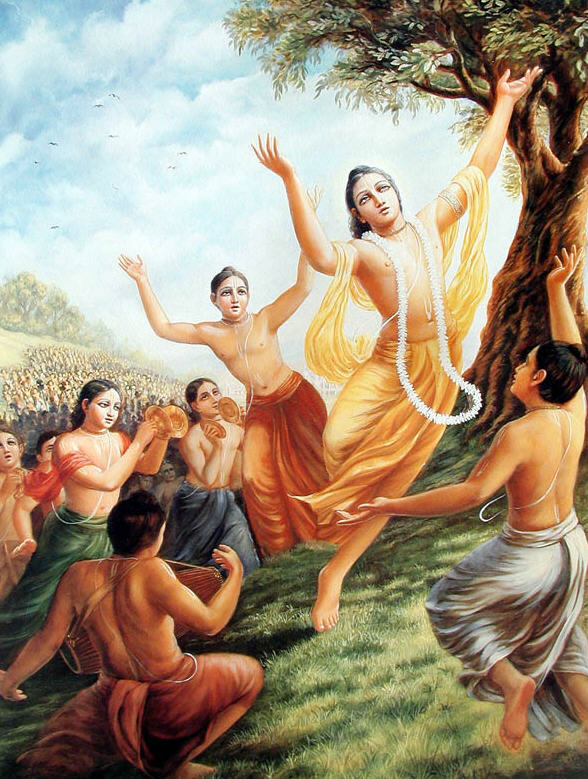
Alongside Sri Chaitanya-mangala, Lochana Dasa Thakura composed a substantial body of independent devotional songs, or padavali, in Bengali. By his own admission, this songwriting arose partly out of a scruple about his own great book: because Sri Chaitanya-mangala concentrates its praise on his guru Narahari Sarkara Thakura's closeness to Chaitanya Mahaprabhu and does not dwell at equal length on Nityananda Prabhu's glories, Lochana Dasa Thakura worried this might read as neglect, and so wrote a set of songs specifically glorifying Nityananda Prabhu to make up the balance. Two of these, Nitai Gunamani ("Nitai is the jewel of virtue") and Akrodha Paramananda ("Free from anger, the embodiment of supreme joy"), describe Nityananda Prabhu wandering from door to door distributing the holy names to the fallen without regard for who deserved it, and both remain in active kirtana use among Gaudiya Vaishnavas today.
| Detail | Description |
|---|---|
| Best-known songs | Parama Karuna, Nitai Gunamani, Akrodha Paramananda |
| Subjects | Chaitanya Mahaprabhu, Nityananda Prabhu, Gauridasa Pandit |
| Other credited works | Prarthana, Durlabha-sara, Dhamali |
| Translations attributed to him | Ramananda Raya's Jagannatha-vallabha-nataka; the Rasa-panchadhyaya, in Bengali verse |
| On this site | 12 songs catalogued under Locana Dasa Thakura in the /songs/ collection |
Parama Karuna and Srila Prabhupada's Purport #
Of all Lochana Dasa Thakura's songs, Parama Karuna, Pahu Dui Jana ("Supremely merciful are these two Lords, Nitai and Gauracandra") appears to have held a special place for Srila Prabhupada. In a recorded talk given in Los Angeles on 4 January 1969, Prabhupada sang the song in full and then went through it line by line, introducing it simply: "This is a song by Locana dasa Thakura, a great devotee and acharya of the Gaudiya-sampradaya." He explained each line in turn — that Nitai and Gauracandra are the most merciful of all incarnations because they distribute love of God through the simple, joyful process of chanting and dancing rather than through demanding philosophical study, and that the song's final verses have Lochana Dasa Thakura turning the lens on himself, confessing his own entanglement in sense gratification and his fear of Yamaraja's punishment for failing to take shelter of Nitai-Gauracandra's mercy. Prabhupada's decision to devote an entire recorded class to a single six-verse Bengali song is itself a measure of how highly he regarded Lochana Dasa Thakura's devotional poetry.
A Teaching on Raganuga Bhakti #
Beyond songs of simple glorification, at least one of Lochana Dasa Thakura's compositions carries a specific teaching point: that a raganuga bhakta, a devotee following the spontaneous devotional moods of Vraja rather than the regulated path of vaidhi-bhakti, should take shelter of Gadadhara Pandit — addressed in this song by the epithet Vrindavanishvari, queen of Vrindavana — in order to attain prema-bhakti for Radha and Govinda. Placed alongside his songs of praise for Chaitanya Mahaprabhu, Nityananda Prabhu, and Gauridasa Pandit, this shows Lochana Dasa Thakura's padavali were not only devotional in tone but occasionally doctrinal in content, quietly transmitting points of Gaudiya Vaishnava theology in singable verse rather than in prose argument.
His Songs on This Site #
This website's own collection of Gaudiya Vaishnava devotional songs carries a dozen compositions catalogued under the name Locana Dasa Thakura, including Nitai Guna Mani, Bhaja Bhaja Hari, Akrodha Paramananda, and Parama Karuna Pahu Dui Jana among others — the very songs described above, still preserved and sung in Gaudiya Vaishnava kirtana five centuries after they were written. Visitors curious to read or hear these compositions in full can find them in the site's songs section.
Other Writings #
Beyond his devotional songs and Sri Chaitanya-mangala, tradition credits Lochana Dasa Thakura with several other works: Prarthana, a further collection of prayers; Durlabha-sara; and Dhamali, along with Bengali verse translations of Ramananda Raya's Sanskrit drama Jagannatha-vallabha-nataka and of the Rasa-panchadhyaya, the five chapters of Srimad-Bhagavatam describing Krishna's rasa dance. Taken together with Sri Chaitanya-mangala, this body of work places Lochana Dasa Thakura among the more prolific literary figures of the generation that followed Chaitanya Mahaprabhu's own associates — a poet who, in Srila Prabhupada's own estimate, deserves to be counted alongside Narottama Dasa Thakura and Bhaktivinoda Thakura among the great song-composers of the Gaudiya Vaishnava line.