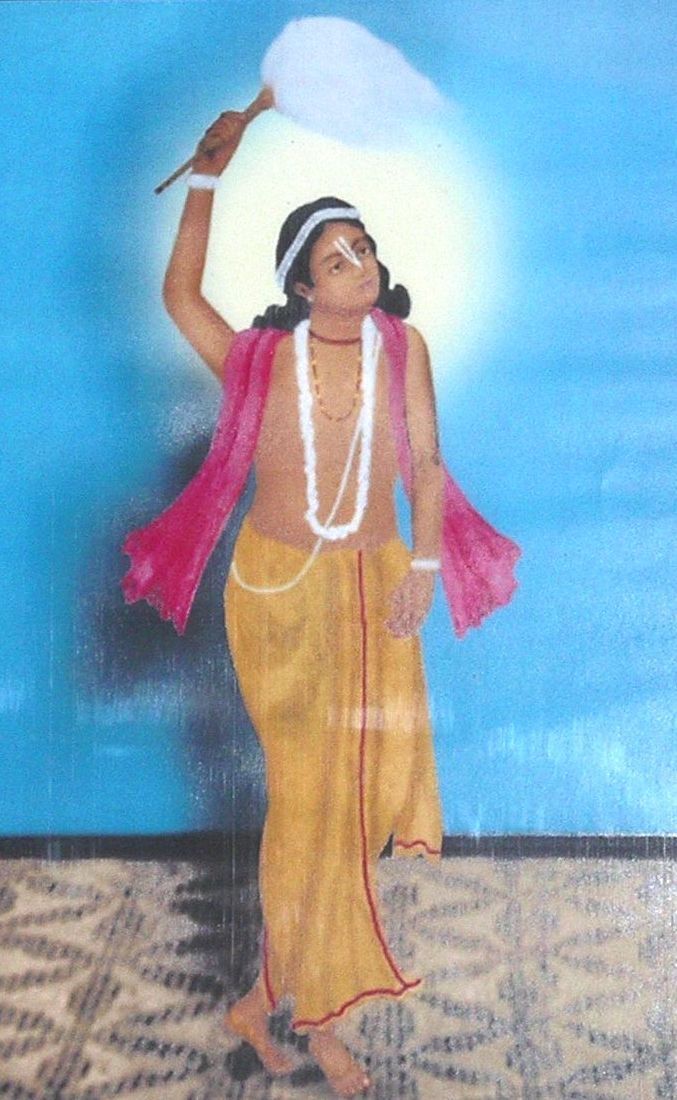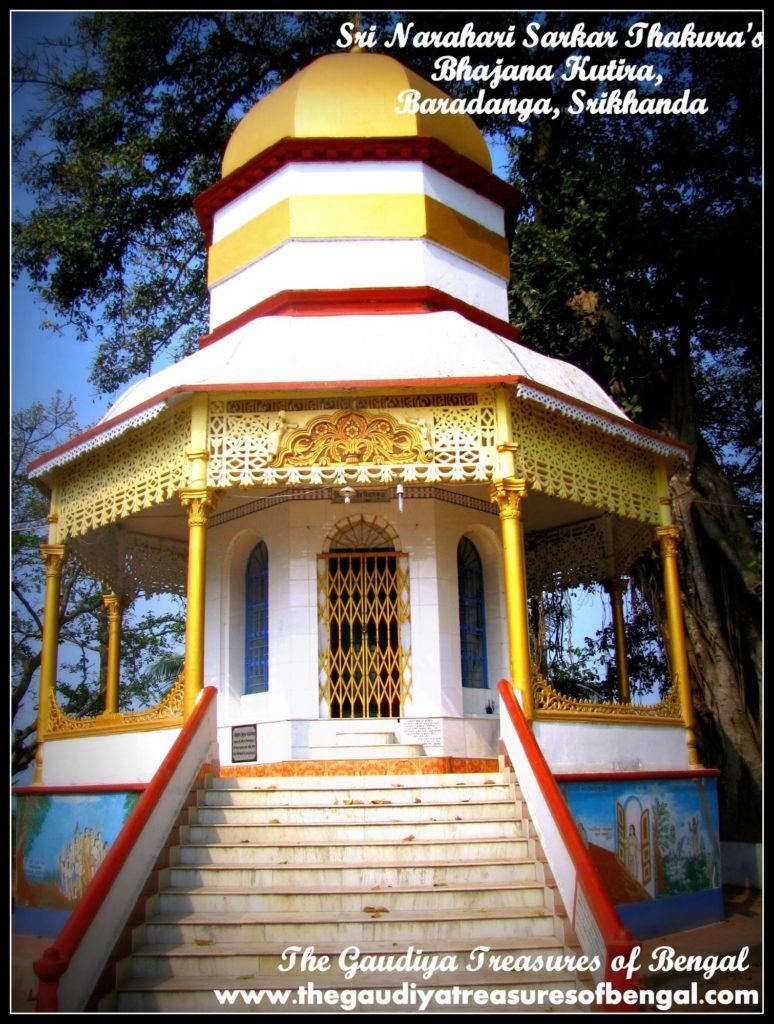
Lochana Dasa Thakura's guru was Narahari Sarkara Thakura, one of the personal associates of Sri Chaitanya Mahaprabhu and among the senior Vaishnavas settled at Srikhanda, a village near Katwa in Bardhaman district. Sri Chaitanya-caritamrita's account of the great branches of Chaitanya Mahaprabhu's tree of mercy names Narahari Sarkara Thakura directly, alongside the Srikhanda householder-devotees Mukunda Dasa and his son Raghunandana Thakura, and Krishnadasa Kaviraja Goswami states there, in his own purport on that passage, that "Locana dasa Thakura, the celebrated author of Sri Chaitanya-mangala, was his disciple." Narahari Sarkara Thakura's own service to Chaitanya Mahaprabhu is traditionally remembered as that of fanning the Lord with a camara, a yak-tail whisk, during kirtana — a small, humble service that set the tone for how he related to his own disciples in turn.
| Detail | Description |
|---|---|
| Guru | Narahari Sarkara Thakura |
| Place of discipleship | Srikhanda, near Katwa |
| Fellow Srikhanda Vaishnavas | Mukunda Dasa, Raghunandana Thakura |
| Textual confirmation | Sri Caitanya-caritamrita, Adi-lila 10.78-79, purport |
Taking Shelter at Srikhanda #
Drawn by his growing attachment to the sankirtana movement described on Birth and Early Life, Lochana Dasa Thakura took up residence at Narahari Sarkara Thakura's ashram in Srikhanda after receiving initiation from him. In his own writing, in the opening invocation of Sri Chaitanya-mangala, he addresses his guru directly and repeatedly: "My lord and master is Narahari Dasa. I prostrate myself in humility to him," he writes in one verse, and in another, "Other than him, I have no friend in the three worlds." These are not passing courtesies; across the Sutra-khanda he returns again and again to his dependence on Narahari's mercy as the one thing that makes his own work possible at all, going so far as to write that he considers himself utterly unfit to attempt such a composition without his guru's grace behind it.
Learning Kirtana, Receiving an Order #
At Srikhanda, Lochana Dasa Thakura learned the art of kirtana directly from his guru, and it was Narahari Sarkara Thakura who eventually instructed him to compose a Bengali account of Chaitanya Mahaprabhu's life and pastimes — an order Lochana Dasa Thakura took seriously enough to spend years fulfilling. Tradition holds that Narahari Sarkara Thakura had long wished for such a book to exist in Bengali specifically so that ordinary people, not just Sanskrit scholars, could enter into the esoteric sweetness of Chaitanya Mahaprabhu's pastimes, and that Lochana Dasa Thakura's whole life's purpose, from this point on, was to fulfill that wish. The resulting work, Sri Chaitanya-mangala, and how he went about writing it, is described in full on Writing Sri Chaitanya-mangala.
A Wider Circle of Srikhanda Vaishnavas #
Narahari Sarkara Thakura was not the only notable devotee at Srikhanda. Sri Chaitanya-caritamrita's list of great branches also names Mukunda Dasa, identified in the Gaura-ganoddesha-dipika as an incarnation of the gopi Vrindadevi, and his son Raghunandana Thakura, who is remembered for his personal Deity worship of Chaitanya Mahaprabhu; a further Srikhanda resident named in the same passage, Chiranjiva, had two sons, one of whom, Govinda Dasa Kaviraja, became a celebrated Vaishnava poet in his own right. It is worth noting, since the names are easily confused, that this same Chaitanya-caritamrita passage also names a separate devotee called Sulocana as a distinct branch of the tree — a different person from Lochana Dasa Thakura, whom Krishnadasa Kaviraja Goswami identifies by name only a little further on, as Narahari Sarkara Thakura's disciple and the author of Sri Chaitanya-mangala. Growing up in this densely devotional village, surrounded by householder Vaishnavas of real literary and devotional stature, evidently shaped the seriousness with which Lochana Dasa Thakura himself later approached both kirtana and composition.
Present at His Guru's Final Festival #
According to the Bhakti-ratnakara, Lochana Dasa Thakura was present at Narahari Sarkara Thakura's own disappearance festival, where he took on the humble task of greeting the assembled guests and distributing sandalwood paste and garlands to them — a detail that, small as it is, places him at his guru's side through to the very end of Narahari Sarkara Thakura's own life on earth. Narahari Sarkara Thakura also left behind his own devotional writings, including the Bhakti-chandrika-patala and Sri Krishna-bhajanamrita, and Lochana Dasa Thakura's own reverence for him remained undimmed throughout his life: in Sri Chaitanya-mangala he confesses that his highest hope, greater even than fame for his own composition, is simply to remain at Narahari's lotus feet and continue serving him. That devotion to a single guru, expressed so plainly in his own verse, is one reason later Gaudiya Vaishnava tradition remembers Lochana Dasa Thakura as much for the manner of his discipleship as for the scale of his literary output.