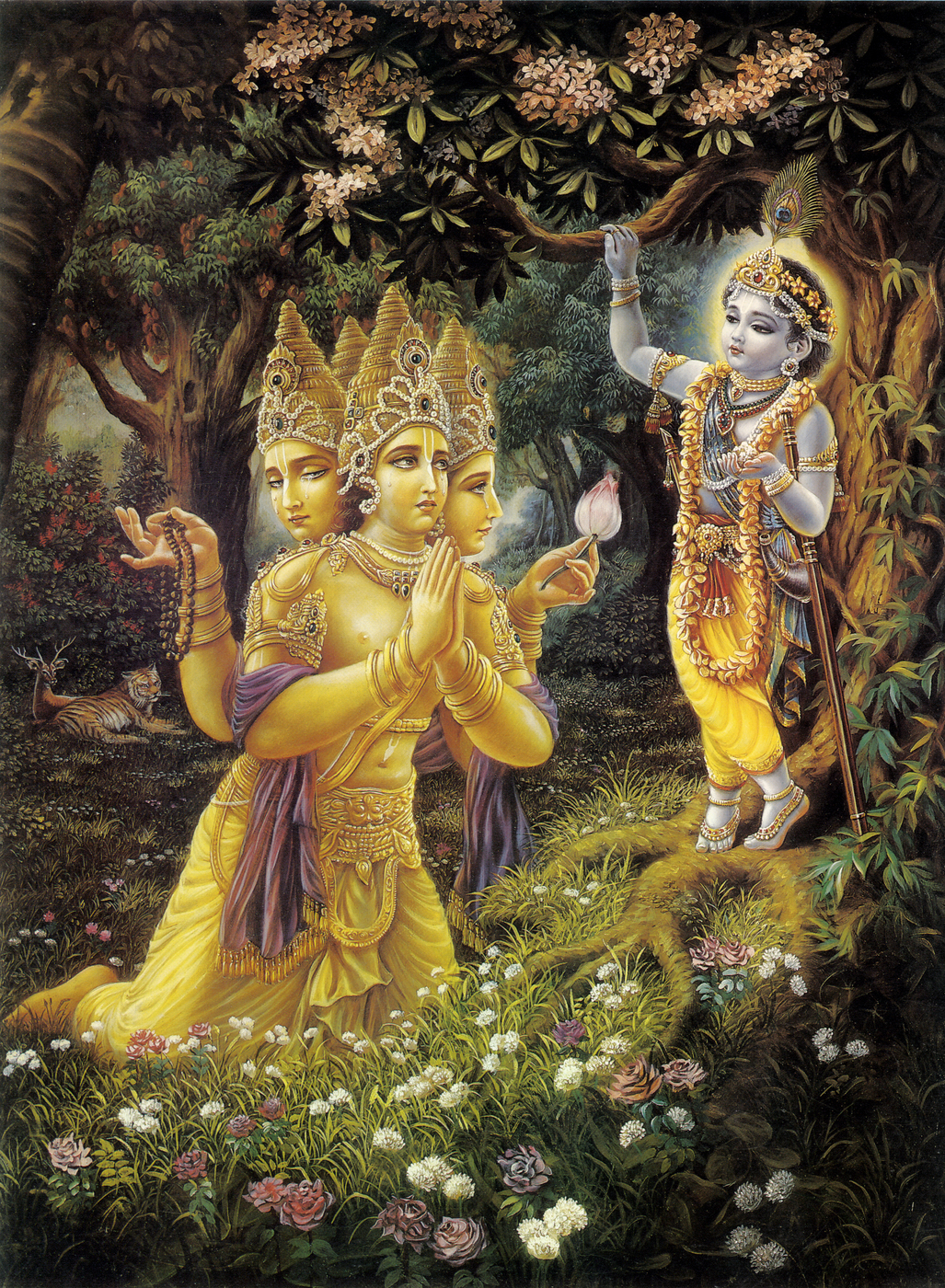
Brahma had received the catur-shloki directly from the Lord, and he stood at the head of the disciplic succession bearing his name. Even so, he still needed to be taught a further lesson. Krishna taught it to him personally, as a small boy in Vrindavana. Gaudiya Vaishnavas call this episode Brahma-vimohana-lila, "the bewilderment of Brahma," and it occupies all of Srimad-Bhagavatam's Canto 10, Chapters 13 and 14.
A Test of the Supreme Lord #
One day, Krishna and His cowherd friends were out grazing their calves in the forest. Brahma wanted to test for himself whether this cowherd boy was truly the Supreme Personality of Godhead he had heard described. So he used his mystic power to steal away every single boy and every calf, and hid them out of sight. It was, on Brahma's part, an act of doubt dressed up as an experiment. The very being entrusted with secondary creation was testing the Lord he owed his own existence to.
Krishna's Answer #
Krishna's response was not to search, argue, or expose what had happened. He simply expanded Himself into exact replicas of every missing boy and every missing calf. They were identical in every feature, indistinguishable to anyone in Vrindavana, and he led them home as though nothing at all were wrong. By the reckoning of the residents of Vrindavana, these Krishna-expansions lived as everyone's own sons and calves for a full year. They did this so completely that the cows and mothers are said to have loved them with even greater intensity than before. None of them knew that the Supreme Lord Himself stood directly in the place of their own children.
On his own vastly different scale of time, Brahma's return felt like scarcely a moment. He expected to find Vrindavana in an uproar. He found nothing of the kind. Bewildered further by this, he looked again with his own mystic vision, and saw that every one of the boys and calves he thought he had hidden had become a four-armed form of Vishnu, surrounded by demigods offering worship. Only then did Krishna withdraw the illusion. Krishna restored the original boys and calves, who had been sleeping under Brahma's spell the entire time, exactly as they had been, with no time lost to them at all.
| Detail | Description |
|---|---|
| Setting | Vrindavana, during Krishna's childhood pastimes |
| Scriptural source | Srimad-Bhagavatam, Canto 10, Chapters 13-14 |
| What Brahma stole | The cowherd boys and calves grazing with Krishna |
| Krishna's response | Expanded Himself into identical replicas of each one |
| Outcome | Brahma's test failed completely; he fell at Krishna's feet in prayer |
Brahma's Prayers #
Brahma understood that he had been thoroughly defeated in the very test he had devised. He fell at Krishna's feet and offered an extended sequence of prayers, recorded in Srimad-Bhagavatam 10.14. Vaishnava commentators consider these prayers among the most theologically dense passages in the entire text. Their substance is a confession. Even a soul as elevated as himself, first-born, adi-guru, direct recipient of the catur-shloki, cannot fathom the Supreme Lord's glories by any effort of his own. He can know the Lord at all only by receiving a trace of His causeless mercy. "If one is favored by even a slight trace of the mercy of Your lotus feet," Brahma says at Srimad-Bhagavatam 10.14.29, "he can understand the greatness of Your personality. But those who speculate... are unable to know You, even though they continue to study the Vedas for many years." At verse 10.14.8 he goes further still. He describes the devotee who simply endures the reactions of his own past deeds while offering obeisances with heart, words, and body. Such a devotee is like someone who has earned an inheritance he did not have to demand.
Why This Episode Matters #
The theological weight of this pastime falls on exactly the tension it sets up. Brahma received Krishna's own summary of Vedic philosophy at the dawn of creation, and he is honoured throughout this parampara as its first teacher. Yet this same pastime shows him to be limited, capable of doubt, and in need of correction directly from the Lord, in His most intimate, human-like form. Gaudiya Vaishnava theology takes this as evidence that the personal, playful Krishna of Vrindavana is the most complete revelation of Godhead available to any soul, more complete even than Brahma's own prior vision of the Lord's majesty in Vaikuntha. Brahma's own hymn of praise to Krishna, the Brahma-samhita, is traditionally said to have been spoken at the dawn of creation, before any of the events described here. It is the subject of The Brahma-Samhita and Its Rediscovery.