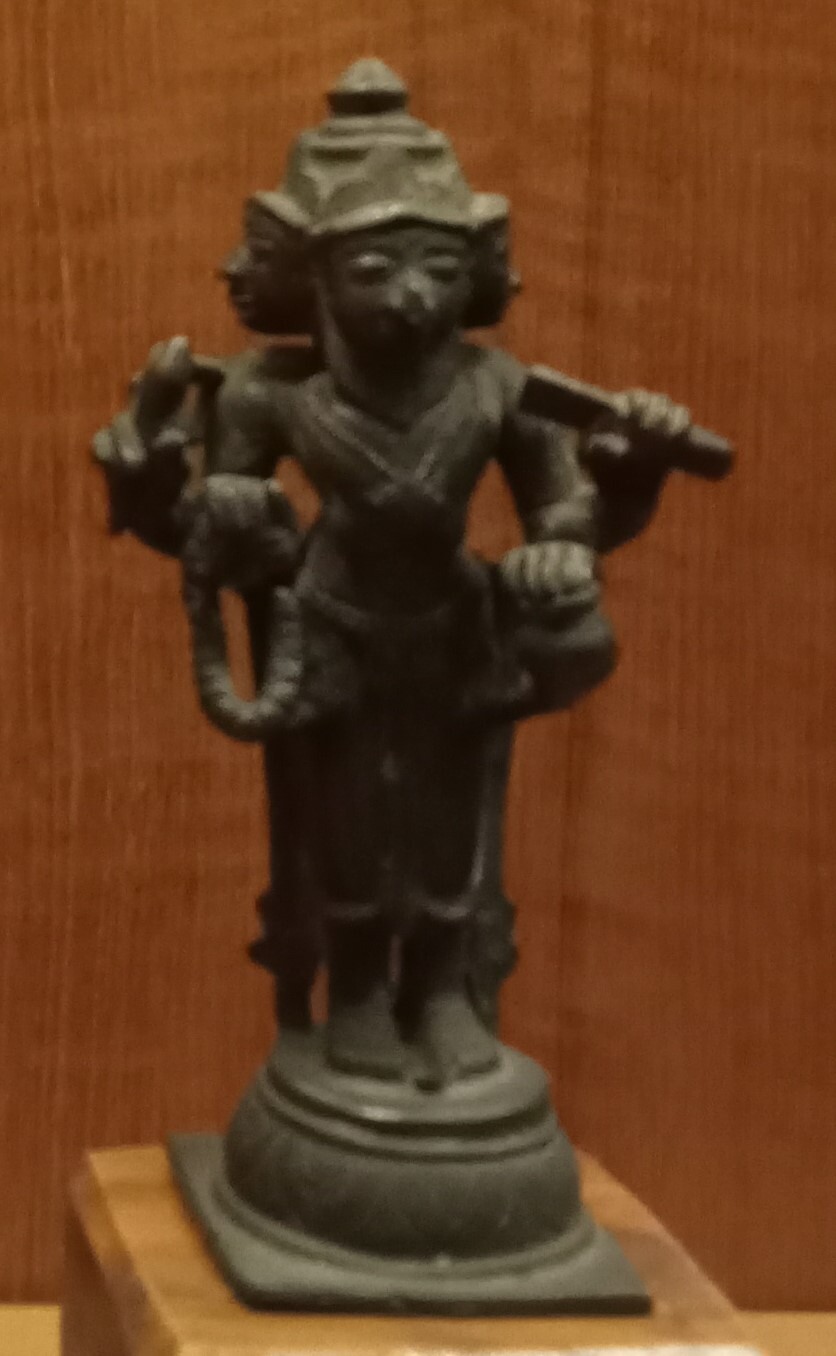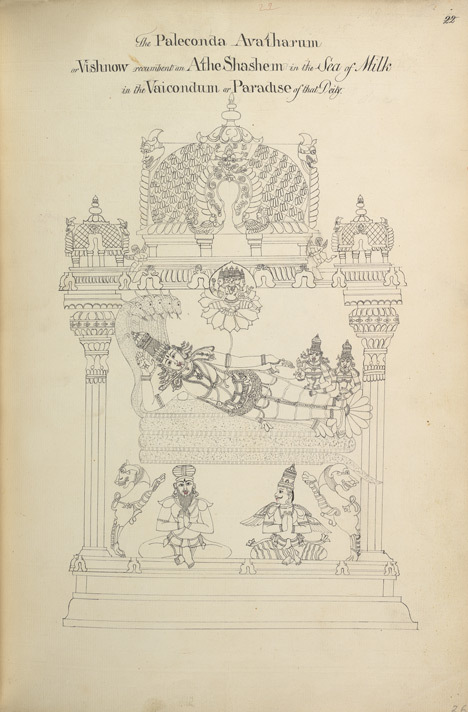
Of everything traditionally attributed to Brahma, nothing is quoted by Gaudiya Vaishnavas more often than a short Sanskrit text called the Brahma-samhita. Almost the only reason anyone can quote it today is that Sri Chaitanya Mahaprabhu discovered a single manuscript of it on the southern coast of India.
A Hymn Spoken at the Dawn of Creation #
The Brahma-samhita is traditionally described as a hymn of prayer that Brahma himself spoke in glorification of Krishna. Later tradition says it ran to as many as one hundred chapters, of which only the fifth, sixty-two verses, is known to survive. Its opening line is the single verse most identified with the entire text, translated simply: "Krishna who is known as Govinda is the Supreme Godhead. He has an eternal, blissful, spiritual body. He is the origin of all. He has no other origin, and He is the prime cause of all causes." The verse comes from Brahma, the being entrusted with secondary creation, who might in a lesser theology have claimed some ultimate status for himself. Instead, it is a deliberate act of humility: it names Krishna, not Brahma or even Vishnu's other forms, as the cause of all causes.
| Detail | Description |
|---|---|
| Attributed author | Brahma, at the dawn of creation |
| Surviving portion | Chapter five, sixty-two verses (of a text tradition says once ran far longer) |
| Most quoted verse | Chapter 5, verse 1: ishvarah paramah krishnah |
| Rediscovered by | Sri Chaitanya Mahaprabhu, during His South India tour, c. 1510 CE |
| First English translation | Bhaktisiddhanta Sarasvati Thakura, 1932, with Jiva Goswami's commentary |
Found on the Far Southern Coast #
For centuries the text existed, at most, as scattered fragments and a title devotees had heard of but could not read. That changed during Sri Chaitanya Mahaprabhu's South India tour, when He came to the temple of Adi-keshava on the banks of the Payasvini river. Later tradition and modern scholarship both identify this site with the Adi Keshava Perumal Temple at Thiruvattar, near Kanyakumari, at the very southern tip of India. Among a gathering of advanced devotees discussing spiritual subjects there, Mahaprabhu found a manuscript chapter of the Brahma-samhita, a text by then effectively lost. Krishnadasa Kaviraja Goswami recorded his own judgement of what was found in Chaitanya-charitamrita, examined further on Sri Chaitanya Mahaprabhu's South India Tour, and it is unqualified. He calls it essential among all Vaishnava literatures, with no scripture equal to it on the final philosophical conclusion. Mahaprabhu had the chapter copied by hand and carried it back to Bengal and Odisha. There it became one of two manuscripts that the tour's own biographer calls the two jewels He brought home, the other being Bilvamangala Thakura's Krishna-karnamrita.
From Manuscript to Modern Kirtana #
For nearly four centuries after that, the text remained known mainly within Gaudiya circles who had access to hand-copied manuscripts. Bhaktisiddhanta Sarasvati Thakura changed that in 1932, publishing the first English translation of the surviving fifth chapter together with Srila Jiva Goswami's Sanskrit commentary, a work still in print and still the standard English edition today. Its verses are now sung as part of daily temple worship across the Gaudiya Vaishnava world. They reached an unexpected wider audience in 1970, when George Harrison produced a modern recording of the prayer titled "Govinda," sung by a disciple of Srila Prabhupada. Its title comes from the same chorus line, "govindam adi-purusham tam aham bhajami," that opens so many of the text's individual verses.
An Honest Note on Dating #
Real difficulties deserve honest treatment rather than being talked away, and there is one worth stating plainly here. Gaudiya Vaishnava tradition holds that Brahma spoke these verses at the very beginning of the universe, and that Sri Chaitanya Mahaprabhu simply rediscovered, rather than helped compose, a text already many ages old. Some modern academic scholarship of Pancharatra literature sits in real tension with that traditional dating: Mitsunori Matsubara's study of the genre places the surviving text's composition at around 1600 CE, closer to the century after Mahaprabhu's own discovery than to the dawn of creation. That gap is reported here rather than resolved. A scholar working from manuscript and literary-history evidence, and a devotional tradition working from an unbroken chain of received teaching, are simply asking different questions and reaching different answers. Adjudicating between them is not the purpose here.