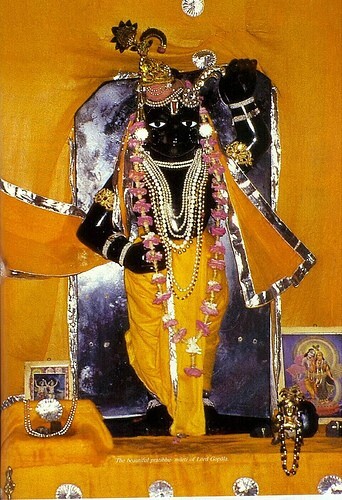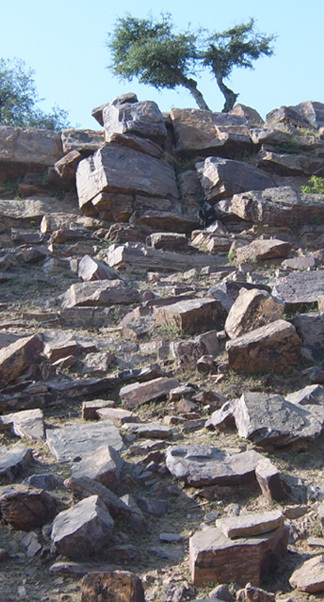
After years of wandering, Madhavendra Puri arrived at Govardhana Hill in Vrindavana, and it was here, according to Chaitanya-charitamrita, that Krishna Himself began arranging one of the tradition's most beloved Deity stories. Madhavendra Puri circumambulated the hill in near-constant ecstasy, "almost mad in his ecstasy of love of Godhead," unable to tell whether it was day or night, sometimes standing, sometimes collapsing to the ground. After bathing at Govinda-kunda he sat beneath a tree to rest for the evening.
Milk From an Unknown Boy #
An unfamiliar cowherd boy approached him with a pot of milk and asked, smiling, why Madhavendra Puri had not eaten and what kind of meditation he was performing. When Madhavendra Puri asked who he was, the boy answered simply that he was a village cowherd, and that in his village nobody went hungry: the women who had seen Madhavendra Puri at the water had sent Him with milk. After drinking it, Madhavendra Puri found the boy had vanished without returning for the pot as promised. He sat awake most of the night chanting, and only near dawn did he doze off, at which point the same boy returned, this time in a dream.
Gopala's Own Request #
In the dream, the boy led Madhavendra Puri to a bush deep in the jungle and identified Himself: "My name is Gopala. I am the lifter of Govardhana Hill. I was installed by Vajra, and here I am the authority" (Madhya 4.41). He explained that His priest had hidden Him in the thicket during an attack and then fled, leaving Him exposed to cold, rain and heat for years, and that He had been waiting specifically for Madhavendra Puri to come and serve Him. Waking in tears, lamenting that he had seen Krishna face to face without recognizing Him, Madhavendra Puri gathered the villagers at dawn, had them cut a path into the dense jungle with choppers and spades, and found the Deity exactly as described, covered in dirt and undergrowth.
An Installation Vrindavana Still Remembers #
What followed was less a quiet re-installation than a full public festival. Villagers carried the heavy Deity to the hilltop, where He was seated on a stone throne. Nine hundred pots of water were brought from Govinda-kunda for the bathing ceremony; the Deity was massaged with oil, bathed in stages with panca-gavya and panchamrita, dressed in new garments, and garlanded with tulasi and flowers. Every family in the surrounding villages contributed food, and the entire hilltop was reportedly covered with stacks of rice, dal, chapatis, and sweets, an offering so large that Chaitanya-charitamrita records a small miracle in passing: "Although Sri Gopala ate everything offered, still, by the touch of His transcendental hand, everything remained as before" (Madhya 4.77). This became the first annakuta, or Govardhana Puja, festival at the site, an event still celebrated by Vaishnavas worldwide, and news of Gopala's appearance drew crowds from village after village for days afterward. Madhavendra Puri initiated many of the local brahmanas into Vaishnava worship on the spot and eventually entrusted the Deity's daily service to two renounced brahmanas who had arrived from Bengal, an arrangement of organized temple worship at Govardhana that Rupa Goswami and Sanatana Goswami would substantially build on when they themselves settled and began restoring Vrindavana not long afterward.
Sandalwood, and a Second Journey #
After two years of worship, Gopala appeared to Madhavendra Puri in another dream. His body, buried so long in the earth, was still overheated; He asked for sandalwood pulp from the Malaya hills, obtainable through Jagannatha Purl, to cool Him (Madhya 4.106). Despite his age, Madhavendra Puri immediately set out east on foot to fulfil the order, a journey that carried him first to Advaita Acharya's home in Shantipura, discussed on Life in the Madhva Sampradaya, and from there into one of the most famous pastimes connected with his name, told on The Kshira Chora Gopinatha of Remuna.
A Deity, and a Disputed History #
What eventually happened to this same Gopala Deity is, honestly, a matter of real dispute between two living Vaishnava traditions. The Gaudiya account, recorded in Chaitanya-charitamrita and repeated by Srila Prabhupada in numerous lectures and conversations, holds that Gopala continued to be worshiped at Govardhana in the Gaudiya line Madhavendra Puri founded, was later moved for safety during renewed unrest, and is today worshiped as Srinathji at Nathadvara in Rajasthan. Prabhupada stated on more than one occasion that an Indian court had formally ruled the Deity's origin to belong to Gaudiya Vaishnavism. The Pushtimarga tradition founded by Vallabhacharya tells a substantially different story, in which Vallabhacharya himself, or his son Vitthalanatha, personally discovered and began worshiping Srinathji, with no role for Madhavendra Puri at all; some Pushtimarga texts instead describe Madhavendra Puri as a later teacher of Vallabha, a claim modern historians such as Alan Entwistle consider chronologically improbable given the two men's likely lifespans. This project has not tried to settle which tradition's account is historically correct; both are reported here because both are genuinely, and sincerely, held.