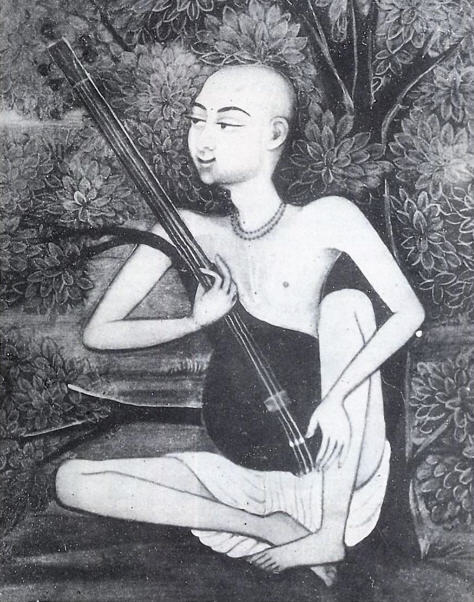
Srila Madhavendra Puri
Root of the Gaudiya Bhakti Creeper
Also known as Madhvendra Puri, Sri Madhava Puri, Madhava Puri, Madhavendra Puri Gosvami
“O My Lord! O most merciful master! O master of Mathura! When shall I see You again? Because of My not seeing You, My agitated heart has become unsteady. O most beloved one, what shall I do now?”
Composed by Madhavendra Puri and chanted by him at the end of his life; quoted twice in Sri Chaitanya-charitamrita (Madhya 4.197 and Antya 8.34) and recited often by Sri Chaitanya Mahaprabhu Himself in ecstasy
Srila Madhavendra Puri belongs to a small group of devotees whom Sri Chaitanya-charitamrita credits not merely with holiness but with starting something. Krishnadasa Kaviraja Goswami calls him the point where the seed of love of Godhead first cracked open in the modern age, a seed that later grew, through his own disciple's disciple, into Sri Chaitanya Mahaprabhu Himself. Madhavendra Puri was formally a sannyasi of the Madhva (Tattvavadi) order, but his personal devotion ran so far ahead of that order's ritual framework that Gaudiya Vaishnavas remember him less as a Madhva monk than as the fountainhead of their own distinctive mood of loving, often grief-stricken, separation from Krishna, called vipralambha-bhakti.
| Detail | Description |
|---|---|
| Also called | Madhvendra Puri, Sri Madhava Puri |
| Sannyasa order | Madhva (Tattvavadi) sampradaya, under Lakshmipati Tirtha |
| Lived | Dates not fixed by tradition; Wikipedia estimates circa 1420-1490 |
| Chief disciples | Isvara Puri and Advaita Acharya |
| Famous for | Discovering the Gopala Deity at Govardhana; the kshira-chora Gopinatha pastime at Remuna |
| Called in Chaitanya-charitamrita | The first sprout of the desire tree of bhakti |
| Samadhi | Remuna, Orissa, beside the Kshira-chora Gopinatha temple |
A Sannyasi Whose Devotion Outgrew His Order #
Tradition places Madhavendra Puri's initiation with an acharya named Lakshmipati Tirtha, in the disciplic line running from Madhvacharya. Srila Prabhupada's purport to Chaitanya-charitamrita states this plainly: of the four sampradayas, Madhavendra Puri accepted the Sri Madhvacharya-sampradaya, and from Madhvacharya down through Lakshmipati there had been, in Prabhupada's words, no real cultivation of devotional service in conjugal love before him. Madhavendra Puri, the purport says, was the one who introduced that mood of madhurya, of loving Krishna the way the gopis of Vrindavana do, into a sampradaya that had until then been mostly ritual and philosophy. Modern historians are more cautious about the sectarian label itself; some argue Madhavendra Puri's own teacher belonged to an Advaita Vedanta monastic order rather than the Madhva line, and that later Gaudiya and Pushtimarga writers each folded him into their own account of the lineage after the fact. Sri Chaitanya-charitamrita simply calls him a sannyasi of the Madhva-sampradaya and moves on to what actually made him remarkable: his behavior.
That behavior is illustrated by a story Chaitanya Mahaprabhu Himself retold with approval. In Mathura, Madhavendra Puri had once accepted a Sanodiya brahmana as his initiated disciple and even eaten a meal cooked in his home, though sannyasis of that community were not normally expected to do so. Years later, when Chaitanya Mahaprabhu met that same brahmana's family and asked to eat there too, He explained why caste custom did not apply: "A devotee's behavior establishes the true purpose of religious principles. The behavior of Madhavendra Puri Gosvami is the essence of such religious principles." It is one of the clearest single statements in the entire text of how highly Chaitanya-charitamrita rates Madhavendra Puri, ranking his personal conduct above formal rules of community and caste. The fuller shape of his life within, and beyond, the Madhva sampradaya is told on Life in the Madhva Sampradaya.
Gopala Found on Govardhana Hill #
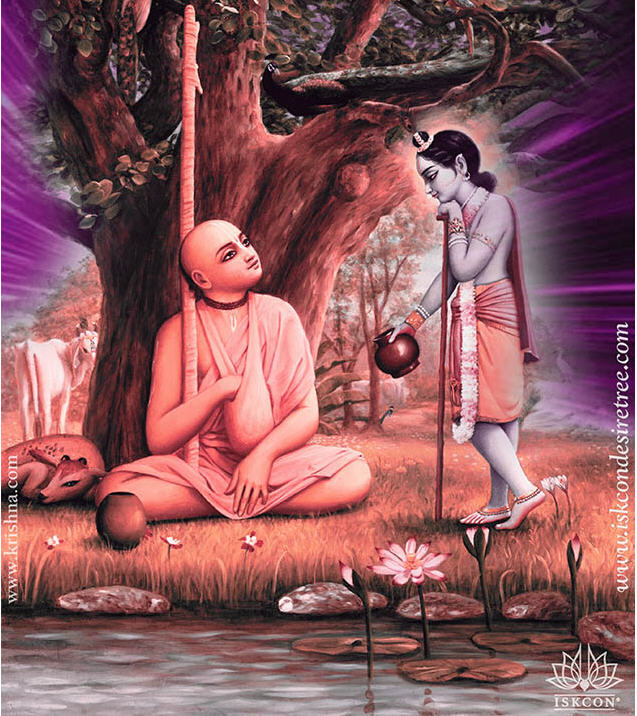
Late in his life, wandering Vrindavana in almost constant ecstasy, Madhavendra Puri circumambulated Govardhana Hill and bathed at Govinda-kunda. There Krishna Himself, as an unnamed cowherd boy, brought him milk and later appeared to him in a dream, revealing that He lay buried in a nearby thicket, having been hidden there by a fleeing priest during a period of unrest, and asking to be uncovered and installed on the hilltop. Madhavendra Puri organized the villagers, recovered the Deity, and held an installation festival so large it grew into the annakuta tradition still observed at Govardhana. He later handed that Deity's care to two Bengali brahmana renunciants he had initiated, in an arrangement of temple worship that Rupa Goswami and Sanatana Goswami would build on when they settled Vrindavana themselves not long after. This whole episode, along with the honest dispute over what later happened to that same Deity, is told in full on Discovering the Gopala Deity at Govardhana.
The Gopinatha Who Stole His Sweet Rice #
Sent by Gopala in a second dream to fetch sandalwood from Jagannatha Puri, Madhavendra Puri passed through the village of Remuna and stopped at the temple of Gopinatha. Learning that the Deity was nightly offered pots of celebrated sweet rice, he caught himself wishing to taste a little of it for himself, judged the wish itself an offense, and left the temple without asking anyone for food at all. That night Gopinatha secretly directed His own priest to carry a hidden pot of the sweet rice out to the old sannyasi, who was sitting hungry and unasked-for in the village marketplace. The Deity has been called Kshira-chora Gopinatha, the sweet-rice thief, ever since. The full pastime, and why Srila Prabhupada returned to it as an example of Krishna's absolute freedom to act as He pleases for His devotee's sake, is told on The Kshira Chora Gopinatha of Remuna.
The Seed of the Bhakti Creeper #
Chaitanya-charitamrita opens its list of Chaitanya Mahaprabhu's associates with a verse of praise reserved for very few names: "All glories to Sri Madhavendra Puri, the storehouse of all devotional service unto Krishna! He is a desire tree of devotional service, and it is in him that the seed of devotional service first fructified." Krishnadasa Kaviraja Goswami then traces that seed forward one generation at a time, sprouting next in Isvara Puri and finally growing into the full tree in the person of Chaitanya Mahaprabhu Himself. Prabhupada's own purport makes the mechanism explicit: Madhavendra Puri was the first in his disciplic line to show real symptoms of love of Godhead, and the first to compose the verse beginning ayi dina-dayardra natha, the same verse he recited again and again at the end of his life, in which, Prabhupada writes, "is the seed of Chaitanya Mahaprabhu's cultivation of love of Godhead." What Madhavendra Puri modeled, and what later Gaudiya acharyas spent centuries unpacking, was not devotion in general but a very specific flavor of it, an aching, tearful longing for Krishna in His absence. The full account of this verse, this mood, and the many places Prabhupada spoke about it at length, is on The Seed of the Bhakti Creeper.
Isvara Puri and the Line to Mahaprabhu #
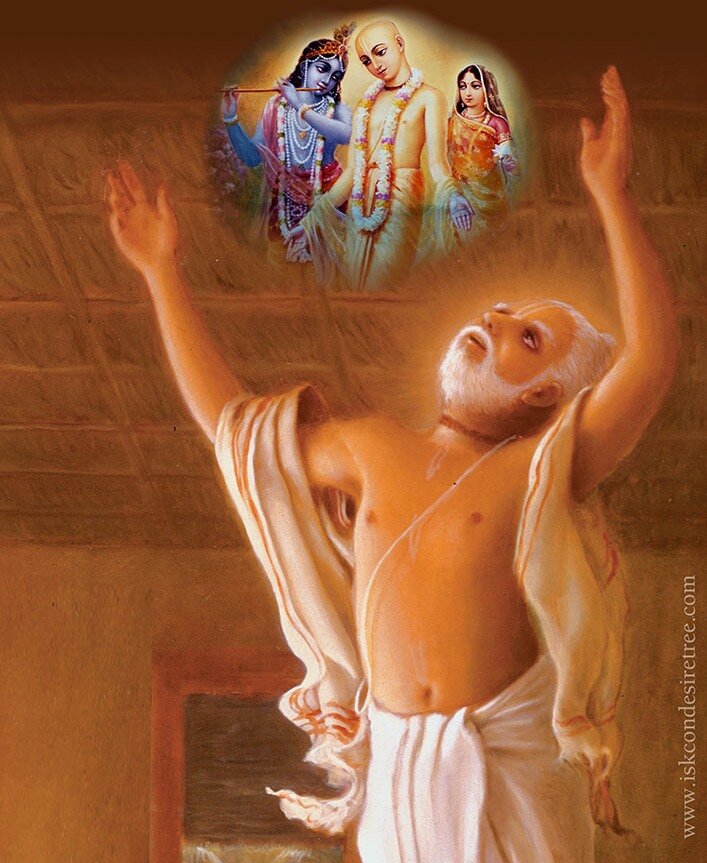
Among Madhavendra Puri's disciples, two stand out for opposite reasons. Isvara Puri served him with total humility through his final illness and was rewarded with a benediction of pure love for Krishna; he went on to become Sri Chaitanya Mahaprabhu's own diksha-guru, so that the seed Madhavendra Puri sowed passed, quite literally, into Mahaprabhu's own initiation. A second disciple, Ramacandra Puri, misunderstood his teacher's tears of separation as ordinary lamentation, tried to correct him, and was sharply rebuked instead. Chaitanya-charitamrita treats the two men as a single teaching aid: one shows what a great soul's mercy looks like, the other what his correction looks like. The fuller account of Isvara Puri's place in this lineage, and of Madhavendra Puri's other disciples, is on Isvara Puri and His Disciples.
Final Days and a Lasting Legacy #
Chaitanya-charitamrita does not give an exact date for Madhavendra Puri's disappearance; Wikipedia's modern estimate of roughly 1490 is itself built on inference rather than a recorded year. What the text does preserve, in some detail, is the manner of his passing: cared for by Isvara Puri, chanting his own verse of separation until the end. Tradition keeps his samadhi at Remuna, by the very Gopinatha temple where the sweet rice was stolen for him. Sri Chaitanya Mahaprabhu spoke of him with open reverence throughout His own pastimes, and Srila Prabhupada, centuries later, kept returning to Madhavendra Puri's example in lecture after lecture as the clearest available picture of what pure, spontaneous love of Krishna actually looks like. His final years, and how the tradition has honored him since, are told on Final Days and Disappearance.
Further Reading #
This site's blog also carries a short devotional piece on him — Sri Madhvendra Puri.
Scriptural evidence
mādhava-īśvara-purī, śacī, jagannātha
advaita ācārya prakaṭa hailā sei sātha
Word for word
mādhava — Mādhavendra Purī; īśvara-purī — Īśvara Purī; śacī — Śacīmātā; jagannātha — Jagannātha Miśra; advaita ācārya — Advaita Ācārya; prakaṭa — manifested; hailā — were; sei sātha — together with this
"Madhavendra Puri, Isvara Puri, Srimati Sacimata and Srila Jagannatha Misra all appeared with Sri Advaita Acharya."
Chaitanya-charitamrita lists Madhavendra Puri among the small handful of eternal associates who appeared on earth specifically to prepare the way for Sri Chaitanya Mahaprabhu's own descent.
What Srila Prabhupada said
"Madhavendra Puri installed a Deity. Now, for months, years together, only festival was going on."
Room Conversation with Malcolm — Conversation, 1973-07-18, London
- Sri Chaitanya-charitamrita, Madhya-lila Chapter 4 (Sri Madhavendra Puri's Devotional Service)
- Sri Chaitanya-charitamrita, Antya-lila Chapter 8 (Ramacandra Puri Criticizes the Lord)
- Sri Chaitanya-charitamrita, Adi 9.10-11, purport
- Madhavendra Puri - Gaudiya History (ISKCON Desire Tree)
- Madhavendra Puri - Wikipedia
- Madhavendra Puri - Stephen Knapp
- Srimad-Bhagavatam 4.14.14, lecture transcript, Delhi, November 16 1971
Disciples
Sri Advaita Acharya
The Devotee Whose Prayers Called the Lord Down
1434, Magha Sukla Saptami – after 1534
5 pastime pages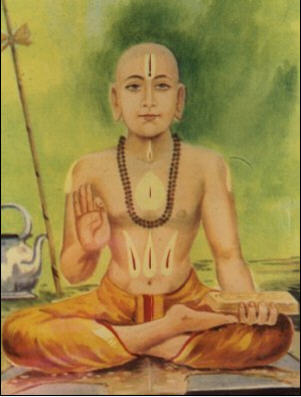
Srila Ishvara Puri
Diksha-Guru of Sri Chaitanya Mahaprabhu
Full moon day of the month of Jyestha (exact year not recorded) – Exact date not recorded — he passed away between Sri Chaitanya Mahaprabhu's initiation at Gaya (c. 1509-1510) and the Lord's arrival at Jagannatha Puri after taking sannyasa
5 pastime pagesFrequently asked
When was Srila Madhavendra Puri born?
Srila Madhavendra Puri appeared Not precisely recorded by tradition; Wikipedia estimates circa 1420 in Not recorded in the sources found for this project.
When and where did Srila Madhavendra Puri disappear?
Srila Madhavendra Puri disappeared Not precisely dated in Sri Chaitanya-charitamrita itself; Wikipedia estimates circa 1490 at Bengal or Orissa, while journeying between Vrindavana and Jagannatha Puri; his samadhi is kept at Remuna, Orissa, beside the Kshira-chora Gopinatha temple.
What are the main pastimes of Srila Madhavendra Puri?
Dedicated pages on this site cover: Life in the Madhva Sampradaya, Discovering the Gopala Deity at Govardhana, The Kshira Chora Gopinatha of Remuna, The Seed of the Bhakti Creeper, Isvara Puri and His Disciples, Final Days and Disappearance.