Discovering a Deity is one thing. Serving one, every single day, for decades, with no temple building, no institution, and often no one watching, is another. That second, quieter task is what actually fills most of Madhu Pandit Goswami's recorded life, and it is the part of his story with the least drama and the most substance.
| Detail | Description |
|---|---|
| Length of personal service | Reported as around forty years |
| Setting | A simple hut at Vamshivata, before any temple structure existed |
| Later status | Sri Gopinatha's temple became one of Vrindavana's Sapta-devalaya, its seven principal ancient Deity temples |
| Named companions | Gopala Bhatta Goswami, Bhugarbha Goswami, Paramananda Bhattacharya, and others, per Chaitanya-charitamrita's quotation of Bhakti-ratnakara |
| Samadhi | Within the Radha-Gopinatha temple compound, Vrindavana (exact spot varies by source; another devotee-compiled account places it near the eastern gate) |
| Unique altar feature | Ananga-manjari stands on Krishna's left, with Radharani on His right, the reverse of every other Gopinatha temple |
Seva in a Hut #
Several accounts state plainly that Madhu Pandit served Sri Gopinatha for roughly forty years out of a simple hut, long before the Deity had anything like a proper temple. There would have been no grand arati hall, no crowd of pilgrims, no funding beyond what a solitary devotee and perhaps a few well-wishers could provide. This is, in fact, exactly the pattern of Vrindavana's rediscovery in this period: Rupa Goswami and Sanatana Goswami themselves lived and wrote under similarly modest conditions, and several of Vrindavana's now-famous temples, Govindaji's included, began as simple huts around a single recovered Deity before wealthy patrons or devoted institution-builders gave them permanent form. Madhu Pandit's forty years belong to that same quiet, unglamorous, foundational phase of Vrindavana's history.
Named in Chaitanya-charitamrita's Own Pages #
Sri Chaitanya-charitamrita does not tell Madhu Pandit's story directly: no chapter narrates his arrival, his service, or his ordinary days at Vamshivata. But his name does appear, once, inside Krishnadasa Kaviraja Goswami's own text, in a purport where Srila Prabhupada quotes a passage from Bhakti-ratnakara listing the Vaishnavas who lived together with Rupa Goswami in Vrindavana: "the merciful Gopala Bhatta Gosvami; Bhugarbha Gosvami; Sri Lokanatha dasa Gosvami, a reservoir of good qualities; Sri Madhava; Sri Paramananda Bhattacharya; Sri Madhu Pandita, whose characteristics are all wonderful..." and the list continues for many more names. It is a brief mention, tucked inside a much longer roll call, but it places Madhu Pandit, by name, in Srila Prabhupada's own English rendering of the text, squarely inside the working community of devotees who made Vrindavana what it became.
From Hut to Temple #
Over time, the hut gave way to something more lasting. Sri Gopinatha's worship grew into a full temple, counted among Vrindavana's Sapta-devalaya, the seven principal ancient Deity temples that also include Govindaji, Madana-mohanji, Radha-vallabha, Radha-ramana, Radha-damodara, and Gokulananda. Building a proper stone temple at this scale required resources well beyond what a solitary priest could raise on his own; another devotee-compiled account dates the first such temple's opening to 1589 and credits its construction to Raja Saganji, one of the Shekhawat princes of Rajasthan, which fits the broader historical pattern in which Vrindavana's original Deity temples were built up during the sixteenth century with support from nobles of Sanatana Dharma connected to the Mughal court, the same pattern behind Govindaji's own famous red sandstone temple. That same account records that Aurangzeb's soldiers desecrated this temple in 1670, after which a new temple was built beside the original one.
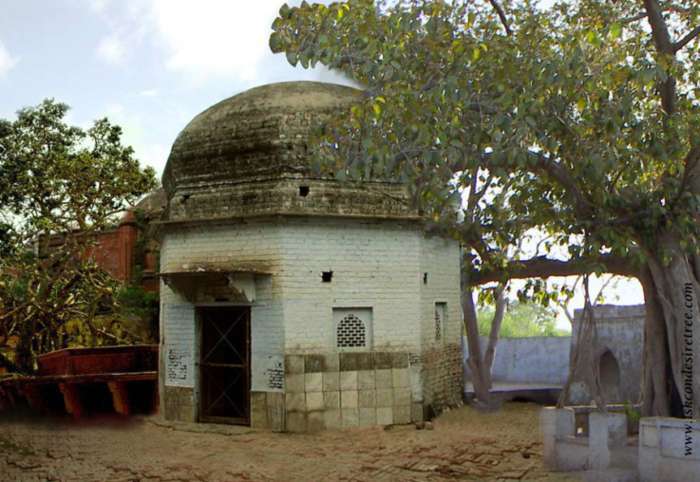
Madhu Pandit's own samadhi, his memorial tomb, where his body was laid to rest, still stands within the Radha-Gopinatha temple compound in Vrindavana. Sources checked for this page do not fully agree on exactly where inside the compound it sits; some describe it as near the entrance, others toward the rear. Another devotional account of the founding acharyas is more specific: it places the samadhi near the temple's eastern gate. That is recorded here as that account's own claim, alongside the earlier hedge rather than in place of it. What is not in dispute is that the temple itself, and the tradition of worship inside it, trace back directly to the decades Madhu Pandit spent serving Gopinatha largely alone.
The Unusual Deities on the Altar #
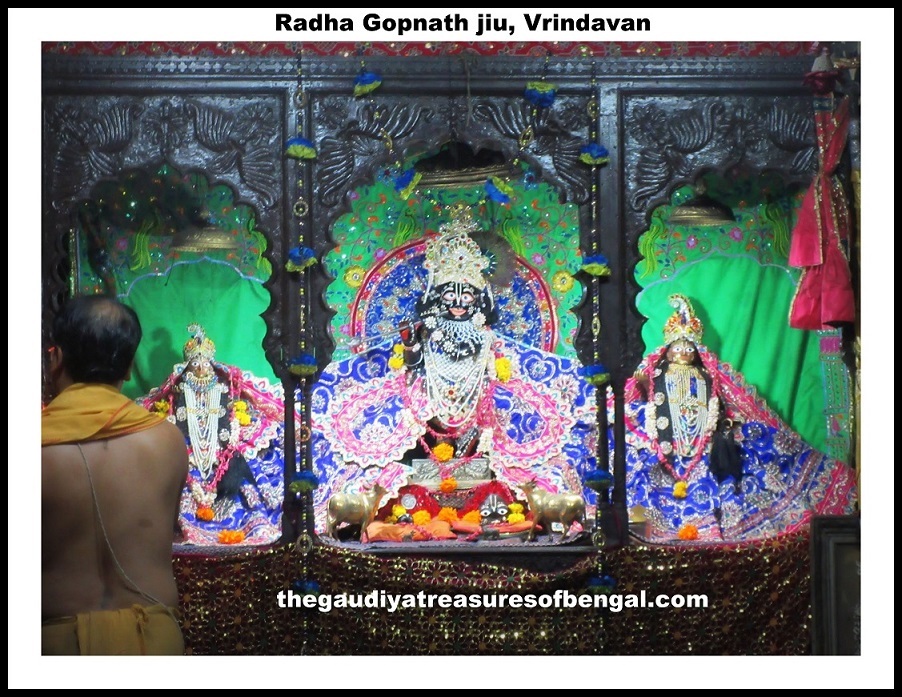
The Gopinatha temple has one further distinction that sets it apart from every other Gopinatha temple in Vraja: on its altar, Ananga-manjari, Radharani's younger sister, stands to Krishna's left, the position Radharani occupies everywhere else, while Radharani herself stands to His right. Another devotional account of the founding acharyas tells the story behind this. In 1582, when Jahnava Mata, the wife of Nityananda Prabhu, visited Vrindavana on pilgrimage, she felt that the Radharani Deity then being worshiped in the Gopinatha temple was too small, and on returning to Bengal she asked one of her own disciples to carve a new Radharani Deity for the temple. When the new image reached Vrindavana and was installed beside Gopinatha, the devotees there noticed that it looked just like Jahnava Mata herself, because the disciple who carved it, being her own follower, had modeled its features on her.
After consulting the senior Vaishnavas of Vrindavana, it was decided that the new Deity was not simply a fresh image of Radharani, but Ananga-manjari herself, who in Mahaprabhu's own pastimes had appeared as Jahnava Mata. Since that Deity had already been installed on the left of Gopinatha, it was felt this must have been arranged by Gopinatha Himself, and so she was left standing there rather than moved. The smaller, original Radharani Deity was then placed to Gopinatha's right, where she remains today, and devotees came to see the arrangement as Radharani's own compassion: out of love for her younger sister's deep desire to serve, Radharani is said to have elevated Ananga-manjari to her own customary place at Krishna's left. That same account states that this same arrangement, Ananga-manjari on the left and Radharani on the right, is repeated at the two Gopinatha temples of Radha-kunda and at the Jaipur temple where Gopinatha's original Deity is now worshiped.