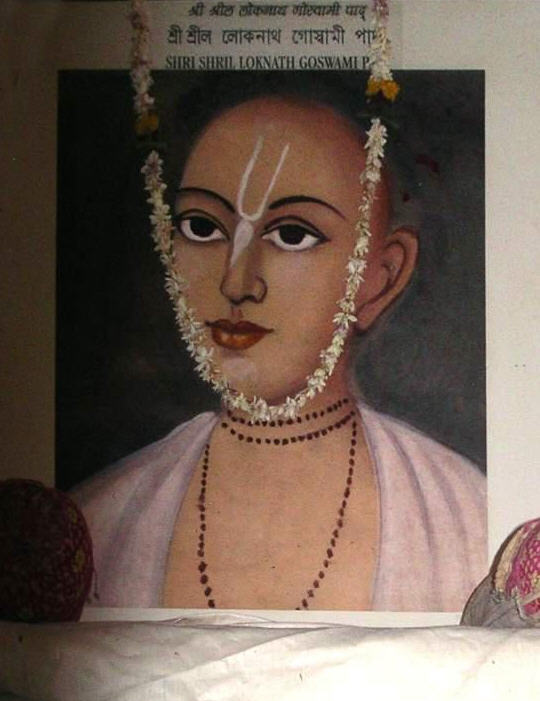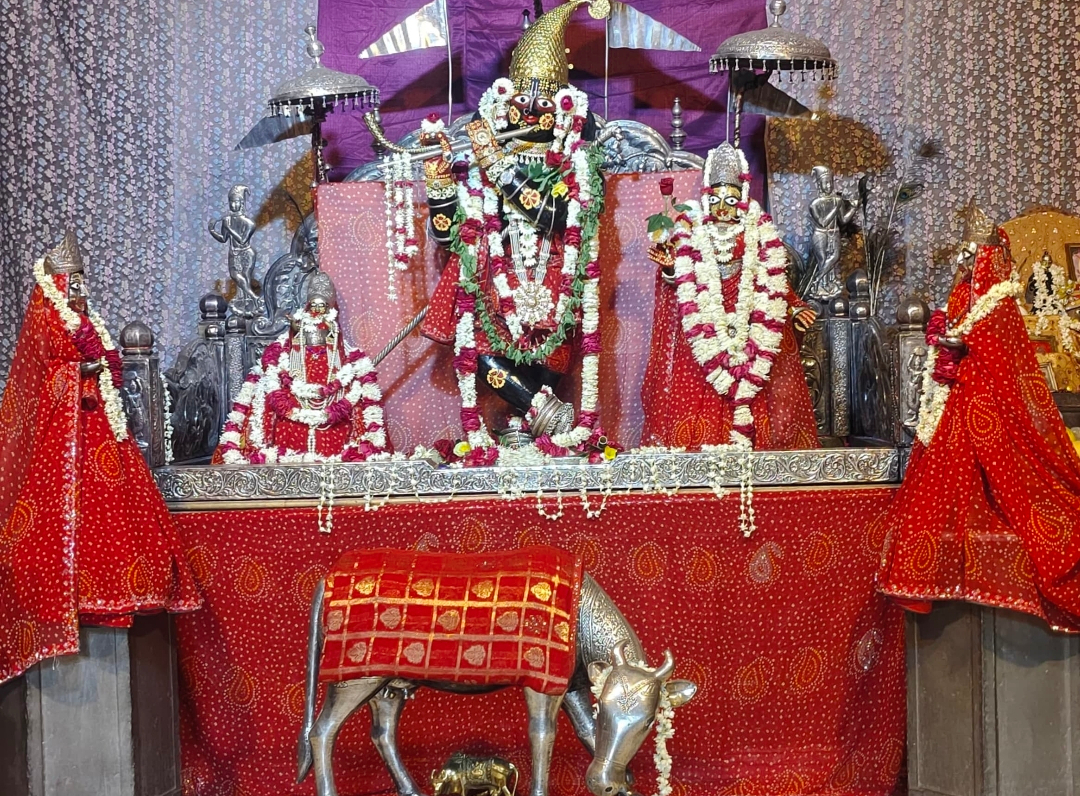
Sri Madhu Pandit Goswami
Priest of Sri Gopinatha at Vamshivata
Also known as Madhu Pandita, Madhupandit Goswami
“Sri Madhu Pandita, whose characteristics are all wonderful.”
Sri Chaitanya-charitamrita, Madhya-lila 18.52, purport — Srila Prabhupada's translation of a Bhakti-ratnakara passage listing the Vaishnavas who lived with Sri Rupa Gosvami in Vrindavana.
madhu-sneha-sama-yuktaṁ prema-saktaṁ mahāśayam |
vṛndāvane rasa-rataṁ vande śrī-madhu-paṇḍitam ||
"I offer my respectful obeisances unto Sri Madhu Pandit. This highly magnanimous soul is bound by strong ties of attachment in love to the Divine Couple, and the affection he feels is as sweet as honey (madhu), so he is known by that name. He is always absorbed in the highest exchange of mellows there in Vrindavan."
This is the verse that opens another devotional account's own chapter on him.
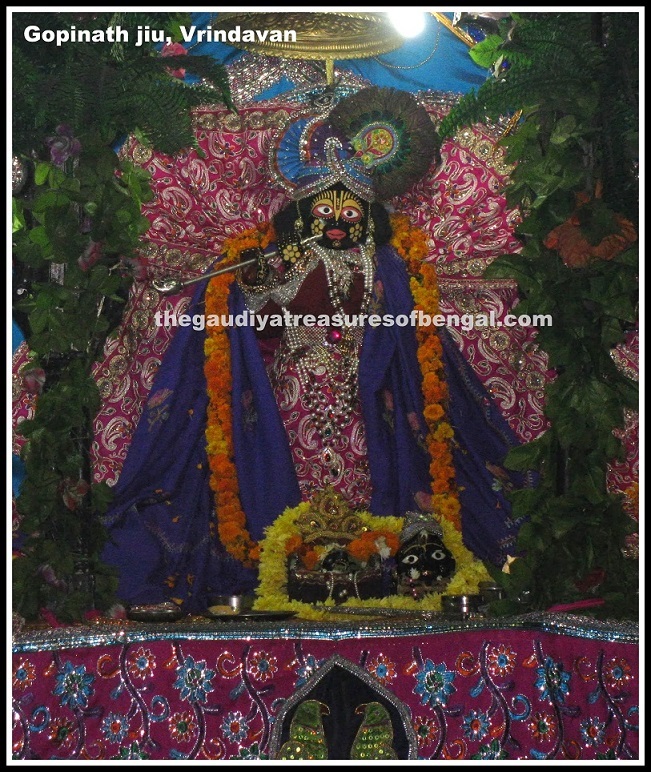
Sri Madhu Pandit Goswami is remembered in Gaudiya Vaishnava tradition as the devotee who took up loving worship of Sri Gopinatha, an ancient Deity of Krishna rediscovered on the bank of the Yamuna at Vamshivata in Vrindavana. He belonged to the generation of devotees who gathered around Rupa Goswami and Sanatana Goswami in Vrindavana after Sri Chaitanya Mahaprabhu's own disappearance, and tradition places him in the disciple-line of Gadadhara Pandit, one of Mahaprabhu's closest personal associates. His name is not widely known outside specialist Gaudiya history, but the Deity he served is: the Gopinatha of Vamshivata is one of Vrindavana's oldest and most celebrated forms of Krishna, and Madhu Pandit's decades of quiet seva are the reason a temple stands there today.
| Detail | Description |
|---|---|
| Also known as | Madhu Pandita, Madhupandit Goswami |
| Home village | Saibona, about two miles from Khardaha, in the district of Twenty-four Parganas, Bengal, where he had already established the worship of Sri Sri Radha-Nandadulalji before coming to Vrindavana |
| Guru | Sri Gadadhara Pandit, on whose order he set out for Vrindavana; some accounts describe him training under Gadadhara's own disciple, Paramananda Bhattacharya, after reaching Vrindavana |
| Known for | Discovering and worshiping Sri Gopinatha at Vamshivata, Vrindavana, for several decades |
| Era | Generation of Rupa Goswami and Sanatana Goswami's companions in Vrindavana, 16th century |
| Samadhi | Within the Sri Radha-Gopinatha temple compound, Vrindavana, near the temple's eastern gate |
| Primary sources | Bhakti-ratnakara (quoted in a Prabhupada purport and in secondary translations); another devotional account of the founding acharyas |
A note before going further, because this site already tells two other Gopinatha stories and the names are easy to mix up. This page is not about the Kshira-chora Gopinatha of Remuna, the Deity in Orissa linked to Madhavendra Puri and famous for stealing a pot of condensed milk. That story is told in full on The Kshira-chora Gopinatha of Remuna. It is also not the Radha-Gopinatha of Agradwipa connected with the Ghosh brothers, Govinda Ghosh, Madhava Ghosh and Vasudeva Ghosh. And it is a separate Deity again from Tota Gopinatha at Jagannatha Puri, which Madhu Pandit's own guru Gadadhara Pandit served for the rest of his life after Mahaprabhu's disappearance. That story is on Gadadhara Pandit's page. Gaudiya Vaishnavism has several Deities named Gopinatha in several different places; this page is about the one at Vamshivata in Vrindavana.
A Disciple in Gadadhara Pandit's Line #
Little has survived about Madhu Pandit's birth and family, but one concrete detail has: another devotional account of the founding acharyas records that he came from Saibona, a village about two miles from Khardaha in the district of Twenty-four Parganas, and that he had already established the worship of Sri Sri Radha-Nandadulalji there before he ever set out for Vrindavana. Beyond that one home and that one earlier seva, the sources agree only in general terms that he came to Vrindavana from Bengal with the same longing that drew Rupa Goswami, Sanatana Goswami, and dozens of other devotees there in the years after Mahaprabhu's own pastimes at Puri and Vrindavana ended: to live where Krishna had walked as a cowherd boy, and to serve Him there directly. That same devotional account states plainly that it was on the order of his guru, Sri Gadadhara Pandit, that Madhu Pandit made the journey, which anchors the more commonly followed account of his discipleship. Other accounts are more precise about the chain: they say Madhu Pandit came under the personal guidance of Paramananda Bhattacharya, who was himself Gadadhara Pandit's disciple and already settled in Vrindavana. Either way, every source keeps him inside the same short spiritual line, and this site records Gadadhara Pandit as his guru while noting the Paramananda Bhattacharya detail honestly rather than picking one version and hiding the other.
Discovering Sri Gopinatha at Vamshivata #
Vamshivata, the "banyan tree of the flute," is one of Vrindavana's most sacred spots, the place tradition holds Krishna once stood playing His flute for the gopis. Gaudiya Vaishnava tradition holds that the Gopinatha Deity now worshiped there is extremely old: it says Krishna's own great-grandson Vajranabha had three Deities carved from descriptions of Krishna's body given by Queen Uttara, Maharaja Parikshit's mother, who had personally seen Him. One image showed Krishna's face, one His legs, and one His chest and shoulders. Tradition identifies the third of these as Gopinatha, and says all three were eventually buried or hidden, and forgotten, for many centuries.
By the account preserved in Bhakti-ratnakara, Gopinatha was brought back to light near Vamshivata by Paramananda Bhattacharya, whom the same tradition names as Gadadhara Pandit's disciple. Several tellings describe this as no ordinary discovery: the Deity is said to have appeared in a dream to reveal exactly where He lay buried in the earth, after which local villagers dug and found Him. Another devotional account of the founding acharyas tells the moment of finding differently: it says Madhu Pandit himself had been searching for the lost Deity, gave up eating out of sorrow at not finding Him, and sat weeping at Vamshivata, when a monsoon flood swept the Yamuna over her banks and carried away the old banyan tree standing there; once the waters receded, Paramananda Bhattacharya found Gopinatha lying half buried in the ground just where the tree had stood, and called Madhu Pandit to retrieve Him. Both accounts agree on who found the Deity and where, but differ on how: a dream-revelation in the more widely repeated telling, a flood uncovering the Deity in that other account. This page records both rather than silently choosing one. Bhakti-ratnakara's own description of the Deity, once uncovered, is worth quoting for its warmth: it calls Gopinatha "an ocean of mercy" who "forever sports along the enchanting banks of the Yamuna at Vamshivata," and says the sweetness of His form, once it enters the heart, "immediately extinguishes the burning fire of material existence." It was Madhu Pandit who then took up the Deity's daily worship and care.
Forty Years of Service, and a Temple Takes Shape #
By most accounts, Madhu Pandit did not begin with anything grand. He is remembered as having served Sri Gopinatha for around forty years out of a simple hut at Vamshivata, long before any proper temple building existed: cooking, dressing, and worshiping the Deity essentially alone, in the same spirit of personal, unhurried devotion that marked so many of the Vrindavana Goswamis' own lives. Sri Chaitanya-charitamrita itself does not narrate this part of his life directly; the one place Madhu Pandit's name appears in Srila Prabhupada's own English-language corpus is a purport to Chaitanya-charitamrita, Madhya-lila 18.52, where Prabhupada quotes Bhakti-ratnakara's list of the Vaishnavas then living with Rupa Goswami in Vrindavana, a list that includes "Shri Madhu Pandita, whose characteristics are all wonderful," alongside Gopala Bhatta Goswami, Bhugarbha Goswami, and Paramananda Bhattacharya himself.
Over time, the worship Madhu Pandit had kept alive grew into one of the seven principal ancient Deity temples of Vrindavana, the group Gaudiya Vaishnavas call the Sapta-devalaya, which also includes Govindaji, Madana-mohanji, Radha-vallabha, Radha-ramana, Radha-damodara, and Gokulananda. A proper temple structure eventually rose over the site: another devotional account of the founding acharyas dates its opening to 1589 and credits its construction to Raja Saganji, one of the Shekhawat princes of Rajasthan, which agrees with the more general report elsewhere of a Rajasthani patron's support. Madhu Pandit's own samadhi, or memorial tomb, still stands within that temple's compound in Vrindavana today; that same account places it near the temple's eastern gate, though other sources checked for this page hedge only between "near the entrance" and "toward the rear" without naming a side.
The temple holds one more distinction. It is the only Gopinatha temple where Ananga-manjari, Radharani's younger sister, stands on Krishna's left, the position Radharani herself occupies in every other temple, with Radharani standing to His right instead. Another devotional account of the founding acharyas traces this to a visit by Jahnava Mata, the wife of Nityananda Prabhu, in 1582. Feeling that the Radharani Deity then worshiped there was too small, she asked a disciple to carve a larger one for the temple; when it arrived, devotees noticed it resembled Jahnava Mata herself, because the disciple who carved it had modeled it on her own features. After consulting the senior Vaishnavas of Vrindavana, it was decided that the new Deity was in fact Ananga-manjari, who had appeared in Mahaprabhu's own pastimes as Jahnava Mata, and since she had already been placed on the left of Gopinatha, she was left standing there, with the smaller, original Radharani Deity moved to His right, where both remain today. That same account states that this arrangement repeats at the two Gopinatha temples of Radha-kunda and at the Jaipur temple where Gopinatha's original Deity is now worshiped.
The Garland That Blessed a Mission #
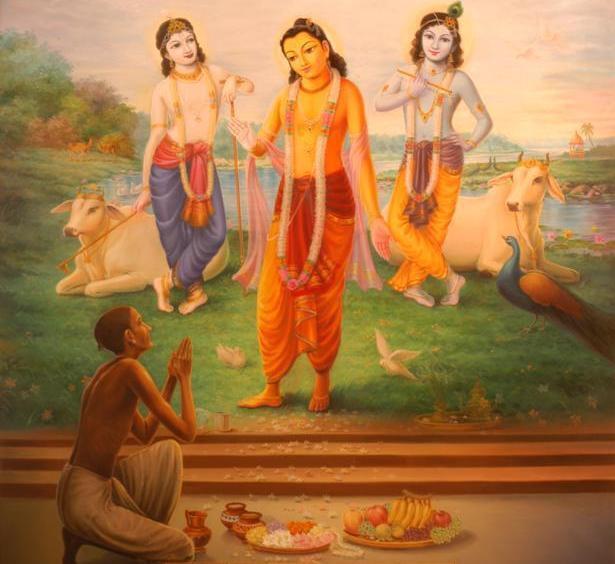
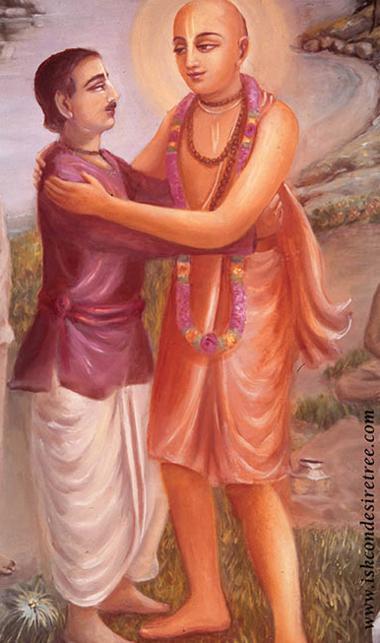
The one specific episode that ties Madhu Pandit into a larger, better-documented story concerns Shrinivasa Acharya. When Shrinivasa, Narottama Dasa Thakura, and Shyamananda Pandit had finished their training under Jiva Goswami and Gopala Bhatta Goswami, they prepared to carry the Goswamis' manuscripts out of Vrindavana to Bengal, a journey told in full on this site's page about carrying the scriptures to Bengal. Bhakti-ratnakara records that Madhu Pandit Goswami blessed Shrinivasa before he set out, placing on him a garland that had first been offered to Sri Gopinatha, and the same source preserves the words spoken over him: "Ohe Srinivas! What more can I say? The Lord reveals Himself to His pure devotee, who then preaches His glories to the world. Who can describe the incomprehensible activities of such pure devotees, by which the Lord becomes subservient to their love. Thus did Sri Brajendra Kumar reveal himself to Paramananda Bhattacharya and Sri Madhu Pandit, who are the abodes of many wonderful qualities" (Bhakti-ratnakara 2.473). In a tradition where a Deity's garland is understood to carry His personal blessing, the gesture reads as Gopinatha Himself sending Shrinivasa off with the older generation's approval for a mission that would decide whether Gaudiya Vaishnavism's philosophy ever reached the audience Mahaprabhu meant it for in Bengal.
From Vrindavana to Jaipur, and How He Is Remembered #
Decades after Madhu Pandit's own service, Vrindavana's ancient Deities came under serious threat during the Mughal period, particularly under Aurangzeb, whose policies toward Sanatana Dharma's temples pushed several of Vrindavana's guardians to move their Deities to the safety of Rajasthan. Gopinatha was carried, along with Govindaji and Madana-mohanji, to Jaipur, where all three remain enshrined today as among the most important historic Krishna Deities in Rajasthan. A second, "pratibhu" Gopinatha Deity was later installed back at Vamshivata so worship there could continue, and a fresh temple building for this replacement Deity is recorded by one source as having gone up in 1819. Another devotional account of the founding acharyas gives a related but not obviously matching account of the temple's structure: it says the original Gopinatha temple at Vamshivata, which it dates to 1589, was desecrated by Aurangzeb's soldiers in 1670, after which a new temple was built beside the old one, without mentioning either an 1819 date or a separate pratibhu Deity. This page has not been able to reconcile those two accounts of the temple's rebuilding, and reports both rather than choosing between them.
Within Gaudiya Vaishnavism's own devotional framework, which assigns many of Mahaprabhu's associates an eternal identity in Krishna's original pastimes, Madhu Pandit Goswami is remembered as a Mandali-sakhi, a maidservant in the group of Champakalata-sakhi, in the eternal Vrindavana of Goloka. That is a matter of devotional tradition rather than historical record, and this page presents it as such. What is easier to state plainly is this: a devotee whose own biography barely survives kept a single Deity's worship alive, by hand, for the better part of a lifetime, and in doing so helped keep one thread of Vrindavana's Krishna-bhakti unbroken between Mahaprabhu's own generation and the Goswamis who followed Him there.
Scriptural evidence
"Shri Gopinathaji, who is an ocean of mercy, forever sports along the enchanting banks of the Yamuna at Vamshivata. His bodily luster steals the mind of whoever sees Him. When the soothing sweetness of Gopinathaji's charming form enters the heart it immediately extinguishes the burning fire of material existence."
Bhakti-ratnakara has no standalone corpus on vedabase.io, so this passage is quoted here via a reputable secondary translation (Gaudiya History) and cited explicitly as such. It is the traditional description of the Deity Madhu Pandit came to worship.
- Sri Chaitanya-charitamrita, Madhya-lila 18.52 (purport quoting Bhakti-ratnakara)
- Madhu Pandit Goswami — Gaudiya History (ISKCON Desire Tree)
- Srila Madhu Pandit Goswami Biography — Hare Krishna Mandir
- Radha Gopinath Temple, Vrindavan: Founded by Madhu Pandit — The Gaudiya Treasures of Bengal
- Sri Sri Radha Gopinath — Holy Dham
- Sri Sri Radha Gopinath — ISKCON Desire Tree
- Madhu Pandit Disappearance — Ramai Swami
Frequently asked
When was Sri Madhu Pandit Goswami born?
Sri Madhu Pandit Goswami appeared Not precisely recorded by tradition in Not established in the sources found for this project.
Who was the guru of Sri Madhu Pandit Goswami?
The spiritual master of Sri Madhu Pandit Goswami was Sri Gadadhara Pandit.
When and where did Sri Madhu Pandit Goswami disappear?
Sri Madhu Pandit Goswami disappeared Not precisely dated; belonged to the generation of Rupa Goswami and Sanatana Goswami's companions in 16th-century Vrindavana at Vrindavana; his samadhi stands within the Sri Radha-Gopinatha temple compound.
What are the main pastimes of Sri Madhu Pandit Goswami?
The pastimes covered here include: Early Life and Discipleship Under Gadadhara Pandit, The Discovery of Sri Gopinatha at Vamshivata, Forty Years of Service and a Temple Takes Shape, Blessing Shrinivasa Acharya and the Legacy in Jaipur.