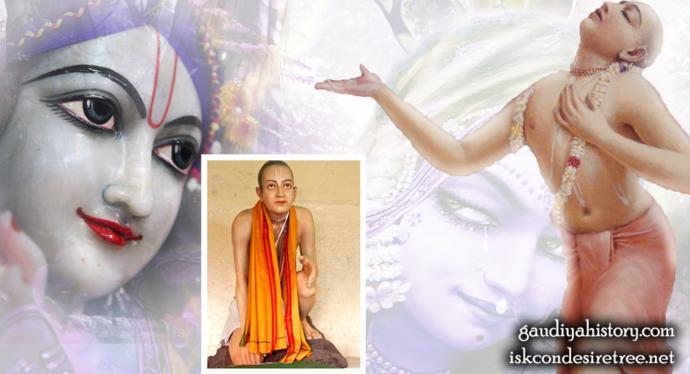
Leaving royal service was not, for either brother, a matter of simply walking away. Rupa and Sanatana returned home from Ramakeli and spent a considerable time preparing their exit, engaging two brahmanas to perform puraskarana ceremonies and chant the holy name so that their release might come about smoothly. Rupa moved first. Gathering the wealth he had accumulated in office — Sri Chaitanya-charitamrita describes it as filling boats — he set out for Bakla Chandradvipa and, once there, divided everything according to a plan that has since become a model cited across the tradition: fifty percent to brahmanas and Vaishnavas, twenty-five percent to relatives, and the remaining twenty-five percent kept in reserve, part of it as a working deposit with a local grocer, against whatever legal or personal difficulty his sudden retirement might bring.
| Detail | Description |
|---|---|
| Rupa's distribution of wealth | 50% to brahmanas and Vaishnavas, 25% to relatives, 25% kept in reserve |
| Deposit for Sanatana's later use | 10,000 gold coins, left with a Bengali grocer |
| Sanatana's excuse to the Nawab | Feigned illness |
| Result for Sanatana | Arrested and imprisoned by Husain Shah |
| Rupa's travelling companion | His younger brother Anupama (also called Vallabha) |
Preparing the Ground Before Leaving #
Rupa and Sanatana did not simply walk out of their positions the morning after Ramakeli. Sri Chaitanya-charitamrita records that the two brothers first engaged brahmanas to perform puraskarana ceremonies and chant the holy name on their behalf, seeking a smooth and auspicious departure from lives that could not simply be abandoned overnight without consequence for their households and dependents. Only once this groundwork was laid did Rupa begin the more visible part of his withdrawal: gathering his accumulated wealth, informing no one of his final intentions, and making his way toward Bakla Chandradvipa, a district in the Bengal delta some distance from the capital, where he could settle his affairs away from the immediate notice of the court.
A Ruse That Could Not Last #
While Rupa settled his own affairs, Sanatana tried a quieter approach: he told the Nawab he was too ill to attend to government business and simply stayed home, spending his days discussing Srimad-Bhagavatam with an assembly of twenty or thirty learned brahmanas. Husain Shah was not so easily satisfied. He first sent his own physician to examine Sanatana, and when the report came back that nothing was medically wrong, the Sultan came in person, furious at what he plainly recognized as a resignation dressed up as sickness. Sanatana told him outright that he could no longer be counted on for service. The Nawab, enraged, accused Sanatana's elder brother of having "destroyed all Bengal" through his own departure and, when Sanatana refused to accompany him on a coming military campaign against Orissa, had him arrested and thrown into prison.
A Brother's Deliberate Delay #
Sanatana's stalling tactic bought him time but not sympathy. He kept up the pretense of illness for weeks, continuing his Bhagavatam discussions with the visiting brahmanas even as Husain Shah's suspicion grew, and when the Sultan finally lost patience and confronted him in person, Sanatana answered with a bluntness that left no room for further negotiation: he told the ruler outright that no further service could be expected of him. It is worth noting how differently the two brothers managed their exits — Rupa's departure was quiet, financially deliberate and largely uncontested, while Sanatana's grew into open confrontation and imprisonment, a difference that would shape the very different paths each brother took to reach Sri Chaitanya Mahaprabhu again.
Word Sent Ahead #
By the time this happened, Rupa had already learned that Sri Chaitanya Mahaprabhu had left Jagannatha Puri and was travelling toward Vrindavana through the forest of Jharikhanda. He wrote at once to his imprisoned brother, telling him where the ten thousand gold coins had been deposited and urging him to use that money, by whatever means necessary, to secure his own release and follow on to Vrindavana. Then, with his youngest brother Anupama beside him, Rupa set out to overtake the Lord — a search that would end at Prayaga, where Sri Chaitanya Mahaprabhu was waiting, and where the most important ten days of Rupa Gosvami's life were about to begin. That meeting, and the instruction that followed it, is described in full in The Instruction at Prayag. Sanatana's own escape from prison, and his separate two months of instruction from the Lord at Varanasi, belong to Sri Sanatana Gosvami's own page rather than this one, since the brothers' paths diverged from this point until they were reunited in Vraja.