Twelve years separate the morning Bhaktivedanta Swami stepped off the Jaladuta in Boston harbor from the evening he died at the Krishna-Balaram Mandir in Vrindavan. Almost everything described across this section of the site, the storefronts, the world tours, the books, the temples, happened inside that single span. What survived him is the more interesting measure of the life than any inventory of it could be.
| Detail | Description |
|---|---|
| Temples founded | More than 100, across six continents, by 1977 |
| Sri Chaitanya-charitamrita | 17 volumes, translation completed 1974 |
| Bhaktivedanta Book Trust founded | 1972 |
| Disciples initiated in his lifetime | Nearly 5,000 |
| Successor gurus today | Close to 100 disciples and grand-disciples serving as initiating gurus |
What He Built in Twelve Years #
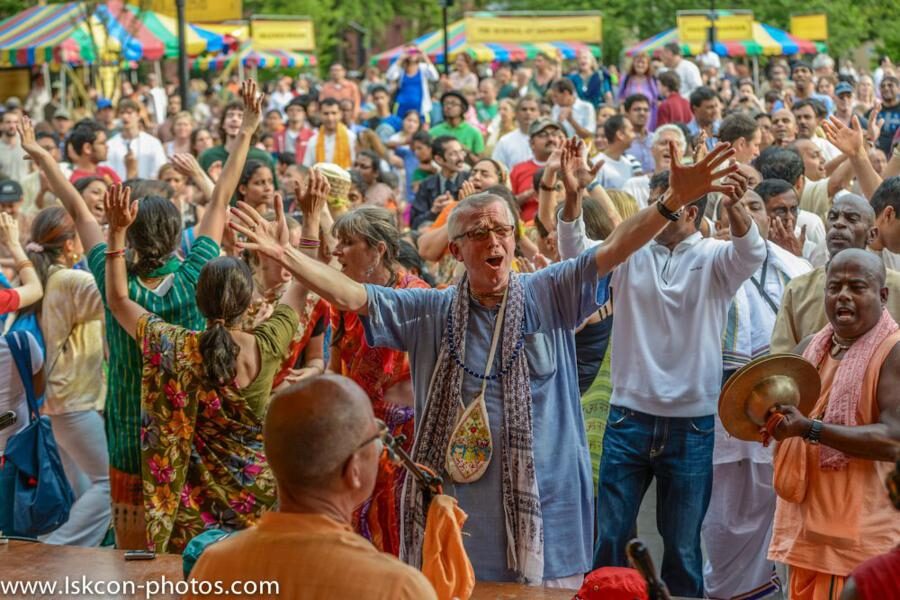
By the time of his death, the society Prabhupada had incorporated in a single room on Second Avenue counted more than a hundred temples spread across six continents, along with farm communities, restaurants, and schools for the movement's own children. He had circled the globe well over a dozen times in his final decade alone, installing deities, training leaders, and returning again and again to the same cities to see that what he had started there was still standing. Few religious founders in the modern era have built an international institution from nothing, in old age, on this scale, within a single lifetime. Harvey Cox, the Harvard theologian, put the achievement in terms worth quoting at length:
"There aren't many people you can think of who successfully implant a whole religious tradition in a completely alien culture... So when I say [he's] 'one in a million,' I think that's in some ways an underestimate. Perhaps he was one in a hundred million."
A Literary Legacy #
Alongside the institution stands the writing. Prabhupada completed Bhagavad-gita As It Is, a multi-volume translation and commentary on the Srimad-Bhagavatam that occupied him from 1962 until his death, and Sri Chaitanya-charitamrita in seventeen volumes, finished in 1974. To reach readers who might never work through the full annotated Bhagavatam, he also wrote Krsna Book, a retelling of Krishna's own life and pastimes drawn from its tenth canto, and The Nectar of Devotion, a summary study of the classical Gaudiya text on the practice of bhakti, along with dozens of other titles. All of it was published and kept in print by the Bhaktivedanta Book Trust, which he founded in 1972 to manage exactly this task. Between 1973 and his death, his followers distributed several million pieces of this literature every year in airports, shopping malls, and public squares across the world, and his books have since gone on to appear in more than eighty languages. A full account of that body of work is given elsewhere on this site. By scholarly estimate, printed in tens of millions of copies across that many languages, Prabhupada's books make him the most translated and most widely read author on Krishna consciousness in history.
Continuing the Parampara #
Prabhupada always described himself as one link in a chain rather than its origin, a representative of the Brahma-Madhva-Gaudiya disciplic succession he had received from his own guru, Bhaktisiddhanta Sarasvati, and had carried west. That chain has continued to extend since his death: by recent count, close to a hundred of his disciples and grand-disciples now serve as initiating gurus within the line he established, men and women he trained personally now training others in turn, continuing a succession whose fuller history is traced on this site's sampradaya page. In India itself, where he had once worried that a Westernizing culture was forgetting its own spiritual inheritance, the movement he built from abroad now maintains major temple complexes in Mumbai, Delhi, Bengaluru, Chennai, and Kolkata, and his Mayapur headquarters draws millions of pilgrims in an ordinary year, a reversal of direction he did not live to see in full but had set in motion.
From Vrindavan to Kota #
That chain is not an abstraction confined to ISKCON's largest centers. It is also the reason Nandgram Dham, home of the Hare Krishna Movement in Kota, exists at all. Every temple in this lineage, whatever its size, stands as one more link in the same succession Prabhupada extended from Vrindavan to the rest of the world, and this temple is no exception. A fuller account of Prabhupada's own life and mission is available elsewhere on this site; what belongs here, at the close of his biography, is simply the acknowledgment that the work described across these pages did not stop in 1977. It continues, in this temple among many others, as an ordinary consequence of what one man carried across an ocean in 1965.