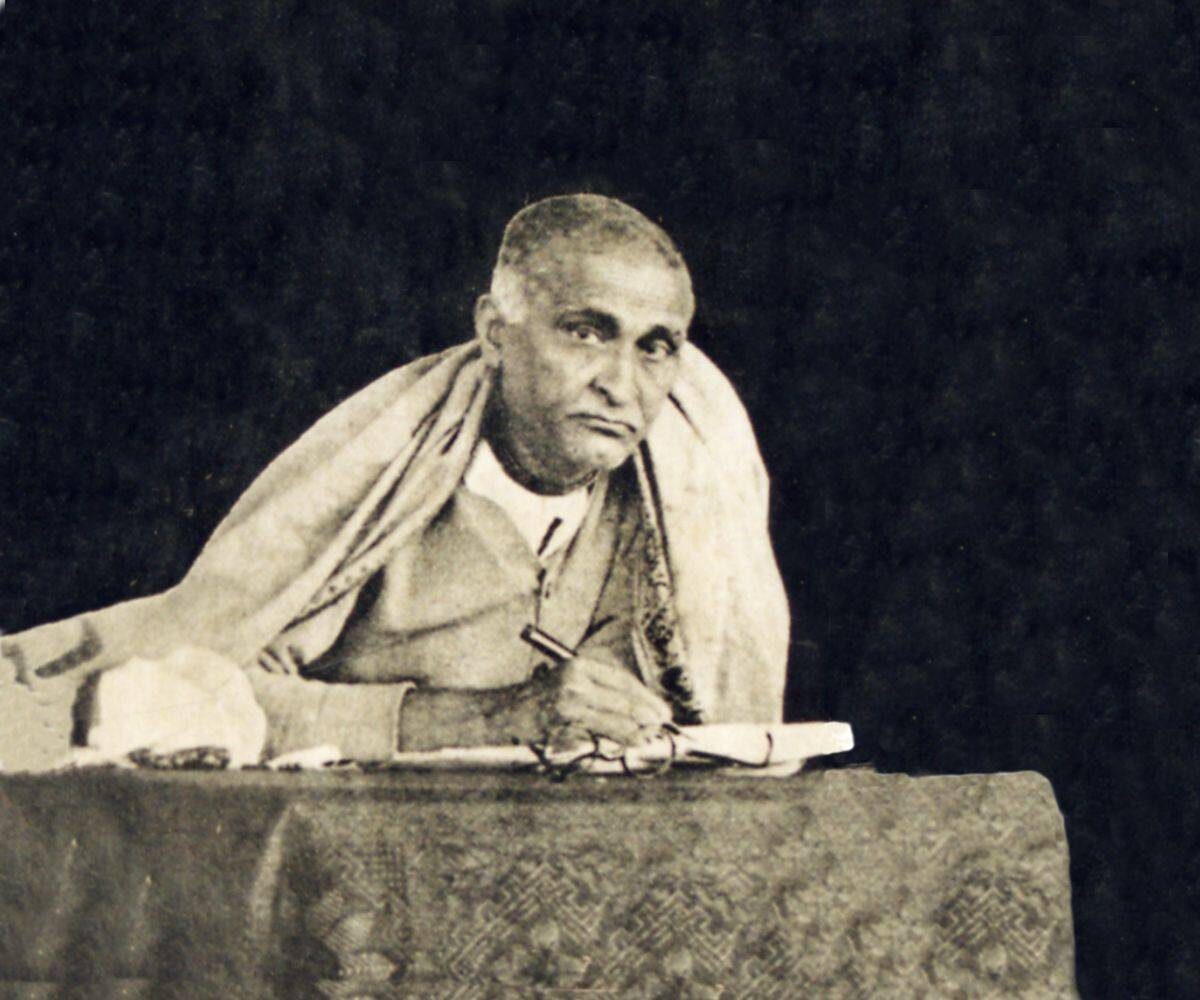
After the 1922 meeting described in Meeting His Spiritual Master, years passed with almost no further contact between Abhay and the Gaudiya Math. What eventually turned an internal conviction into formal discipleship, and formal discipleship into a printed English magazine, was a slow sequence of visits, an initiation, a dying instruction to print books, and finally a letter that arrived two weeks before his guru's death.
| Detail | Description |
|---|---|
| 1928 | Gaudiya Math opens a center in Allahabad |
| 1932 | Visits Bhaktisiddhanta during his Vrindavan parikrama |
| 1933 | Formal initiation at Allahabad; receives the name Abhay Charanaravinda |
| Late 1936 | Told in Vrindavan, "If you ever get money, print books" |
| 1 January 1937 | Bhaktisiddhanta Sarasvati Thakura passes away |
| 1944 | A.C. Bhaktivedanta launches Back to Godhead magazine |
A Kumbha-Mela Visitor at Prayag Pharmacy #
For several years after the 1922 meeting, Abhay had almost no further contact with the Gaudiya Math. He was busy building his pharmaceutical business in Allahabad, and Bhaktisiddhanta Sarasvati was occupied expanding his own mission across India. The gap closed in January 1928, during the Kumbha-mela, when a sannyasi disciple of Bhaktisiddhanta walked unannounced into Prayag Pharmacy with a few companions, looking for support in establishing a Gaudiya Math center in Allahabad. Abhay recognized him at once from the Gaudiya Math circles he had brushed against years earlier in Calcutta, and offered his help.
A Regular at the Allahabad Gaudiya Math #
Once the Allahabad center opened, Abhay became one of its most reliable local supporters. He contributed money regularly, attended lectures, sometimes led kirtan himself, and used his standing as a local businessman to bring prominent Allahabad residents to hear the Math's traveling preachers. His wife had no objection to his involvement but declined to take any initiation herself, content with the simple home worship the family already practiced, a difference between them described further in Marriage and Household Life.
To Vrindavan and Back in 1932 #
In October 1932, Bhaktisiddhanta led several hundred disciples and pilgrims on a month-long parikrama of Vrindavan, circumambulating the sites associated with Krishna's pastimes there. Abhay could not join the full pilgrimage because of his business commitments, but on its twentieth day he traveled from Allahabad to meet the party, spending time again in his prospective guru's company after years of only indirect association through the Math's local preachers.
Initiation at the Cornerstone Ceremony #
The following year, the Allahabad Gaudiya Math secured land and funds for a permanent temple building, and arranged for Bhaktisiddhanta to preside over the cornerstone-laying ceremony in November 1933, with the governor of the United Provinces presiding as guest of honor. When Abhay learned that Bhaktisiddhanta would also be conducting an initiation ceremony that day, he asked to be included. He received both the initiation into chanting and, unusually on the same occasion, the sacred thread marking second initiation as well -- a mark of confidence Bhaktisiddhanta did not extend to every new disciple. He was given the name Abhay Charanaravinda, "Abhay whose shelter is the lotus feet of Krishna," and from this point Vaishnava and scholarly sources generally refer to him as A.C. Bhaktivedanta, a further title he would receive within a few years from his godbrothers in recognition of his writing and scholarship.
If You Ever Get Money Print Books #
At the end of 1936, A.C. Bhaktivedanta again visited Bhaktisiddhanta in Vrindavan. Walking together at Radha-kunda, Bhaktisiddhanta confided his distress over infighting among his senior disciples in Calcutta over control of the Math's newly built marble temple building, a dispute he feared would only worsen after his own death. "It would be better," he said, "to take the marble from the walls and secure money. If I could do this and print books, that would be better." Then, turning directly to his disciple, he gave an instruction that would outlast every dispute over property:
If you ever get money, print books.
A.C. Bhaktivedanta later said the words entered his life permanently at that moment, though it would be more than two decades before he had the means to act on them at any real scale.
A Letter Two Weeks Before the End #
By December 1936, Bhaktisiddhanta's health had declined seriously and he was staying at Jagannatha Puri while A.C. Bhaktivedanta remained occupied with business in Bombay. Aware that most of his godbrothers were serving their guru directly as brahmacharis or sannyasis while he himself remained a householder tied to a business, A.C. Bhaktivedanta wrote to ask whether there was any particular service he could render. Two weeks later a reply arrived:
I am fully confident that you can explain in English our thoughts and arguments to the people who are not conversant with the languages of the other members. This will do much good to yourself as well as your audience. I have every hope that you can turn yourself into a very good English preacher if you serve the mission to inculcate the novel impression of Lord Chaitanya's teachings in the people in general as well as philosophers and religionists.
A.C. Bhaktivedanta recognized in it the same instruction he had first heard, unprompted, on the Ultadanga rooftop fourteen years earlier, described in Meeting His Spiritual Master: that his task was to carry Chaitanya Mahaprabhu's teaching into English. This time it arrived in his own guru's handwriting, addressed to him personally, with no room left for the objection he had once raised about India's political situation.
Bhaktisiddhanta's Death and a Fractured Mission #
Srila Bhaktisiddhanta Sarasvati Thakura passed away at 5:30 in the morning on 1 January 1937, having spent his final days reading Chaitanya-charitamrita and chanting on his beads. He had instructed that a twelve-member governing body should manage the Gaudiya Math's affairs after his departure, but the instruction went largely unheeded; a struggle for personal control of the Math's properties broke out among his senior disciples almost immediately, splintering the mission he had built. A.C. Bhaktivedanta, grieving the loss of both his father and now his guru, kept largely clear of the factional fighting, continuing to write occasional articles for Gaudiya Math publications while the institution around him came apart.
Launching Back to Godhead in 1944 #
The instruction to preach in English did not produce a magazine immediately. Not until 1944, with Calcutta enduring Japanese air raids and the privations of the Second World War, did A.C. Bhaktivedanta act on it fully. Working alone from his front room, he conceived, wrote, edited, and laid out the first issue of an English fortnightly he called Back to Godhead -- a title explained by its own masthead motto, "Godhead is Light, Nescience is darkness," printed beneath a logo showing Lord Chaitanya's effulgence reaching toward a crowd still groping in shadow. The first issue opened by quoting wartime statesmen and religious leaders on the moral exhaustion of a world at war -- Churchill, Roosevelt, the Archbishop of Canterbury, Sarvepalli Radhakrishnan -- and argued that no political settlement could succeed without a return to spiritual first principles. Its content and stated purpose traced back to a single source, printed on the cover of every issue: "Edited & Founded... Under the direct order of His Divine Grace Sri Srimad Bhakti Siddhanta Saraswati Goswami Prabhupada."
Fighting the War for Newsprint #
Publishing under wartime paper rationing proved to be its own trial. Government officials twice denied requests to purchase newsprint for a second issue, on the grounds that an ordinary citizen's religious periodical did not merit scarce paper. A.C. Bhaktivedanta wrote to the paper-control authorities a third time, arguing at length that a magazine devoted to spiritual and moral renewal was, if anything, more urgent during a war than in peacetime, and asked to be allowed even a single page a month rather than be shut down outright. The appeal succeeded, though the venture proved financially unsustainable after only a couple of issues, and he returned to writing for it privately rather than printing it regularly. The magazine he founded in that Calcutta front room in 1944 nonetheless survives today, still published under the same title -- a continuity described further on this site's page on his published works. For the fuller sequence of dates from birth to disappearance, see the Srila Prabhupada milestones timeline.