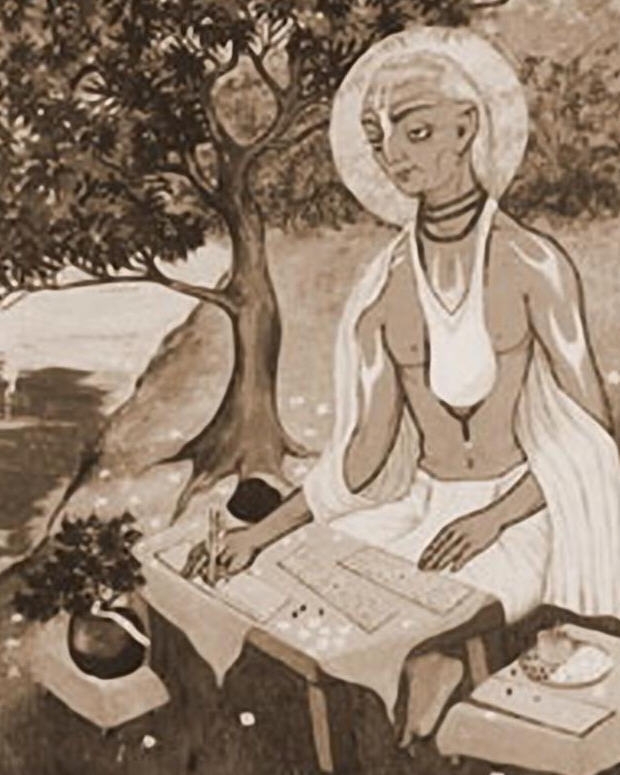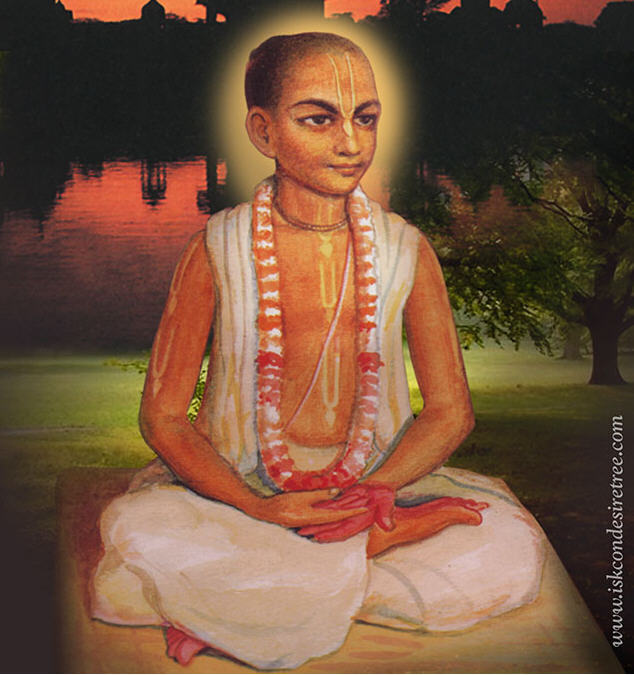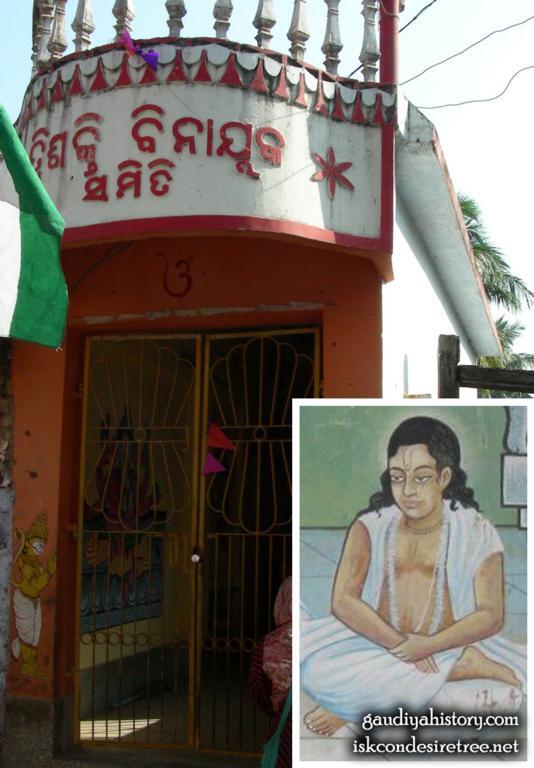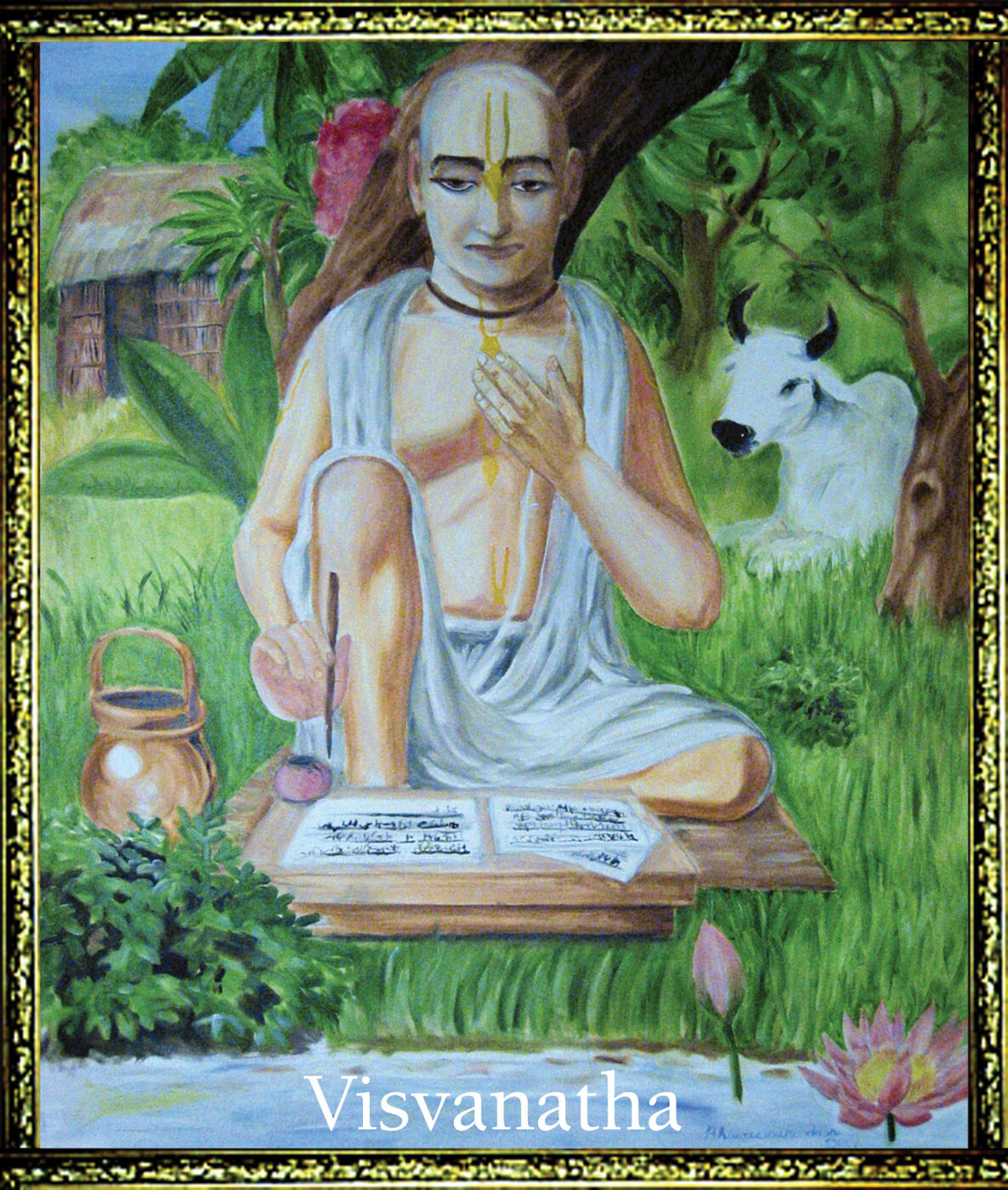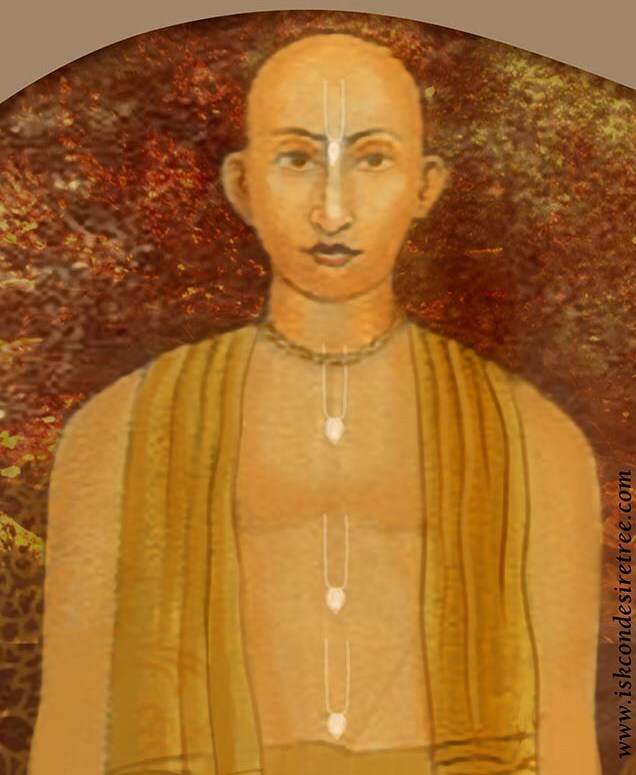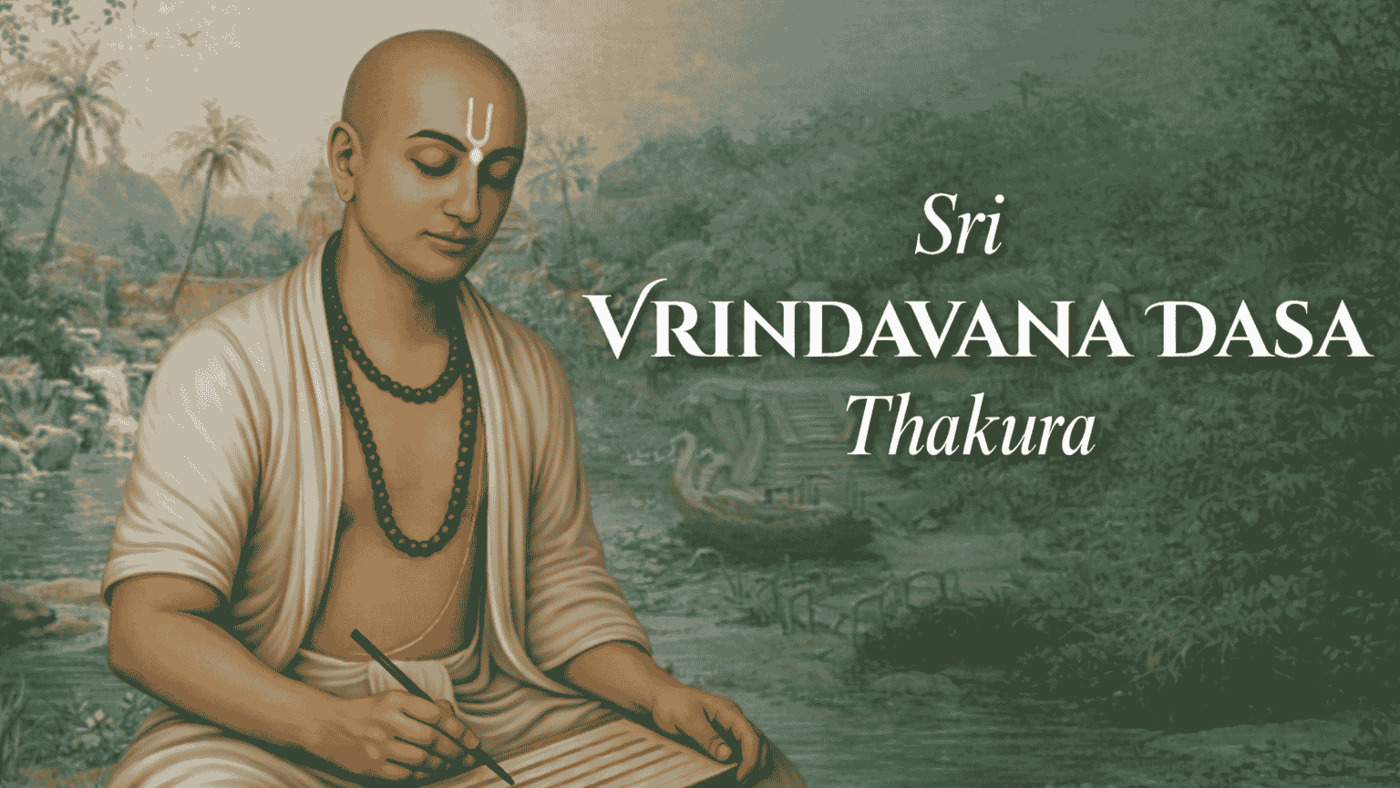
Srila Vrindavana Dasa Thakura
Author of Sri Chaitanya-Bhagavata
Also known as Vrindavan Das Thakur, Brindaban Das Thakura, Vrndavana dasa Thakura, the Vyasa of Chaitanya-lila, Adi-Vyasa
“Whatever passes for religion throughout the world, the Bhagavata declares to be full of cheating.”
From Sri Chaitanya-Bhagavata, quoted and translated by Srila Prabhupada in a Morning Walk conversation, Los Angeles, July 9, 1974.
Srila Vrindavana Dasa Thakura wrote Sri Chaitanya-Bhagavata, the first full-length biography of Sri Chaitanya Mahaprabhu's life, composed in Bengali verse a few years after the Lord's own disappearance. Because he was writing so soon after the events themselves, and because his own mother had grown up inside the household most touched by Mahaprabhu's early pastimes, his book is unusually rich on Mahaprabhu's Navadvipa childhood and youth - the very years that Krishnadasa Kaviraja Goswami's later Sri Chaitanya-charitamrita covers only briefly, since Krishnadasa wrote decades afterward and deliberately left that ground to Vrindavana Dasa. Gaudiya Vaishnavas honor him as the Vyasa of Chaitanya-lila - the Vedavyasa of Sri Chaitanya's pastimes, just as the sage Vyasadeva compiled Krishna's pastimes in Srimad-Bhagavatam.
| Detail | Description |
|---|---|
| Born | c. 1507 CE, Krishna Dvadashi of Vaishakh (1429 Shaka era) |
| Birthplace | Mamgachi, Navadvipa area, Bengal (some accounts say Kumarahatta) |
| Mother | Narayani Devi, niece of Srivasa Thakura |
| Spiritual master | Nityananda Prabhu |
| Chief work | Sri Chaitanya-Bhagavata (originally titled Chaitanya-mangala), composed by tradition in 1535 CE |
| Disappeared | c. 1589 CE (exact year disputed) |
| Samadhi | 64 Samadhis area, Vrindavana |
Birth in Bengal #
Vrindavana Dasa was born around 1507 CE, most traditions say at Mamgachi in the Navadvipa area of Bengal, though at least one early account gives Kumarahatta instead. His father, Vaikunthanatha Vipra, was a brahmana from Sylhet in East Bengal who died while Vrindavana Dasa was still very young. His mother, Narayani Devi, was the niece of Srivasa Thakura - and it was Narayani, not her son, who had the closer personal connection to Sri Chaitanya Mahaprabhu himself: as a small child living in Srivasa's house, she was present when Mahaprabhu revealed his divine identity there, and she is remembered in Chaitanya-Bhagavata's own verses as a girl who regularly received the Lord's own food remnants. Vrindavana Dasa's fuller family story, including this often-simplified detail about who exactly received whose mercy, is told in Birth and Family in Bengal.
Nityananda Prabhu's Blessing #
In his youth, by most accounts around age sixteen, Vrindavana Dasa took initiation from Nityananda Prabhu and became one of his last accepted disciples. Sri Chaitanya-charitamrita itself calls him nityananda-krpa-patra, "the favored recipient of Nityananda's mercy," and states plainly that this closeness is exactly why Vrindavana Dasa became the Vyasa of Chaitanya-lila. Vaishnava tradition holds that it was Nityananda Prabhu who personally directed and empowered him to write the account of Mahaprabhu's life that later Vaishnavas needed - the subject of Nityananda's Blessing and the Order to Write.
Writing Sri Chaitanya-Bhagavata #
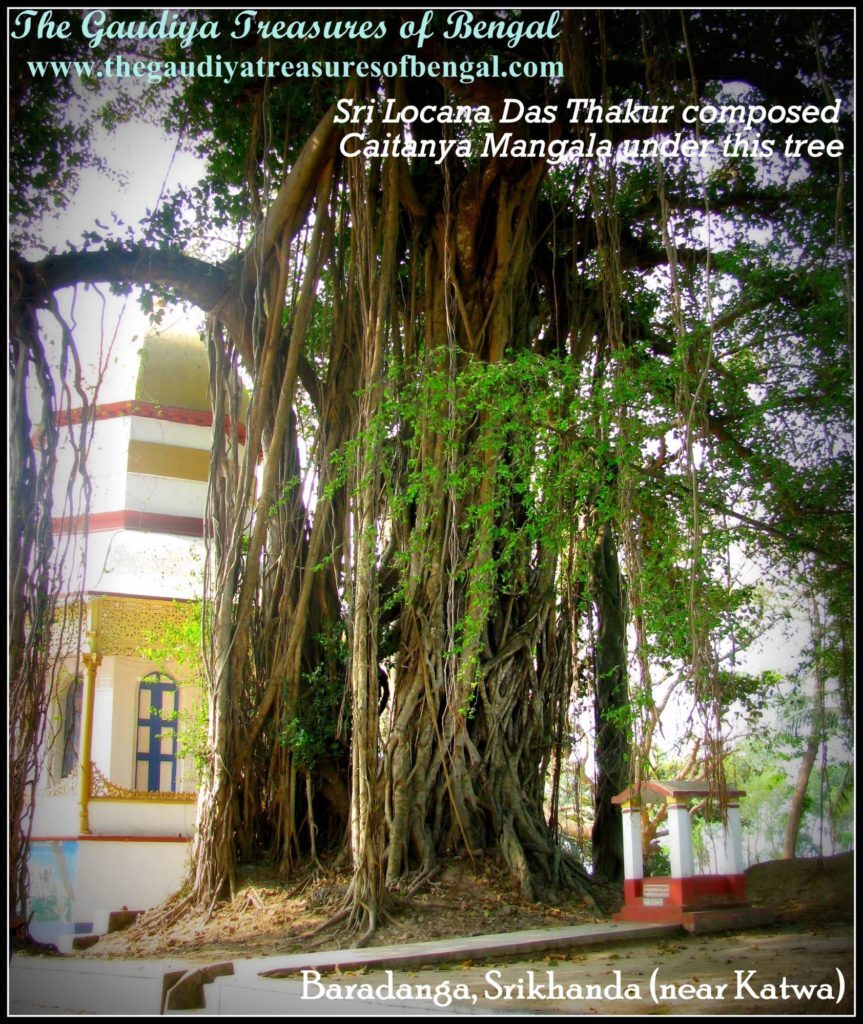
Vrindavana Dasa composed his book, by tradition, in 1535 CE, though later literary scholarship places it somewhat later, in the mid-1540s. He first called it Chaitanya-mangala, but when the poet Lochana Dasa Thakura wrote his own work under the same title, the Vaishnava community at Vrindavana settled on a new name for Vrindavana Dasa's book: Sri Chaitanya-Bhagavata. Chaitanya-charitamrita itself praises the book in the strongest terms available to Krishnadasa Kaviraja Goswami, saying that hearing it destroys misfortune and that even a confirmed atheist who hears it becomes a great devotee. More on the writing itself, and what tradition says about how it was received even in Vrindavana Dasa's own lifetime, appears in Writing Sri Chaitanya-Bhagavata.
Structure and Scope of the Book #
Chaitanya-Bhagavata is organized into three sections, or khandas. The Adi-khanda's sixteen chapters cover the religious condition of Bengal before Mahaprabhu's birth, his childhood, education and first marriage, and his initiation from Ishvara Puri at Gaya. The Madhya-khanda's twenty-seven chapters - the longest section by far - describe the growth of the sankirtana movement in Navadvipa, including the conversion of the sinners Jagai and Madhai and the famous confrontation with the Muslim magistrate Chand Kazi. The Antya-khanda's ten chapters cover Mahaprabhu's acceptance of sannyasa and his early years at Puri, but end well before his final eighteen years there - the gap Krishnadasa Kaviraja Goswami's Chaitanya-charitamrita was later asked to fill. The fuller picture of what each khanda actually contains, and why the book's balance of detail matters so much for how Gaudiya Vaishnavas read Mahaprabhu's life, is in The Scope and Structure of Chaitanya-Bhagavata.
Vrindavana Dasa and Krishnadasa Kaviraja #
Krishnadasa Kaviraja Goswami, writing his own Chaitanya-charitamrita some decades later, treats Vrindavana Dasa with open reverence, calling him equal to Vyasadeva himself and saying he means only to fill in what Vrindavana Dasa's book, out of fear of growing too long, had left out. Modern scholarship reads the two books as complementary rather than competing: Chaitanya-Bhagavata is prized for its simplicity and its uniquely detailed record of the Navadvipa years, while Chaitanya-charitamrita offers a more developed theological argument and by far the fuller record of Mahaprabhu's last eighteen years at Puri. Together, Gaudiya Vaishnavas have long said, the two books give a complete picture that neither offers alone - explored further in His Place Among the Biographers.
Final Years and Legacy #
Vrindavana Dasa settled at Mamgachi, where he installed Deities of Nitai-Gauranga still worshiped there today, and by most accounts lived out his life as a celibate devotee absorbed in their service. He is remembered as having attended the historic Gaura-Purnima festival at Kheturi-grama in the company of Jahnava Devi, Nityananda Prabhu's consort - a gathering Narottama Dasa Thakura helped organize. Gaudiya Vaishnava tradition places his disappearance around 1589 CE, though, as with much of his life, the exact year is not settled. His samadhi today stands in the 64 Samadhis area of Vrindavana, and Srila Bhaktisiddhanta Sarasvati Thakura later prepared an edited edition of Chaitanya-Bhagavata with his own commentary, keeping the book in active use for the generations that followed. The fuller story is in Final Days and Disappearance.
Scriptural evidence
nityananda-kṛpā-pātra — vṛndāvana-dāsa
caitanya-līlāya teṅho hayena 'ādi-vyāsa'
Word for word
nityananda — of Lord Nityananda Prabhu; kṛpā-pātra — the favorite devotee; vṛndāvana-dāsa — Vṛndāvana dāsa Ṭhākura; caitanya-līlāya — in the pastimes of Śrī Caitanya Mahāprabhu; teṅho — he; hayena — is; ādi-vyāsa — the original Vyāsadeva.
“Vrindavana dasa Thakura is Lord Nityananda's favorite devotee, and therefore he is the original Vyasadeva in describing the pastimes of Sri Chaitanya Mahaprabhu.”
The verse that most directly states Vrindavana Dasa Thakura's identity and his standing as the first great biographer of Sri Chaitanya Mahaprabhu's pastimes.
- Vrindavana Dasa Thakura - Biography (Gaudiya History)
- Wikipedia: Chaitanya Bhagavata
- Srila Vrindavana Dasa Thakura - Biography, Caitanya Bhagavata & Nityananda's Mercy (Hare Krishna Mandir)
- Srila Vrindavana Dasa Thakura (Vrindavan Chandrodaya Mandir)
- Vrndavan dasa Thakura (Stephen Knapp)
- Sri Chaitanya-charitamrita, Antya-lila 20.82 (Bhaktivedanta VedaBase)
- Sri Chaitanya-charitamrita, Adi-lila 8.33-40 (Bhaktivedanta VedaBase)
Frequently asked
When was Srila Vrindavana Dasa Thakura born?
Srila Vrindavana Dasa Thakura appeared c. 1507 CE (Krishna Dvadashi, month of Vaishakh, 1429 Shaka era) in Mamgachi, Navadvipa area, Bengal (some early accounts say Kumarahatta).
Who was the guru of Srila Vrindavana Dasa Thakura?
The spiritual master of Srila Vrindavana Dasa Thakura was Sri Nityananda Prabhu.
When and where did Srila Vrindavana Dasa Thakura disappear?
Srila Vrindavana Dasa Thakura disappeared c. 1589 CE (exact year disputed) at Bengal, where he lived most of his life; his samadhi is honored in the 64 Samadhis area of Vrindavana.
What are the main pastimes of Srila Vrindavana Dasa Thakura?
Dedicated pages on this site cover: Birth and Family in Bengal, Nityananda's Blessing and the Order to Write, Writing Sri Chaitanya-Bhagavata, The Scope and Structure of Chaitanya-Bhagavata, His Place Among the Biographers, Final Days and Disappearance.