Sri Uttaradi Matha's own official, numbered guru-parampara page lists its pontiffs in unbroken sequence. Reading from Jayatirtha: Sri Jayateertha (6th), Sri Vidyadhiraja Tirtha (7th), Sri Kavindra Tirtha (8th), Sri Vagisha Tirtha (9th), Sri Ramachandra Tirtha (10th), Sri Vidyanidhi Tirtha (11th), Sri Raghunatha Tirtha (12th), and onward. That eleventh name is, by unlucky coincidence, exactly the same as Vidyanidhi of the Gaudiya guru-parampara list, but he is a different man, in a different generation, with no documented connection to Vidyadhiraja, to Jayatirtha's disciple Dayanidhi, or to Rajendra Tirtha at all.
| Detail | Description |
|---|---|
| Position | Eleventh pontiff of Sri Uttaradi Matha; disciple and successor of Ramachandra Tirtha (10th) |
| Predecessor | Sri Ramachandra Tirtha |
| Successor | Sri Raghunatha Tirtha |
| Installed | c. 1430 CE, per B. N. K. Sharma, a date he ties to the second bifurcation of the original matha, under Ramachandra Tirtha |
| Length of rule | Carama-sloka tradition: 68 years (rejected by Sharma as a late chronological patch). Gurucharya: 7 years, 9 months, 13 days |
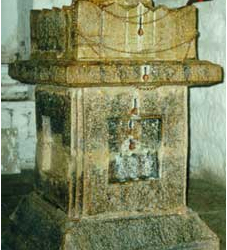
| Burial (brindavana) | Yaragola / Ergola, Yadgir taluk, Gulbarga district, the same general site where Vidyadhiraja Tirtha himself, and Ramachandra Tirtha, were also entombed |
The Pooja-Box Story #
The matha's own official biography of this Vidyanidhi Tirtha tells a specific succession story. Ramachandra Tirtha, falling seriously ill, first ordained a disciple named Kambhaluri Narasimhacharya to sannyasa, renaming him Vibhudendra Tirtha, intending to install him as the next pontiff. Rather than handing over the matha's deities and ritual implements at once, though, he sent him on tour to teach Madhva philosophy, saying he would send for him when the time came. When Ramachandra Tirtha's health failed again at Yaragola, he sent for Vibhudendra Tirtha, who could not return in time. So Ramachandra Tirtha, before entering his own final rites, ordained a second disciple as Vidyanidhi Tirtha, and told the villagers of Yaragola to bury the matha's pooja box (holding its worship implements) in a pit, to be given to Vibhudendra Tirtha only if he returned within six months, and to Vidyanidhi Tirtha otherwise. Vibhudendra Tirtha did not return within six months (the matha's own biography of Vidyanidhi Tirtha says he waited an extra eleven days beyond that out of caution). But just as the villagers prepared to dig up the box for Vidyanidhi Tirtha, Vibhudendra Tirtha finally arrived and asked for it for himself. The villagers, unwilling to simply decide between the two claimants, proposed a contest: each would pray in turn, and whichever saint's prayer caused the earth over the buried box to visibly shift would be recognized as the rightful successor. Vibhudendra Tirtha, as the senior of the two, prayed for three days without effect. On the fourth day, Vidyanidhi Tirtha's own prayer, reciting, per the matha's account, a portion of the fifth canto of the Bhagavata Purana, caused the ground to shift, and the villagers duly installed him as pontiff. Vibhudendra Tirtha went on to found a separate institution, later known as the Raghavendra Swami Matha of Mantralaya after its sixth pontifical successor in that line.
This story is reported here as the matha's own devotional memory of the event, not as independently verifiable history. No source outside the matha's own tradition confirms the specific details of the pooja-box test.
The Same Chronological Patch B. N. K. Sharma Rejects for Vidyadhiraja #
This Vidyanidhi Tirtha's own Carama-sloka verse credits him with a sixty-eight-year pontifical rule, almost exactly the mirror of the unlikely sixty-four years the same tradition assigns to Vidyadhiraja Tirtha. B. N. K. Sharma's academic history treats both figures the same way: both inflated figures, in his judgment, exist to paper over the same roughly 120-year chronological gap created when the matha's own lists pushed Madhvacharya's traditional birth date back by two sixty-year cycles. Sharma instead accepts the Gurucharya's figure of seven years, nine months and thirteen days for this Vidyanidhi Tirtha's actual rule, and separately states that he became head of the matha in 1430 CE, a date reached, in Sharma's own words, from "the second bifurcation of the original Mutt under Ramacandra Tirtha." The matha's own official biography adds that during his tenure it received extensive land grants near Raichur (still held by the matha today), that he traveled across India, had a recorded darshan of Lord Varaha Narasimha Swamy at Simhachalam, was honored by a king of Anegundi, and was known for his exposition of the Nyaya-Sudha, though, unlike Vidyadhiraja Tirtha, no written work of his own has survived or is attributed to him by either the matha or by Sharma.
A Possible, Not Certain, Answer to an Open Question #
Sri Rajendra Tirtha's own pastime page, Vidyanidhi or Vidyadhiraja, reports that Srila Prabhupada's purport to Chaitanya-charitamrita, Madhya 9.245 lists Vidyadhiraja Tirtha as the sixteenth name in its own numbered succession, and then, in what the purport describes as "another disciplic succession" branching off after him, lists "(17) Kavindra, (18) Vagisha, (19) Ramacandra, (20) Vidyanidhi," with Vidyanidhi given a birth year of Shaka 1298 (c. 1376 CE), roughly a century after Vidyadhiraja's own traditional birth year. That page reports this as an open complication: if this later "Vidyanidhi" is a real, distinct figure, he cannot be the same man as Vidyadhiraja Tirtha, which would undercut the identification of Vidyanidhi with Vidyadhiraja reported as plausible on Vidyanidhi's own page.
The sequence of names in that purport (Vidyadhiraja, then Kavindra, then Vagisha, then Ramacandra, then Vidyanidhi) is, name for name and in the same order, identical to Sri Uttaradi Matha's own official succession from its seventh through eleventh pontiffs. No source states outright that Prabhupada's purport and the matha's own official list are describing the very same men. The purport gives Shaka-era birth years the matha's own website does not repeat, and it cannot be independently confirmed that the purport's compiler drew on the same records used here. But the match in both names and relative order, from two sources with no apparent connection to one another, is difficult to put down to coincidence. If the two really are describing the same succession, then Prabhupada's own purport is not naming a rival candidate for Rajendra Tirtha's guru at all. Its "later Vidyanidhi" would simply be this real, separately documented eleventh pontiff of Sri Uttaradi Matha, correctly placed a century after Vidyadhiraja Tirtha because he really did live and rule roughly a century after him, in an entirely different line of succession than Rajendra Tirtha's own.
This reading is offered honestly, as an inference from cross-referencing two independent numbered lists, and not as a fact stated outright by either source. It would not, even if correct, prove that Vidyanidhi really is Vidyadhiraja Tirtha. That identification rests on the separate grounds discussed in Vidyadhiraja Tirtha: The Fuller Record and on Vidyanidhi's own main biography. What it would do, if it holds, is remove one specific piece of evidence that had seemed to complicate that identification, by showing that Prabhupada's own "later Vidyanidhi" most likely refers to someone else entirely, a real man, correctly named, simply living in a different century and a different branch of the same institution.