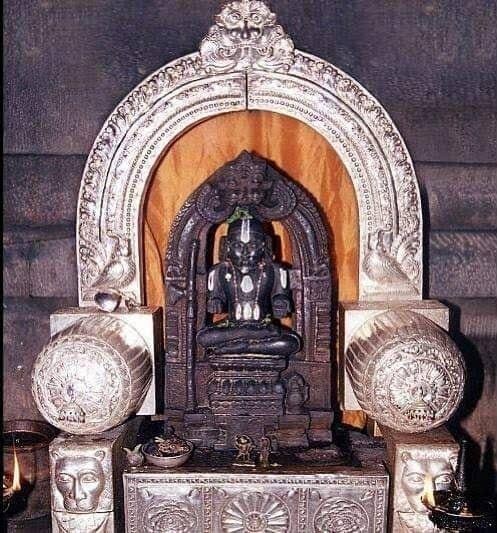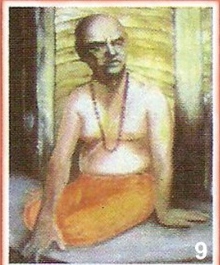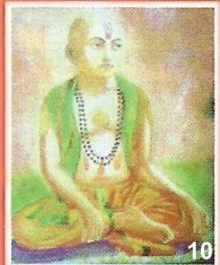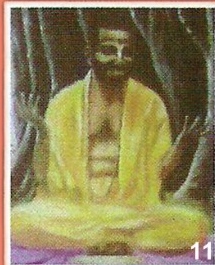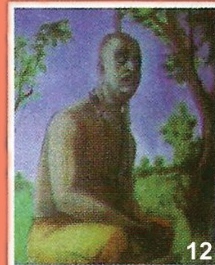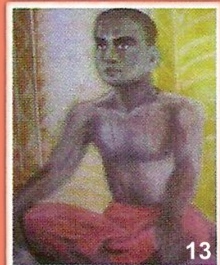
Sri Vidyanidhi
Guru of Rajendra Tirtha in the Gaudiya List
Also known as Vidyanidhi Tirtha; possibly identical with Vidyadhiraja Tirtha, seventh pontiff of the Udupi matha (see below) -- not to be confused with the later Srila Pundarika Vidyanidhi
Sri Vidyanidhi holds the thirteenth position in the traditional Gaudiya guru-parampara list, named as the disciple of Dayanidhi and, in turn, as the guru of Rajendra Tirtha. This Vidyanidhi should not be confused with the much later, unrelated Srila Pundarika Vidyanidhi, guru of Gadadhara Pandit and a contemporary of Sri Chaitanya Mahaprabhu, a completely different person who, if this list's own chronology is right, lived generations after the figure described here.
Agreement On the Position, If Not On Everything Before It #
Unlike the disputed name right before him (see Dayanidhi), Vidyanidhi's own position is not disputed between the two main Gaudiya-tradition sources for this list. Srila Bhaktisiddhanta Sarasvati Thakura's devotional song "Sri Guru-parampara" states: "taha hoite dayanidhi, tara dasa vidyanidhi, rajendra hoilo taha ha'te", "from him [Jnanasindhu] came Dayanidhi; his servant was Vidyanidhi; Rajendra appeared from him." Kavi Karnapura's older *Sri Gaura-Ganoddesha-dipika* (Text 22), even though it names a different figure ("Mahanidhi") one link earlier, agrees exactly on this link: "Mahanidhi's disciple was Vidyanidhi. Vidyanidhi's disciple was Rajendra." Both sources place him right before Rajendra Tirtha.
| Detail | Description |
|---|---|
| Position in the Gaudiya list | Disciple of Dayanidhi (or Mahanidhi); guru of Rajendra Tirtha, agreed by both Gaudiya-tradition sources checked |
| Possible independent identity | If identified with Vidyadhiraja Tirtha, a reading two Gaudiya-tradition compilations state directly, then the seventh, independently documented pontiff of the original Udupi matha, born Krishna Bhatt around 1269 CE |
| Guru, if identified with Vidyadhiraja | Jayatirtha directly, per independent sources and B. N. K. Sharma's academic history, leaving no documented room for Jnanasindhu or Dayanidhi as separate pontiffs in between |
| Disciple | Rajendra Tirtha, in every reading checked |
| Not to be confused with | Srila Pundarika Vidyanidhi, guru of Gadadhara Pandit, a later, unrelated contemporary of Sri Chaitanya Mahaprabhu |
An Identification With Vidyadhiraja Tirtha #
Two independent Gaudiya-tradition compilations go a step further than simply naming Vidyanidhi: both identify him as Vidyadhiraja Tirtha, the seventh pontiff of the original Madhva matha at Udupi. The Vedic Encyclopedia's own numbered guru-parampara list gives this position as "13. Vidyadhiraja (Vidyanidhi) Tirtha," and gaudiyahistory.iskcondesiretree.com's own page on this figure treats "Vidyanidhi" and "Vidyadhiraja" as two names for one person throughout. Read this way, Vidyanidhi is not a separate, otherwise undocumented figure at all, but simply this tradition's own name for a real, independently attested pontiff: born Krishna Bhatt, ordained by Jayatirtha, credited with a commentary on the Bhagavad-gita and, per Dvaita tradition, the first recorded Dvaita commentary on the Vishnu-sahasranama, and remembered as the guru whose serious illness, and a message that reached his intended successor too late, led directly to the historic split of the Madhva mathas into what became the Uttaradi Matha and the line that later took the name Vyasaraja Matha.
That identification, though, sits a little awkwardly against the very record it draws on. Independent sources name Vidyadhiraja Tirtha's teacher simply as Jayatirtha, with no pontiff in between, and B. N. K. Sharma's academic history of the Dvaita school gives no room in the documented succession for a Jnanasindhu or a Dayanidhi to have held the seat in between them. If Vidyanidhi really is Vidyadhiraja, then the two names standing between them in the Gaudiya list, Jnanasindhu and Dayanidhi, cannot both have been pontiffs of the same institutional line in strict succession. At most they were other disciples of Jayatirtha, honored in devotional memory without ever occupying the seat themselves, a possibility the Vedic Encyclopedia's own compiler raises directly.
An Independent Academic Verdict #
The identification above rested, at first, on two Gaudiya-tradition compilations reading the same way. B. N. K. Sharma's academic *History of the Dvaita School of Vedanta and Its Literature* turns out to say essentially the same thing, from an entirely independent, non-Gaudiya angle. Discussing the guru-parampara recorded by Kavi Karnapura and Baladeva Vidyabhushana, Sharma writes plainly that the names "Jnanasindhu and Dayanidhi are nowhere to be found among the successors of Jayatirtha," and adds:
"Vidyanidhi is evidently a mistake for Vidyadhiraja and Jayadharma a variant of Jayadhvaja." (B. N. K. Sharma, *History of the Dvaita School of Vedanta and Its Literature*, p. 525)
Coming from a twentieth-century Dvaita-tradition historian working from the matha's own genealogical records, rather than from a Gaudiya devotional source, this is real independent support for the identification. It is not proof, since Sharma offers it as his own reasoned guess rather than a documented fact, but it is a second, differently motivated voice reaching the same reading.
Sri Uttaradi Matha's own official website adds real biographical detail about the man this identification points to. Vidyadhiraja Tirtha's birth name is given differently by different sources within the tradition itself, "Krishna Bhat" per the matha's own present-day biography and per Sharma's citation of the Sarvajna-Kasi-stotra tradition, but "Nrsimha Sastri" per the older Gurucharya, which also places his family among the Badaganadu Karnataka Brahmins of South India and records that he was ordained directly from the celibate (brahmacharya) stage of life, already highly learned in the shastras before taking sannyasa. He was, by the matha's own account, ordained by Jayatirtha about a year before Jayatirtha's own passing, and the matha's biography also keeps one specific legend: that on tour in North India he was told in a dream he need not travel to the Ganges at Kashi, since the goddess herself would appear to him in the river Bhima, which she duly did the next day.
The length of Vidyadhiraja's own tenure is itself disputed within the tradition, and this is worth reporting rather than smoothing over. The matha's own later "Carama-sloka" verses assign him an unlikely sixty-four years' rule, a figure Sharma rejects outright as a late chronological patch, inserted centuries after the fact to bridge a roughly 120-year gap that opened up when the matha lists pushed Madhvacharya's own birth date back by two full 60-year cycles. The older Gurucharya and Gurucharita texts go to the opposite extreme, giving him only three years, nine months and thirteen days, too short, in Sharma's own judgment, to account for a career that produced three separate scholarly works and a reputation for "ceaseless disputation with Advaitins." Weighing these against each other, Sharma proposes his own estimate of roughly twenty-four years on the pontifical seat, dating Vidyadhiraja's tenure to approximately 1388-1412 CE.
Three works are credited to him: a sub-commentary on the Chandogya Upanishad (attested only indirectly, through a later author's mention, and possibly misattributed), a commentary on the Bhagavad-gita called the Gita-Vivrti (surviving in two manuscripts in the Mysore Oriental Library, described by Sharma as closely following Madhva's own Gita-Bhashya, "little more than a rechauffe" of it in places, though also cited by the historian of philosophy Surendranath Dasgupta), and a commentary on the Vishnu-sahasranama (a roughly 1,650-verse manuscript, also in the Mysore Oriental Library), which both Sharma and the matha's own website call the earliest known Dvaita-tradition commentary on that text. A land grant recorded in an inscription of the Madras Presidency (Udupi taluk, no. 241) names Vidyadhiraja Tirtha as the recipient of two hundred cents of land from a Vijayanagara-era ruler, Devaraja Maharaya, for the matha's upkeep, a rare piece of epigraphic, rather than purely textual, evidence for his historical activity.
The succession question on Rajendra Tirtha's own page also comes into sharper focus with this material. Sri Uttaradi Matha's own account of Kavindra Tirtha, the disciple ordained in Rajendra Tirtha's place, records that Kavindra was Rajendra Tirtha's own brother in worldly life, before either took sannyasa. This is a detail not stated in Sharma's book, and one that, if accurate, gives the whole episode a family dimension. On exactly why Kavindra rather than Rajendra was finally installed, the matha's own telling and Sharma's academic account differ slightly in their particulars. The matha's version has Vidyadhiraja first ordain Rajendra Tirtha, then recover from his first illness and delay installing him, and only turn to Kavindra when a second illness struck while Rajendra was again away. Sharma's account, drawing on the Gurucharya, has Vidyadhiraja send for Rajendra once his health began failing and, when Rajendra failed to return from tour in time, ordain Kavindra instead. Both agree Rajendra was ordained first and was senior in years, and that this is the moment the Madhva mathas first divided. The fuller telling is on Vidyadhiraja Tirtha: The Fuller Record.
A Second, Later Vidyanidhi Tirtha, A Fourth Name To Keep Separate #
There are already three names to keep straight before this: Vidyanidhi himself (the Gaudiya list's thirteenth name), Srila Pundarika Vidyanidhi (a much later, unrelated contemporary of Chaitanya Mahaprabhu), and the possible identification with Vidyadhiraja Tirtha discussed above. Sri Uttaradi Matha's own official succession list supplies a fourth: a real, separately documented pontiff who is himself officially named "Sri Vidyanidhi Tirtha," but who has nothing to do with either of the other two. This fourth Vidyanidhi is the eleventh name on the matha's own numbered list, four full pontiffs after Vidyadhiraja Tirtha (Vidyadhiraja, 7th; Kavindra Tirtha, 8th; Vagisha Tirtha, 9th; Ramachandra Tirtha, 10th; Vidyanidhi Tirtha, 11th). His own official biography, and B. N. K. Sharma's independent account of the same events, describe a completely different and much later succession question: when Ramachandra Tirtha fell seriously ill, he had already ordained a disciple, Kambhaluri Narasimhacharya (renamed Vibhudendra Tirtha), intending him as successor, but sent him on tour rather than installing him at once. When Ramachandra Tirtha's health failed again and Vibhudendra Tirtha could not be found in time, this eleventh-list Vidyanidhi Tirtha was ordained instead. A local tradition at Yaragola (also spelled Ergola or Yaragol) even holds that the matter was settled by a contest of prayer between the two claimants once Vibhudendra Tirtha eventually returned. This Vidyanidhi Tirtha's own reign is dated by Sharma to around 1430 CE, some four decades after Vidyadhiraja Tirtha's death. His own tomb (brindavana), like those of Ramachandra Tirtha and, per Sharma, Vidyadhiraja Tirtha himself, lies at Yaragola. His own Carama-sloka verse credits him with a suspiciously long sixty-eight-year rule, which Sharma rejects for the same reason he rejects Vidyadhiraja's sixty-four-year figure, as a late device for closing the same chronological gap, against the Gurucharya's far more modest figure of seven years, nine months and thirteen days.
This eleventh-list Vidyanidhi Tirtha is not the Vidyanidhi of the Gaudiya guru-parampara list, and nothing in the record supports treating him as such. He succeeds Ramachandra Tirtha, not Dayanidhi, and is himself succeeded by Raghunatha Tirtha, not Rajendra Tirtha, an entirely different position in an entirely different generation of the same institution's history. He is reported here only as a needed caution: "Vidyanidhi," like "Vidyadhiraja," turns out to be something close to a stock pontifical name reused independently by several different Madhva mathas across the centuries (Sharma's own genealogical tables show separately-numbered "Vidyanidhi" pontiffs in at least three of the eight original Udipi mathas, quite apart from the Uttaradi Matha's own two). A name match alone, without a matching guru, disciple, and institutional context, is not a safe basis for identifying anyone in this tradition, a caution worth applying here as much as to any source cited.
There is one place, though, where this fourth Vidyanidhi's own documented dates may help resolve, rather than deepen, a puzzle left open above. Srila Prabhupada's purport to Chaitanya-charitamrita, Madhya 9.245, already discussed at length on Rajendra Tirtha's own cross-reference page, lists Vidyadhiraja Tirtha as the sixteenth name in its own numbered succession, and then, four names later in the same branch, lists "(17) Kavindra, (18) Vagisha, (19) Ramacandra, (20) Vidyanidhi." That is exactly the same sequence of names, in exactly the same order, as Sri Uttaradi Matha's own official list of pontiffs seven through eleven. No source states outright that the purport's twentieth name and this matha's own eleventh-list Vidyanidhi Tirtha are the same man, but the match in both names and relative sequence, across two sources with no obvious connection to each other, is hard to read as coincidence. If it holds, it would mean the "later Vidyanidhi" found in Prabhupada's purport is not a puzzle needing to be squared with Vidyanidhi at all, but simply this same, real, separately documented eleventh pontiff of the Uttaradi Matha, correctly placed a century after Vidyadhiraja because he really did live and rule a century after him. This is offered as a reasoned inference from cross-referencing two independent numbered lists, not as a settled fact. The fuller comparison is on A Second Vidyanidhi in the Uttaradi Line.
The Rajendra Tirtha Question, Cross-Referenced #
Sri Rajendra Tirtha's own page carries a dedicated pastime, Vidyanidhi or Vidyadhiraja, examining a real identity question: the Gaudiya list names Rajendra Tirtha's guru as Vidyanidhi Tirtha, independent Dvaita sources instead name him Vidyadhiraja Tirtha, gaudiyahistory.iskcondesiretree.com harmonizes the two as one person, and Srila Prabhupada's own purport to Chaitanya-charitamrita, Madhya 9.245, separately lists a "Vidyanidhi" as a distinct, later figure, the twentieth name in a different branch, roughly a century after Vidyadhiraja, which would make this specific guru-disciple link chronologically difficult.
Vidyanidhi is, by list-position, the very same guru named there: the immediate predecessor of Rajendra Tirtha in the straight Gaudiya succession. Both a Gaudiya-tradition identification and an independent academic one (B. N. K. Sharma's) connect that same name with Vidyadhiraja Tirtha, consistent with, and lending real independent support to, the harmonization already reported there as one plausible but unconfirmed reading. There is also something that narrows, without fully closing, the complication raised from Prabhupada's own purport: the "later Vidyanidhi" listed there as the twentieth name, roughly a century after Vidyadhiraja, matches, in both name and exact relative sequence, a real, separately documented eleventh pontiff of Sri Uttaradi Matha itself, discussed above and in A Second Vidyanidhi in the Uttaradi Line. If that reading holds, the purport's later Vidyanidhi may simply be that documented figure rather than a rival candidate for Vidyanidhi himself, though this remains an inference from cross-referencing two numbered lists, not a fact either purport or matha record states outright. Readers wanting the fuller comparison, including the exact purport wording, should still read Vidyanidhi or Vidyadhiraja directly.
Scriptural evidence
tāhā hoite dayānidhi, tāra dāsa vidyānidhi, rājendra hoilo tāhā ha'te
Word for word
taha hoite dayanidhi -- from him came Dayanidhi; tara dasa vidyanidhi -- his servant was Vidyanidhi; rajendra hoilo taha ha'te -- Rajendra appeared from him
From him [Jnanasindhu] came Dayanidhi; his servant was Vidyanidhi; Rajendra appeared from him.
From the purport: Purport excerpt: "The acharyas coming from Madhva are Padmanabha, Nrhari, Madhava, Akshobhya, Jayatirtha, Jnanasindhu, Dayanidhi, Vidyanidhi, Rajendra, Jayadharma, Purushottama, Brahmanya-tirtha, Vyasatirtha, Lakshmipati, and Madhavendra Puri."
The one point of full agreement between this project's two Gaudiya-tradition sources for this stretch of the list: both place Vidyanidhi immediately before Rajendra Tirtha, whatever they call the name one link earlier.
From the purport: Purport excerpt: "(16) Vidyadhiraja, 1190; (17) Kavindra, 1255; (18) Vagisha, 1261; (19) Ramacandra, 1269; (20) Vidyanidhi, 1298."
Already used and verified on this website's own Rajendra Tirtha page (see /acharyas/rajendra-tirtha/vidyanidhi-or-vidyadhiraja/); reused here rather than re-fetched, since vedabase.io's page for this verse could not itself be retrieved by this research pass (a client-rendered page that returns no readable text to an automated fetch). This numbered list places a separate 'Vidyanidhi' four names and roughly a century after Vidyadhiraja Tirtha, in a different branch -- the reading this page's own cross-reference section discusses without resolving.
From the purport: "...is to some extent, defective. The names of Jnanasindhu and Dayanidhi are nowhere to be found among the successors of Jayatirtha. Vidyanidhi is evidently a mistake for Vidyadhiraja and Jayadharma a variant of Jayadhvaja."
B. N. K. Sharma's own explicit, independent (non-Gaudiya) reading of the identification this page reports -- found on this project's deeper research pass by searching the full OCR text of his book.
From the purport: Sri Jayateertha - Sri Vidyadhiraja Tirtha - Sri Kavindra Tirtha - Sri Vagisha Tirtha - Sri Ramachandra Tirtha - Sri Vidyanidhi Tirtha - Sri Raghunatha Tirtha - ...
The matha's own official, numbered guru-parampara page -- the institutional backbone for both this page's Vidyadhiraja identification and its report of a second, later Vidyanidhi Tirtha (11th).
- Krishna Hoite Caturmukha (Sri Guru-Parampara) by Srila Bhaktisiddhanta Sarasvati Thakura, from Songs of the Vaishnava Acharyas (BBT, 1972 ed.)
- Guru-parampara, page 1 -- Vedic Encyclopedia (veda.harekrsna.cz), quoting Kavi Karnapura's Sri Gaura-Ganoddesha-dipika, Text 22, and B. N. K. Sharma
- Sripad Vidyanidhi Tirtha -- Gaudiya History (ISKCON Desire Tree)
- Vidyadhiraja Tirtha -- Wikipedia
- B. N. K. Sharma, History of the Dvaita School of Vedanta and Its Literature (1961/1981), full text via Internet Archive
- Rajendra Tirtha: Vidyanidhi or Vidyadhiraja (this website)
- B. N. K. Sharma, History of the Dvaita School of Vedanta and Its Literature, p. 525 ("Influence on Bengal Vaisnavism") and pp. 195-198, 451-453 (Vidyadhiraja Tirtha biography and chronology) -- full text via Internet Archive
- Guru Parampara -- Sri Uttaradi Math (official website, full numbered succession list)
- Sri Vidyadhiraja Tirtha -- Sri Uttaradi Math (official biography page)
- Sri Kavindra Tirtha -- Sri Uttaradi Math (official biography page)
- Sri Vidyanidhi Tirtha -- Sri Uttaradi Math (official biography page, the matha's own eleventh pontiff)
Disciples
Frequently asked
When was Sri Vidyanidhi born?
Sri Vidyanidhi appeared Not independently recorded under the name Vidyanidhi; if identified with Vidyadhiraja Tirtha, born Krishna Bhatt around 1269 CE (Shaka 1190) per Dvaita-tradition sources in Not recorded under the name Vidyanidhi in any source found for this project.
Who was the guru of Sri Vidyanidhi?
The spiritual master of Sri Vidyanidhi was Sri Dayanidhi.
When and where did Sri Vidyanidhi disappear?
Sri Vidyanidhi disappeared Not recorded under the name Vidyanidhi; if identified with Vidyadhiraja Tirtha, his headship of the Udupi matha is dated to about 1388-1392 CE at Not recorded under the name Vidyanidhi in any source found for this project.
What are the main pastimes of Sri Vidyanidhi?
The pastimes covered here include: Vidyadhiraja Tirtha: The Fuller Record, A Second Vidyanidhi in the Uttaradi Line.