Here is the fuller, independently sourced record of Vidyadhiraja Tirtha, the seventh pontiff of the Uttaradi Matha whom two Gaudiya-tradition compilations, and B. N. K. Sharma's academic history, identify with Vidyanidhi. None of this proves the identification, that remains, honestly, a reasoned reading rather than a documented fact, but if the identification holds, this is who the Gaudiya tradition's "Vidyanidhi" actually was.
| Detail | Description |
|---|---|
| Position | Seventh pontiff of the Uttaradi Matha; immediate disciple and successor of Jayatirtha |
| Birth name | "Krishna Bhat" / "Krsnabhatta" per the matha's own tradition and the Sarvajna-Kasi-stotra; "Nrsimha Sastri" per the older Gurucharya |
| Family background | Badaganadu Karnataka Brahmin family of South India, per the Gurucharya; ordained directly from brahmacharya (celibate student life), already learned in the shastras |
| Ordained by | Jayatirtha, about one year before Jayatirtha's own passing |
| Pontifical dates | Traditional matha lists: 64 years' rule (rejected by Sharma as implausible). Gurucharya/Gurucharita: 3 years, 9 months, 13 days (rejected by Sharma as too short). Sharma's own revised estimate: c. 1388-1412 CE, roughly 24 years |
| Works | Chandogya-Bhashya-Tika (attested only indirectly); Gita-Vivrti, a commentary on the Bhagavad-gita (2 mss., Mysore Oriental Library); Vishnu-sahasranama-Bhashya, the earliest known Dvaita commentary on that text (1 ms., Mysore Oriental Library, c. 1,650 verses) |
| Epigraphic record | A Madras Presidency inscription (Udupi taluk, no. 241) records a land grant of 200 cents to him from the Vijayanagara ruler Devaraja Maharaya |
| Disciples | Ordained Rajendra Tirtha first; later ordained Kavindra Tirtha, whose line became the Uttaradi Matha proper |
| Burial (brindavana) | Ergola / Yaragola, near Malkhed, on a lake embankment, also the burial site, generations later, of Ramachandra Tirtha and of a different, later pontiff also named Vidyanidhi Tirtha (see A Second Vidyanidhi in the Uttaradi Line) |
A Disputed Name, A Disputed Length of Rule #
Even within the Dvaita tradition's own sources, Vidyadhiraja Tirtha's identity is not perfectly settled. The matha's present-day official biography and the older Sarvajna-Kasi-stotra tradition give his pre-sannyasa name as Krishna Bhat. The Gurucharya, an older source that Sharma judges more reliable for personal biographical detail, instead gives it as Nrsimha Sastri, and places his family among the Badaganadu Karnataka Brahmins. Both traditions agree he was ordained directly by Jayatirtha, without passing through the intermediate stage some other Madhva sannyasis observed, and both agree this took place about a year before Jayatirtha's own passing.
His length of tenure is even more disputed. The matha's own later Carama-sloka verses, ceremonial memorial verses said to have been composed by each pontiff's immediate successor, assign him a rule of sixty-four years, a figure B. N. K. Sharma rejects outright. Sharma explains that the matha's succession lists, at some point, pushed Madhvacharya's own birth date back by two full sixty-year calendrical cycles, opening a gap of roughly 120 years between the earlier and later pontiffs that the tradition then closed by quietly assigning implausibly long "rules" of sixty-plus years to one or two pontiffs, Vidyadhiraja among them, and, as it happens, a different, later Vidyanidhi Tirtha as well (see below). Working from the opposite direction, the older Gurucharya and Gurucharita texts assign Vidyadhiraja only three years, nine months and thirteen days, which Sharma judges too short to account for a career that, by his own account, included "ceaseless disputation with Advaitins" and produced at least three separate scholarly works. Weighing the evidence, Sharma proposes his own estimate of roughly twenty-four years, dating Vidyadhiraja's pontificate to approximately 1388-1412 CE, the figure this identification's biographical fields use, while candidly noting that it is Sharma's own reasoned reconstruction, not an uncontested fact.
A Legend on the River Bhima #
The matha's own official biography preserves one specific legend from Vidyadhiraja's travels. Touring in North India, he intended to travel to Kashi for a holy bath in the Ganges, but the goddess Ganga appeared to him in a dream and told him this was unnecessary. She would manifest herself in the river Bhima the very next day instead. She duly did, and Vidyadhiraja and his disciples performed worship and bathed in the Bhima in her honor. This is reported here as the matha's own devotional memory of him, not as independently verifiable history.
Three Works, One Genuinely Pioneering #
Three works are credited to Vidyadhiraja Tirtha. A sub-commentary on the Chandogya Upanishad is attested only through a later author's passing mention, and Sharma notes it is possible the mention actually refers to a different, similarly titled author, leaving this attribution uncertain. His commentary on the Bhagavad-gita, the Gita-Vivrti, survives in two manuscripts held by the Mysore Oriental Library. Sharma, who personally examined one of them, describes it as adhering closely to Madhva's own Gita-Bhashya, in places "little more than a rechauffe" of it, though written in a style he compares to Jayatirtha's own, for simplicity and directness, and cited by the historian of Indian philosophy Surendranath Dasgupta in his own multi-volume history.
His third and most significant work is a commentary on the Vishnu-sahasranama, the thousand names of Vishnu, surviving in a single Devanagari manuscript of roughly 1,650 verses, also in the Mysore Oriental Library. Both Sharma's academic history and the matha's own official website independently describe this as the earliest known Dvaita-tradition commentary on the Vishnu-sahasranama, written, in Sharma's assessment, with close attention to the etymology of each of the thousand names but comparatively little interest in their grammatical derivation. Given how highly the Vishnu-sahasranama is held within Madhva's own theology, this is arguably Vidyadhiraja's most lasting individual contribution to Dvaita literature, regardless of how the separate question of his identity with "Vidyanidhi" is eventually resolved.
The Two Disciples, and a Family Detail #
The episode that makes Vidyadhiraja's own tenure significant beyond his own writings is the first split of the Madhva mathas, which took place at the end of his life. The matha's own institutional account and B. N. K. Sharma's academic account agree on the broad shape of events but differ in a few particulars worth reporting honestly rather than smoothing over. The matha's own version has Vidyadhiraja first ordain Rajendra Tirtha as his intended successor during an illness, then recover and not immediately install him. When a second illness struck and Rajendra Tirtha could not be located in time, Vidyadhiraja ordained a second disciple, Kavindra Tirtha, and handed the entire samsthana (institutional seat, deities, and properties) over to him instead. Sharma's version, drawn from the Gurucharya, has Vidyadhiraja ordain Rajendra Tirtha first, in the cyclic year Hevilambi. Later, as his health began failing, he sent word for Rajendra Tirtha to return, but Rajendra Tirtha, on tour at the time, did not make it back in time, and Vidyadhiraja, with no successor formally installed, ordained Kavindra Tirtha instead. Both versions agree that Rajendra Tirtha was ordained first and was senior in years to Kavindra Tirtha, a seniority the matha's own later Carama-sloka verse for Kavindra obscures, in a way Sharma calls "misleading" and "unfortunate."
A detail found only in the matha's own official biography of Kavindra Tirtha, and not found in Sharma's book, is that Kavindra Tirtha was Rajendra Tirtha's own brother in worldly life (purvashrama), before either took sannyasa. If accurate, this reframes the split not simply as an institutional accident of timing, but as a decision that, in effect, chose between two brothers, one of whom went on to found the line that became the Vyasaraja Matha at Sosale, the other the line that became the Uttaradi Matha itself. This detail comes from only the one source, and it is reported with that caveat.
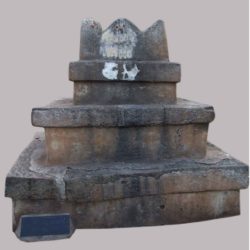
Vidyadhiraja Tirtha died at Ergola (also spelled Yaragola or Yaragol), some four miles from Nalvar on the Wadi-Raichur railway section, where his remains are entombed. B. N. K. Sharma visited the site personally on 28 February 1975 and recorded that, of the tombs then visible on a lake embankment there, only those of Ramachandra Tirtha and a later Vidyanidhi Tirtha remained clearly identifiable, with Vidyadhiraja's own tomb, and those of Rajendra Tirtha and others, likely lying within the ruins of the old town nearby.