Vishvanatha Chakravarti Thakura's move from Bengal to Vrindavana was not a single journey but two: first to his guru's residence to complete his religious education, and only afterward to Vrindavana itself, where he would spend the remainder of his life.
Study at Saiyadabad #
Before leaving Bengal, Vishvanatha traveled to Saiyadabad, in the Murshidabad region (the town survives today as part of Baharampur), to study devotional scripture directly under his guru. It is here that the sources genuinely diverge on a point that matters: who, exactly, his diksha-guru was. Some accounts name Krishnacarana Chakravarti of Saiyadabad as the one who initiated him, describing Krishnacarana as fourth in the disciplic line descending from Narottama Dasa Thakura. Other accounts instead name Radharamana Chakravarti — himself a disciple of Krishnacarana — as Vishvanatha's actual initiating guru, with Krishnacarana one generation further back. Both versions place Vishvanatha within the same line of transmission from Narottama Dasa Thakura; they differ only on which of the two men at Saiyadabad actually gave him diksha. No source available for this page resolves the discrepancy, so it is recorded here as an open question rather than settled either way.
Whichever of the two was his initiating guru, Vishvanatha is said to have studied under him for a considerable period before departing for Vrindavana, and to have already begun composing devotional works during these years at Saiyadabad.
Renunciation and the Road to Vraja #
From childhood, as noted on the previous page, Vishvanatha had shown little interest in domestic life. Eventually — the sources give no precise age or year — he renounced his household entirely and set out for Vrindavana, the forest region in present-day Uttar Pradesh identified in Gaudiya Vaishnava theology as Krishna's eternal abode on earth. His family attempted to bring him back. They did not succeed.
Settling at Radha-Kunda #
On arriving in Vrindavana, Vishvanatha did not build a new residence of his own. Instead, he took up residence with a Vaishnava named Mukunda Dasa, who lived in a bhajana-kutir — a small hut for solitary devotional practice — on the bank of Radha-kunda that had once belonged to Krishnadasa Kaviraja Gosvami, the author of Sri Chaitanya-charitamrita. Krishnadasa Kaviraja Gosvami had disappeared decades before Vishvanatha's birth, so the two men never met; what Vishvanatha inherited was the place and its living tradition of study, not a personal relationship. There, surrounded by the manuscripts and teachings of Rupa Gosvami, Sanatana Gosvami and their contemporaries, Vishvanatha immersed himself in the Gosvamis' literature and began the sustained work of commentary that would occupy the rest of his life.
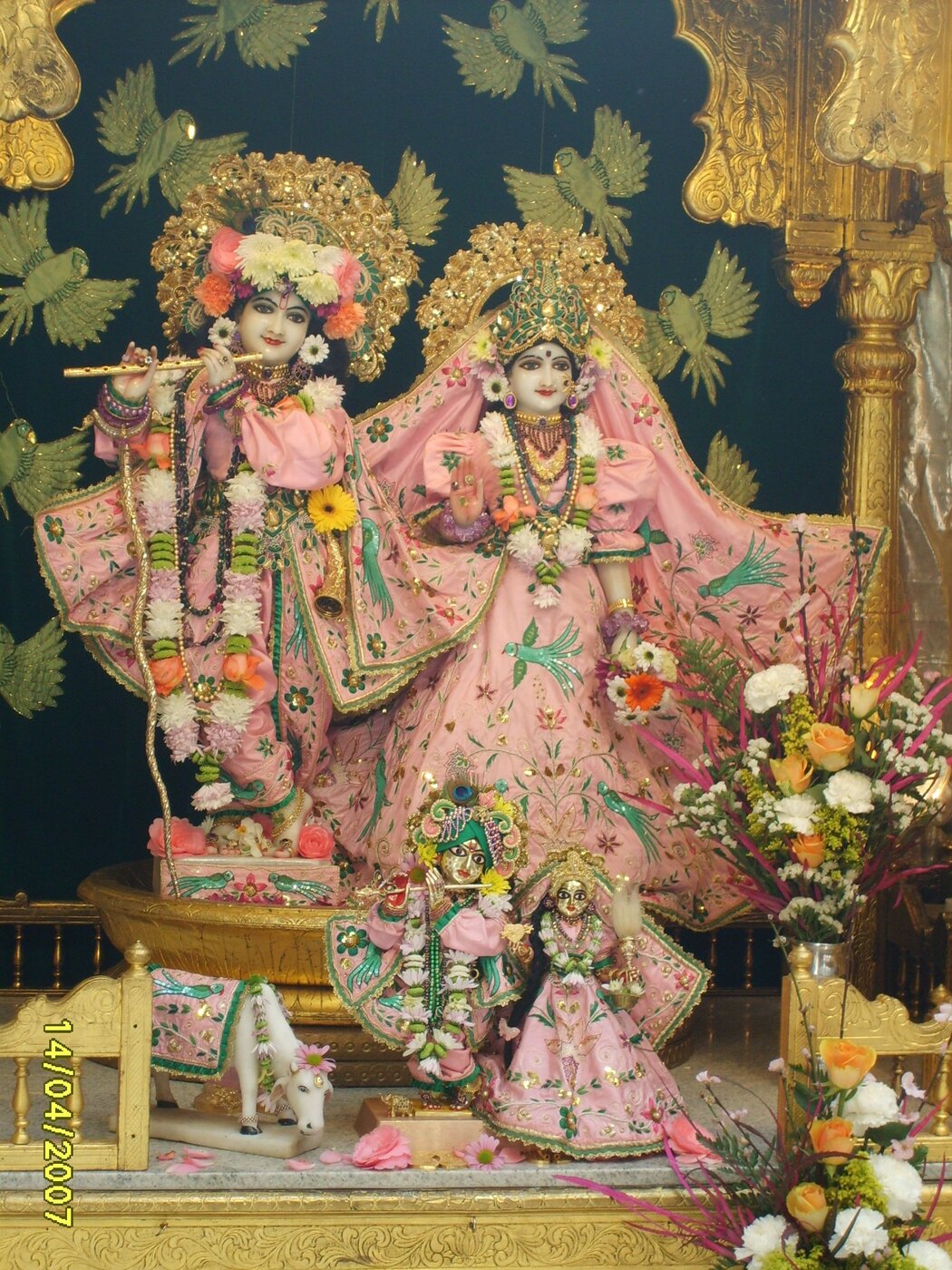
While at Vrindavana, Vishvanatha also took up the worship of a Deity named Gokulananda — installed as Radha-Gokulananda — which remains enshrined in Vrindavana to this day. The temple built around this Deity, the Radha-Gokulananda temple, later became the site of Vishvanatha's own samadhi, standing in the same courtyard as the memorials of Lokanatha Gosvami and Narottama Dasa Thakura, two figures central to the generation just before his own.
It was from this base at Radha-kunda that Vishvanatha produced his most influential work, the Sarartha-darsini commentary on the Srimad-Bhagavatam, along with dozens of other commentaries and original treatises over the following decades.
Living Inside the Gosvami Tradition #
What made this settling-in at Radha-kunda significant was not merely geography but access. Rupa Gosvami, Sanatana Gosvami, Raghunatha Dasa Gosvami and their contemporaries had, over the preceding century, produced an enormous body of Sanskrit devotional literature — philosophical treatises, poetry, drama, scriptural commentary — much of which existed only in manuscript form, preserved and copied by the small community of renunciate scholars who continued to live in Vrindavana after the Gosvamis' own disappearances. By residing at Radha-kunda among the custodians of this literature, Vishvanatha gained the kind of sustained access to primary texts that a visiting scholar could not easily replicate. Later sources describe him as having "very intently studied the books and letters of the Gosvamis," a phrase that captures both his method and his advantage: he was not working from secondhand summaries but directly from the tradition's own foundational documents.
The Deity of Gokulananda #
Alongside his textual work, Vishvanatha also took on the responsibility of Deity worship, establishing or continuing the service of Sri Sri Radha-Gokulananda in Vrindavana. This was not an incidental detail: in Gaudiya Vaishnava practice, scholarship and Deity worship were never treated as separate tracks, and a rasika commentator explaining the intimate moods of Radha and Krishna's Vraja pastimes was, in the same breath, expected to be personally engaged in serving Their arca-vigraha, or worshipable form. The temple that grew up around this Deity, the Radha-Gokulananda temple, would eventually become known as much for housing Vishvanatha's own samadhi as for the Deity that gave it its name.