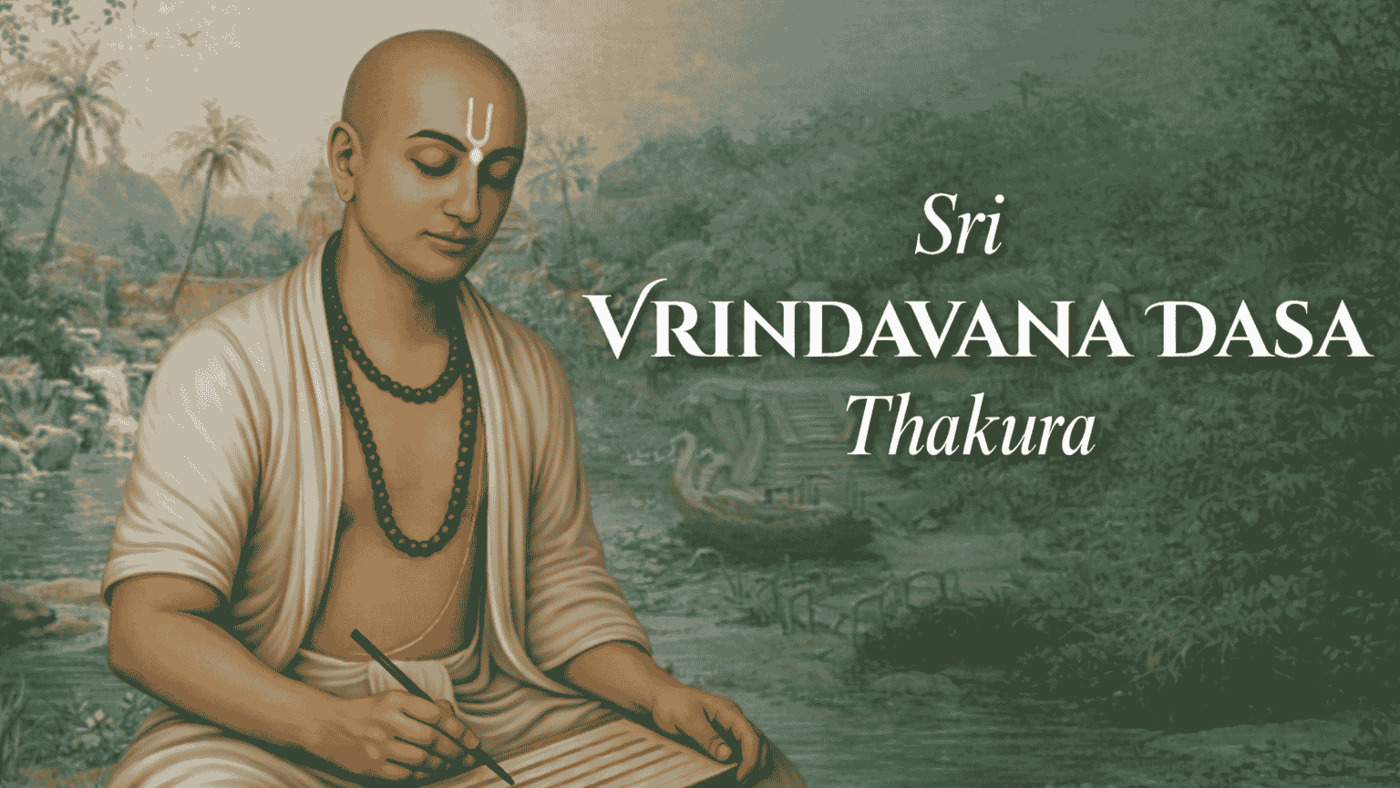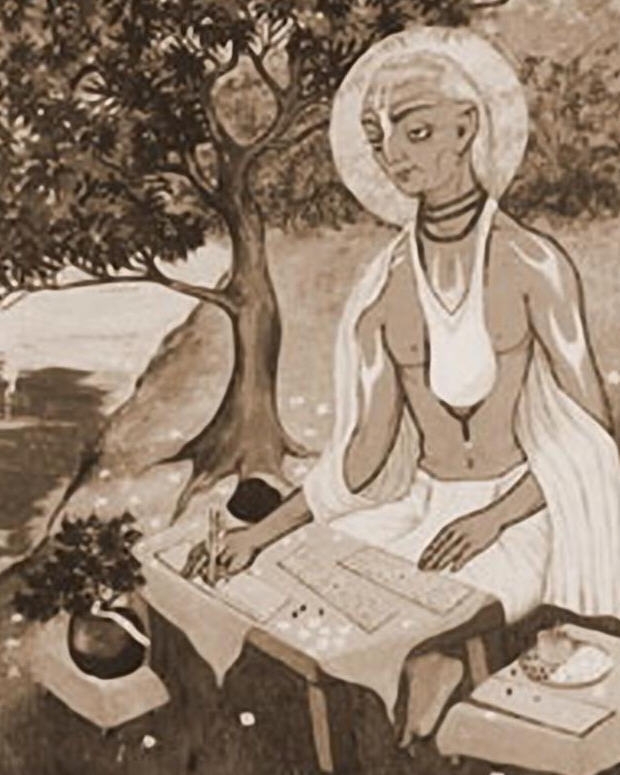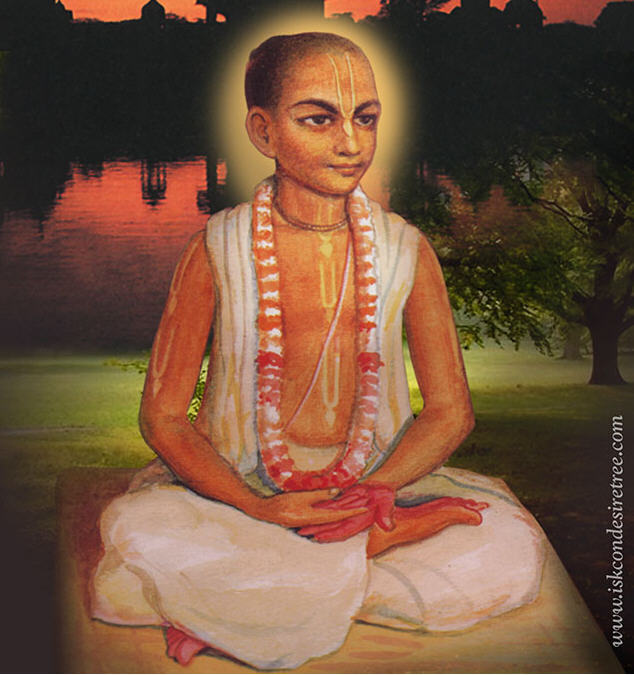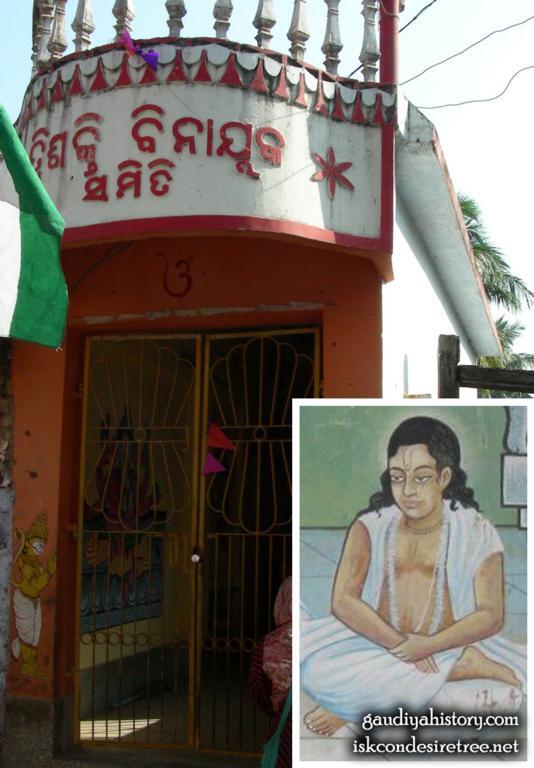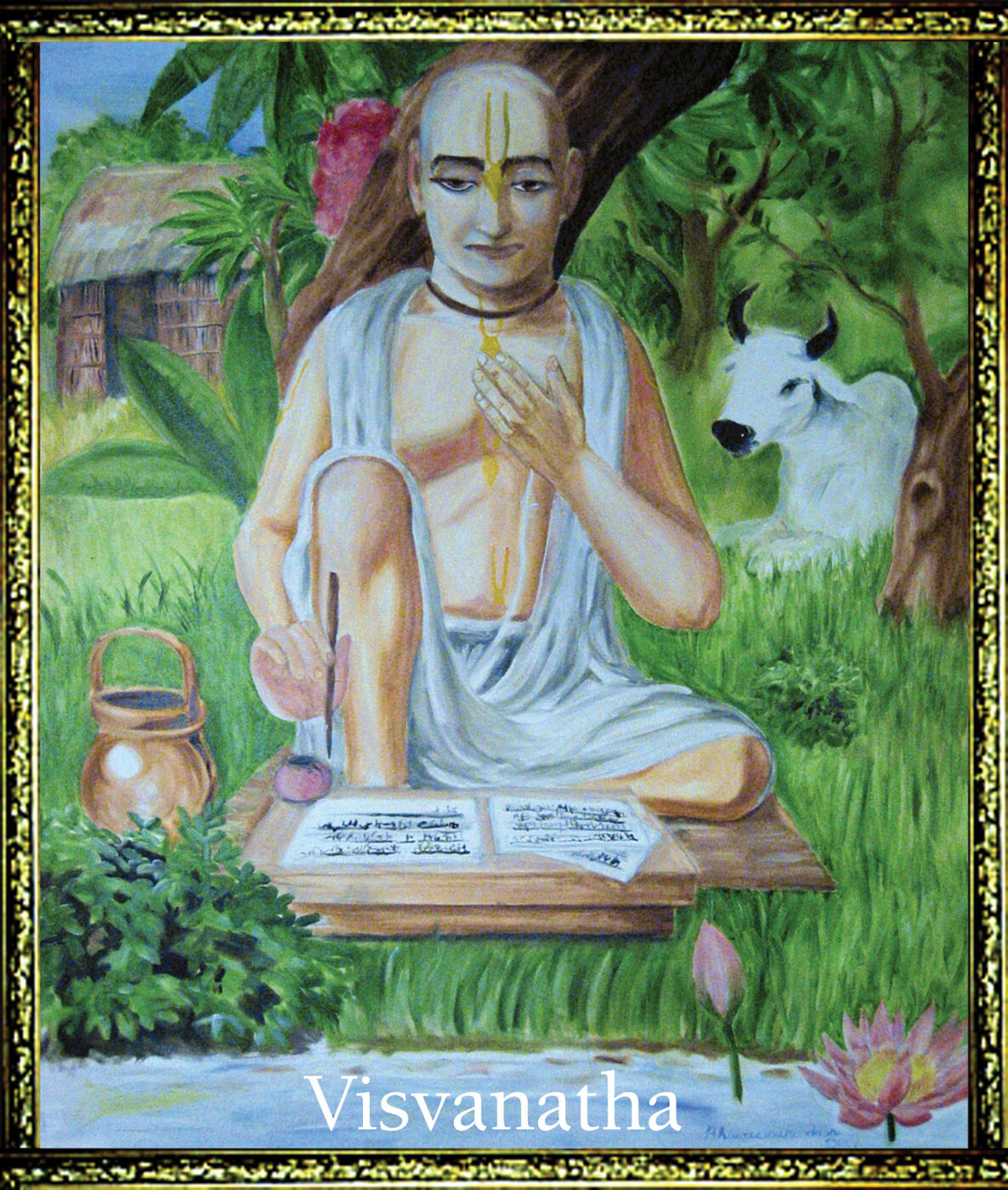
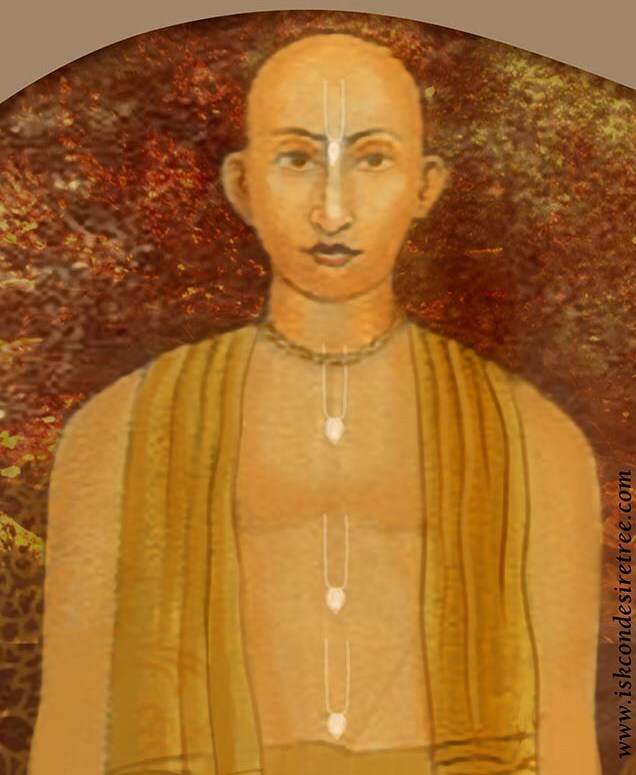
Srila Vishvanatha Chakravarti Thakura
Author of the Sarartha-darsini and Architect of Raganuga-Bhakti
Also known as Visvanatha Cakravarti Thakura, Harivallabha Dasa, Vishvanath Chakravarti
“O devotees, this poor creature is standing at your doorway, waving his tail and barking. Please let him have a little prasadam, so that he may become exceptional among dogs and get the best of masters as his owner.”
His own humility-verse appended to his commentary on SB 10.87.50, punning on his name; quoted by Srila Prabhupada in his purport to the same verse.
Sometime in the middle of the seventeenth century, in a Brahmana household in Bengal's Nadia district, a boy was born who would become one of the most quoted commentators in the history of Gaudiya Vaishnavism. Srila Vishvanatha Chakravarti Thakura left almost no personal trace in the historical record beyond his own books — no diary, no eyewitness memoir of the kind that survives for Sri Chaitanya's own generation — yet his Sarartha-darsini commentary on the Srimad-Bhagavatam and his short treatise Raga-vartma-candrika still shape how Gaudiya Vaishnavas, including Srila Prabhupada and the International Society for Krishna Consciousness, understand and practice raganuga-bhakti, the path of spontaneous loving devotion.
| Detail | Description |
|---|---|
| Birth | c. 1626 (sources vary considerably, from the 1610s to the 1660s) |
| Birthplace | Devagrama village, Nadia district, Bengal (one source places the same village in present-day Murshidabad district) |
| Guru | Sources differ: Krishnacarana Chakravarti of Saiyadabad, or Krishnacarana's own disciple Radharamana Chakravarti — both in the line descending from Narottama Dasa Thakura |
| Disappearance | c. 1708, on Vasanta-panchami in the month of Magha |
| Place of disappearance | Radha-kunda, Vrindavana |
| Major works | Sarartha-darsini, Raga-vartma-candrika, Madhurya-kadambini, Sri Gurvastakam, an incomplete commentary on Sri Chaitanya-charitamrita |
| Pen name | Harivallabha Dasa, used for his Bengali devotional songs |
A Brahmana Family in Nadia #
Vishvanatha was born into a Radhi-sreni Brahmana family, one of Bengal's traditional Brahmana lineages, the son of Rama Narayana Chakravarti and younger brother of Rambhadra and Raghunatha. Sources describing his childhood agree on very little beyond this, but several repeat a specific detail: as a schoolboy at Nadia he completed his studies in grammar, poetry and rhetoric with unusual speed, and is remembered for once defeating a visiting pandit in open debate while still a student himself.
From childhood, biographers say, he showed no attachment to household life. His father, hoping to anchor him at home, arranged his marriage while he was still young. It did not work. Later accounts state that before leaving home for good, Vishvanatha personally taught his wife the Bhagavatam and asked her to take up devotional worship of the Lord in his absence — an account that, if accurate, is one of the only surviving glimpses of him as anything other than an author.
Renunciation and the Journey to Vrindavana #
To deepen his study of devotional scripture, Vishvanatha traveled to Saiyadabad (present-day Baharampur) in the Murshidabad region, where his guru lived. Exactly who that guru was is genuinely unsettled in the sources: some name Krishnacarana Chakravarti directly, "fourth in line from Narottama Dasa Thakura"; others name Krishnacarana's own disciple, Radharamana Chakravarti, as the one who actually initiated Vishvanatha. Both figures place him within the spiritual line descending from Narottama Dasa Thakura, but the sources do not agree on which of the two conferred diksha directly, and this account leaves that question open rather than guessing.
After his studies, Vishvanatha renounced family life entirely and departed for Vrindavana. His relatives are said to have tried to bring him back and failed. The next chapter of his life, his arrival and settling in Vrindavana, placed him at the heart of the Gosvami tradition he would spend the rest of his life documenting and systematizing.
The Sarartha-darsini and a Library of Commentaries #
At Vrindavana, Vishvanatha produced what later generations would recognize as his central legacy: the Sarartha-darsini, a commentary on the Srimad-Bhagavatam especially prized for its treatment of the Tenth Canto's Vrindavana pastimes. Srila Prabhupada draws on it constantly in his own Bhagavatam purports — on the meaning of a single word, on the psychology of the gopis, on the technical sense of a verse — a debt explored on this commentary's own page. Vishvanatha also wrote a Sararthavarsini commentary on the Bhagavad-gita and an incomplete Sanskrit commentary on Sri Chaitanya-charitamrita, alongside commentaries on several works of Rupa Gosvami. Sources credit him with anywhere from roughly seventeen major titles to as many as sixty works once minor commentaries and hymn collections are counted — the exact number is simply not settled.
Mapping the Path of Spontaneous Love #
Vishvanatha's most distinctive theological contribution was his systematic treatment of raganuga-bhakti — devotion practiced by following, rather than merely regulating, spontaneous loving attachment to Krishna. His Raga-vartma-candrika lays out, in two sections, how vaidhi-bhakti (rule-based devotion) differs from raganuga-bhakti, and how a practitioner may inwardly identify with a particular eternal associate of Radha in Vraja — a maidservant, or manjari — while outwardly continuing ordinary devotional practice. His Madhurya-kadambini, built on a single verse of Rupa Gosvami, mapped the entire progression of bhakti from initial faith through saintly association to the final flowering of prema, pure love of Krishna. Together these two works became, and remain, standard reference points for how Gaudiya Vaishnavas describe the inner life of devotion.
Prayers Still Sung Today #
Paradoxically, the composition of his that reaches the most people today is not a commentary at all but a short Sanskrit prayer: Sri Gurvastakam, the "Eight Prayers to the Spiritual Master" that opens with the words samsara-davanala-lidha-loka. It is sung every morning in ISKCON temples worldwide during guru-puja, making Vishvanatha's own words, in this sense, more widely recited today than at any point in his lifetime. He also wrote numerous Bengali devotional songs under the pen name Harivallabha Dasa and compiled a body of Sanskrit prayers to Radha and Krishna known as Stavamrta-lahari.
Disappearance and a Debated Connection #
Late in his life, tradition holds, Vishvanatha was too old to travel to Jaipur to answer a challenge from rival scholars questioning the Gaudiya sampradaya's authority to worship its own Deities, so he deputed a younger scholar of the Vrindavana temple circle, Baladeva Vidyabhushana, to go in his place — a mission that produced the Govinda-bhashya and the title "Vidyabhushana." How close their personal relationship was is not fully clear from the sources this account draws on; some call Baladeva his disciple, others describe a looser association through Vrindavana's scholarly community. Vishvanatha is said to have passed away at Radha-kunda on Vasanta-panchami in the month of Magha, commonly dated to around 1708, though a few sources place his samadhi decades earlier. His memorial stands today in the courtyard of the Radha-Gokulananda temple in Vrindavana, and his commentaries remain among the most-cited Gaudiya Vaishnava sources in Srila Prabhupada's own writings.
Songs in the Vaishnava Song Book #
This site's own Vaishnava Song Book carries 4 songs attributed to Srila Vishvanatha Chakravarti Thakura — see the full author page here.
Scriptural evidence
he bhakta dvary ayam cancad-
valadhi rauti vo manak
prasadam labhatam yasmad
visistah sveva nathati
"O devotees, this poor creature is standing at your doorway, waving his tail and barking. Please let him have a little prasadam so that he may become exceptional among dogs and get the best of masters as his owner."
From the purport: Purport excerpt: "Here the acarya makes a pun on his own name: vis(istah), 'exceptional'; sva(iva), 'like a dog'; natha(ati), 'having a master.' Such is the perfection of Vaisnava humility."
Vishvanatha Chakravarti Thakura appended this verse, punning on his own name, to his own commentary on this closing verse of the Bhagavatam's Tenth Canto prayers of the personified Vedas; Srila Prabhupada reproduces and explains the pun in his purport.
- Visvanatha Chakravarti - Wikipedia
- Sri Visvanatha Cakravarti Thakura - Gaudiya History
- Visvanatha Cakravarti Thakura - Biography (Pastimes) - Gaudiya History
- A Short Biography of Srila Visvanatha Cakravarti Thakura - ISVARA.org
- Sri Vishvanatha Chakravarti Thakura - ISKCON Bangalore
- Vishvanatha Chakravarti Thakura - Stephen Knapp
- Viswanath Chakravarti Thakur - Hare Krsnas (harekrsna.com)
- Teachings of Srila Visvanatha Cakravarti Thakura - Vanipedia
- Srimad-Bhagavatam 10.87.50, Purport - Vedabase
Disciples
Frequently asked
When was Srila Vishvanatha Chakravarti Thakura born?
Srila Vishvanatha Chakravarti Thakura appeared c. 1626 (sources vary widely, 1610s-1660s) in Devagrama, Nadia district, Bengal.
When and where did Srila Vishvanatha Chakravarti Thakura disappear?
Srila Vishvanatha Chakravarti Thakura disappeared c. 1708, Vasanta-panchami (Magha) at Radha-kunda, Vrindavana.
What are the main pastimes of Srila Vishvanatha Chakravarti Thakura?
Dedicated pages on this site cover: Birth and Early Life, Arrival in Vrindavana, Sarartha-Darsini and the Bhagavatam Commentary, Commentary on Chaitanya-Charitamrita, Systematizing Raganuga-Bhakti, Devotional Songs and Prayers, Disappearance and Legacy.