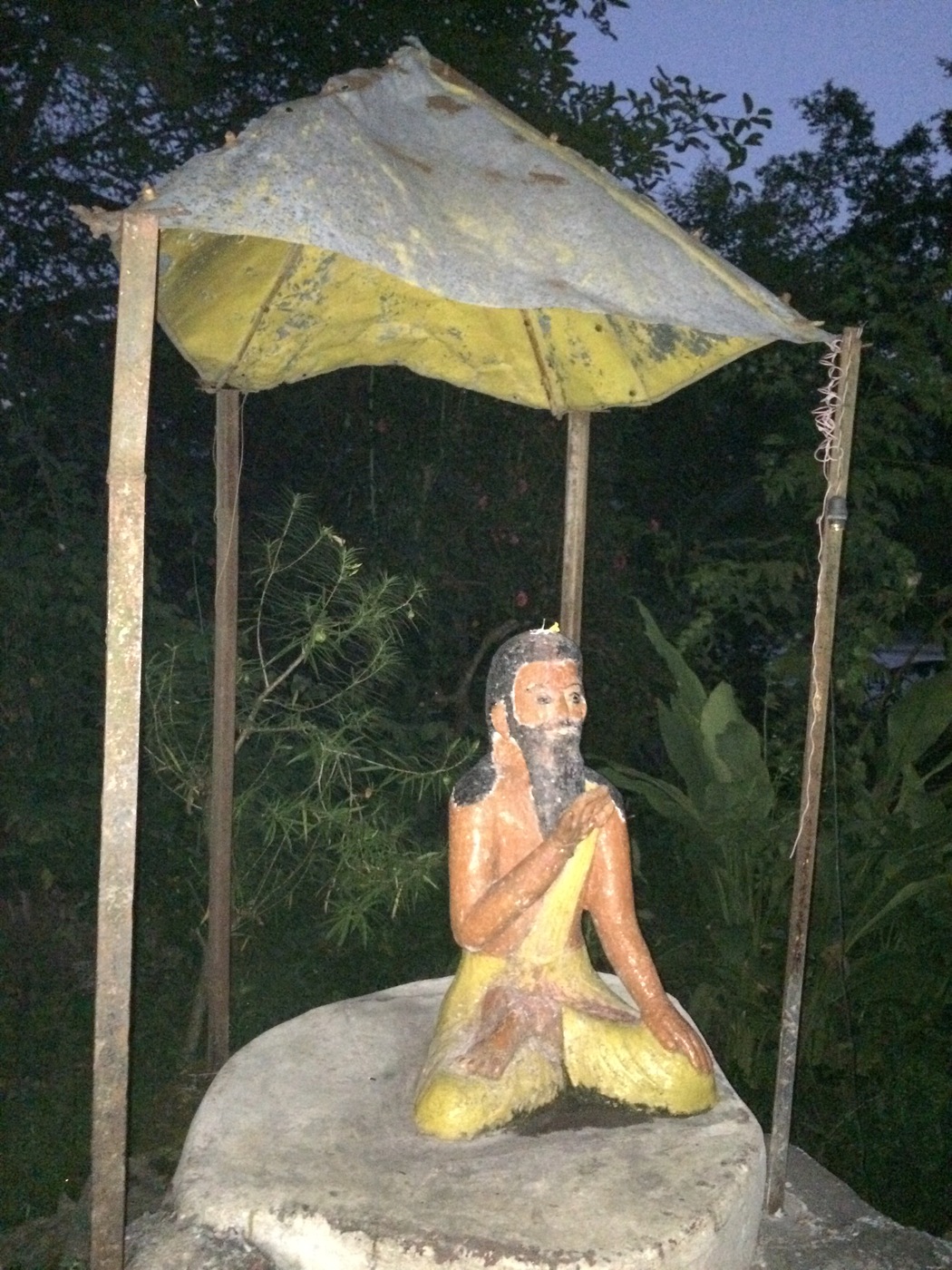
Before she was ever queen of the Kuru dynasty, Satyavati was a fisherman's daughter who ferried travelers across a river for a living. Puranic tradition adds a stranger layer beneath even that. It holds that Satyavati herself had been born from a fish, the transformed body of a celestial woman named Adrika who had conceived after the seed of a distracted king fell into the water she lived in. This website reports that detail as the puranic legend it is, not as verified history. But it is the traditional explanation for the name she carried before her own children changed it: Matsyagandha, "the one who smelled of fish."
A Boat, a Fog, and an Island #
It was in the course of her ferrying work that Satyavati encountered the wandering sage Parashara. Accounts agree that he was overcome with desire for her the moment he saw her. She resisted him, pleading to keep her chastity. Parashara then used his own mystic power in three ways: he raised a fog around the boat to conceal them both, he turned her fish-scent into a permanent fragrance of musk, and he created an island in the middle of the river for the meeting itself. Before it was over, he told her two things: that she would remain a virgin afterward regardless of what followed, and that the son born of this union would be a partial incarnation of Vishnu, "a man of purity, the spiritual master of the entire world," destined to divide the Vedas. Satyavati's pregnancy and delivery were both said to be instantaneous. The child was said to mature into full ascetic adulthood the moment he was born, on the same island. Before departing for a life of austerity in the forest, he promised his mother that he would return to her side whenever she truly needed him.
He was named for the two facts of that single day: Krishna, for the darkness of his complexion, and Dvaipayana, "island-born." Together the two names combine into the one most Vaishnavas actually use for him, Krishna-Dvaipayana Vyasa. The far more common title, simply "Vyasa," is itself a description rather than a name, meaning "one who divides" or "compiles."
Where, Exactly, Did This Happen #
Vaishnava sources do not agree on the river or the region. The most widespread devotional account, drawn from the Mahabharata's own opening books, places the island in the Yamuna. A separate, still-living local tradition in Nepal identifies a cave near Damauli, on the Madi and Seti rivers in what is now called Vyas Municipality, as both his conception site and a place he returned to later in life. A small deity of him stands at the cave's entrance today. The site is sometimes also, confusingly, associated in local memory with the authorship of the Ramayana, but that work belongs to the different sage Valmiki, not to Vyasa. A third tradition, citing the Padma Purana, places the island in the Yamuna near a spot called Soma Tirtha. This website has not found a way to adjudicate between these traditions and reports the disagreement honestly rather than picking a winner.
Vyasa in Srimad-Bhagavatam's Catalogue of Incarnations #
Whatever the precise geography, Srimad-Bhagavatam treats the birth itself as a matter of settled theological importance. Its third chapter runs through a formal list of the Supreme Lord's incarnations, one by one, and gives Vyasadeva a numbered place among them: "Thereafter, in the seventeenth incarnation of Godhead, Sri Vyasadeva appeared in the womb of Satyavati through Parashara Muni, and he divided the one Veda into several branches and subbranches, seeing that the people in general were less intelligent" (Srimad-Bhagavatam 1.3.21). Srila Prabhupada's own lectures on this verse add a detail the Sanskrit itself only implies: that Satyavati's remaining a virgin after this birth, exactly as Parashara had promised, was itself part of why she could later be married, without any social irregularity, to King Shantanu. That marriage produced the Bhishma of Mahabharata fame and set the entire Kuru succession crisis in motion a generation later.
An Office Held Across the Ages #
There is one more layer of tradition worth reporting honestly, because it shapes how Vaishnavas actually think about who Vyasadeva is. The Vishnu Purana and Vayu Purana both describe "Vyasa" as a recurring cosmic office rather than a single unrepeated individual. In every Dvapara-yuga of the current cosmic cycle, they say, the same task of dividing the Veda falls to a different personality who then bears the title. Twenty-eight such Vyasas are said to have already appeared in the present Manvantara. Krishna-Dvaipayana, the son of Parashara and Satyavati, is reckoned as the twenty-eighth and most recent of them. Gaudiya Vaishnavas honor this Vyasa specifically as an incarnation of Narayana. But the broader Puranic framework helps explain a detail that otherwise seems strange: how one person can be credited with compiling literature spanning so vast a scope, across a role that Puranic cosmology itself describes as periodically renewed. The knowledge this particular Vyasa organized, and the disciples he entrusted it to, are told next, on Dividing the Single Veda into Four.