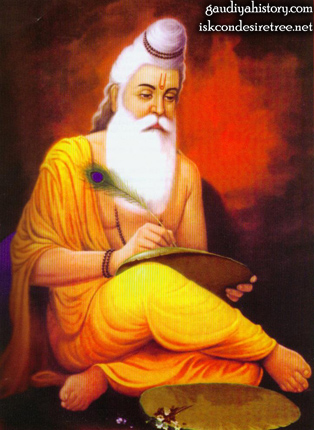
Most people who take part in a Vyasa-puja ceremony today are not thinking about a sage who lived at the dawn of Kali-yuga. They are honoring their own living or departed spiritual master, on that guru's own appearance day. The name itself, though, is not a coincidence or a metaphor. It is a direct, still-functioning link back to Krishna-Dvaipayana Vyasa. Srila Prabhupada explained the reasoning behind it in his own words on more than one occasion.
The Seat Called Vyasasana #
In Gaudiya Vaishnava temples, a spiritual master sits, when honored formally, on an elevated seat called vyasasana, "the seat of Vyasa." Srila Prabhupada, speaking at a Vyasa-puja ceremony in Hyderabad in 1976, explained the term to his audience directly: "This asana where they have seated me, it is called vyasasana. The guru is the representative of Vyasadeva. Every one of you have heard the name of Vyasadeva, Veda-vyasa. So anyone who represents the great acharya, Vyasadeva, he is allowed to sit on the vyasasana. So Vyasa-puja... Guru is representative of Vyasadeva, therefore his birthday anniversary is accepted as Vyasa-puja" (Sri Vyasa-puja Lecture, Hyderabad, 19 August 1976). The logic is direct rather than merely symbolic. A bona fide guru transmits the same body of Vedic knowledge that Vyasadeva first organized and handed down. The disciplic succession, or guru-parampara, is understood as one unbroken chain of that same transmission, teacher to disciple, reaching back to Vyasadeva himself and, before him, to Narada Muni and Lord Brahma.
Worshiping the Birthday of Guru #
Prabhupada made the same point even more plainly in an informal exchange during a morning walk in Bombay in 1974, when a disciple asked him a direct question about the term. His answer was characteristically economical: "No, Vyasa, Vyasadeva... The guru is called Vyasa. That is one of... But the original Vyasa is one. Just like we. We worship the birthday of guru as Vyasa-puja day, because guru is representative of Vyasa" (Morning Walk, Bombay, 6 May 1974). The phrasing here matters. There is one original Vyasa, Krishna-Dvaipayana. But every subsequent guru in the disciplic succession is honored, functionally, under that same title, because each one carries forward the identical work of transmitting Vedic knowledge that the original Vyasa performed.
An Annual Practice, Still Observed #
In practical terms, this means every guru in the Gaudiya Vaishnava tradition, including Srila Prabhupada himself, has his own appearance day marked each year as his personal Vyasa-puja, distinct from the calendar festivals shared across the whole tradition. Disciples traditionally compose written offerings for the occasion, expressing gratitude and reaffirming their commitment to the teaching received. ISKCON has continued this practice in published form since the movement's earliest years, and it is still carried out in temples and homes wherever Srila Prabhupada's disciples and their own students gather each year on his appearance day. Srila Prabhupada is, for most people connected to this website's own tradition, the guru whose Vyasa-puja is most immediately relevant. But the same principle applies to every acharya in the chain running back through him.
Prabhupada's own conversation records show this was not an abstract point of etiquette for him but something he expected disciples to actually understand, not merely perform. When asked directly what Vyasa-puja meant during a 1976 morning walk in Bombay, several of his own secretaries and assistants could only describe items of clothing or physical arrangements associated with the ceremony before Prabhupada himself supplied the substantive answer. The exchange is a useful reminder that the outward form of a festival, the seat, the offerings, the flowers, means little on its own without the underlying reason. Prabhupada gave that reason plainly: the person seated there is a representative of Vyasadeva, not Vyasadeva's replacement or equal. He carries forward a specific, traceable transmission rather than claiming any independent authority of his own.
One Office, Carried Forward #
This website's page on Vyasadeva's own birth notes that Vaishnava cosmology already describes "Vyasa" as an office renewed across ages, with twenty-eight Vyasas having appeared in the current cycle before the birth of Krishna-Dvaipayana himself. See Birth of Krishna-Dvaipayana for that fuller picture. Vyasa-puja extends the same underlying idea into ordinary devotional life, on a much smaller and more personal scale. It does not mean that every guru literally is Vyasadeva. It means that every guru functions, for his own disciples, exactly as Vyasadeva functioned for the world: as the one who receives Vedic knowledge faithfully and hands it on unchanged. It is, in the end, one of the most concrete and least abstract connections this entire website can draw between an ancient sage and the tradition still actively practiced in its own temple today.