Sri Chaitanya Mahaprabhu

Accepting the Sannyasa Order of Life

At twenty-four, Nimai Pandita renounces home, caste and family to become Sri Krishna Chaitanya

Katwa, 1510

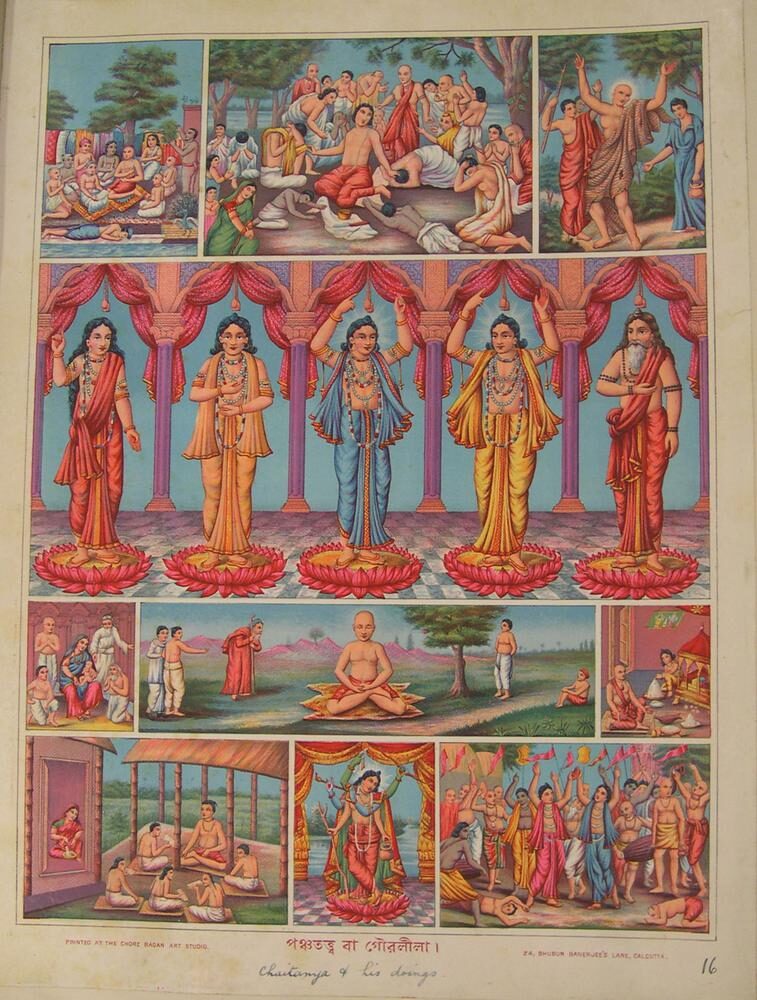
Chore Bagan Art Studio colour lithograph titled 'Panchatattva ba Gauralila' (Pancha-tattva or the Pastimes of Gaura), c.1895. Central band shows the five members of the Pancha-tattva on lotuses; ten surrounding vignettes show Chaitanya's pa
Chore Bagan Art Studio colour lithograph titled 'Panchatattva ba Gauralila' (Pancha-tattva or the Pastimes of Gaura), c.1895.Wikimedia Commons (British Museum) · public domain

By the time He was twenty-four, Chaitanya Mahaprabhu had already transformed Nabadwip: a nightly gathering of devotees in a private courtyard had grown into open, town-wide sankirtana, the local Muslim administration had withdrawn its opposition, and even the town's most notorious sinners had been reclaimed. Yet Nimai — still, in the eyes of most of Bengal, a brilliant young householder pandit — became convinced that His mission of freely distributing love of Krishna to every soul, irrespective of caste or social station, could not fully succeed while He remained a grihastha (householder), because the honour and deference automatically extended to a married brahmana scholar in Bengali society would always stand between Him and the most fallen people He most wished to reach.

DetailDescription
Age at renunciationTwenty-four
PlaceKatwa, on the banks of the Ganges
Sannyasa guruKeshava Bharati
Sannyasa nameSri Krishna Chaitanya
Insignia receivedDanda, kamandalu, kaupina and bahirvasa
Journey afterwardsShantipura, then Jagannatha Puri

Why the Renounced Order Was Necessary #

The renounced order of sannyasa carried exactly the opposite social signal: a sannyasi renounces all family ties, all claim to caste privilege, and depends on the charity of others for his very food, becoming in the eyes of society the equal of anyone, high or low. By formally accepting sannyasa, Nimai would strip away the last worldly distinction that stood between Himself and the people He had come to deliver — a decision consistent with, but far more drastic than, everything He had already been doing in the sankirtana movement.

Sannyasa from Keshava Bharati at Katwa #

Having resolved on this course, He is said to have left home quietly at night, travelling from Nabadwip to the town of Katwa on the banks of the Ganges, so as to spare His mother and young wife the anguish of watching Him depart. At Katwa He approached the sannyasi Keshava Bharati and requested initiation into the renounced order; despite Keshava Bharati's initial hesitation to accept as a disciple someone so evidently exalted, Nimai insisted, and Keshava Bharati performed the sannyasa ceremony, shaving Nimai's head, giving Him the danda (the sannyasi's staff) and kamandalu (water pot), dressing Him in the simple kaupina and bahirvasa of a renunciant, and bestowing on Him the sannyasa name by which He would be known for the rest of His life and for all the centuries since: Sri Krishna Chaitanya.

The Grief of Sachi Devi and Vishnupriya #

When word reached Nabadwip of what had happened, the devotees — led by Nityananda Prabhu and including Mukunda Datta and others — hurried to Katwa, arriving in time to witness the immediate aftermath. Sachi Devi and Vishnupriya, informed that Nimai had renounced the world without even a final farewell, were overcome with grief; the biographies do not soften this moment, describing at length the household's anguish at losing, in a single night, the son and husband on whom their whole domestic life had depended.

The Last Meeting at Shantipura #

Advaita Acharya and the assembled devotees eventually persuaded the newly sannyasi Krishna Chaitanya to travel first to Shantipura, to the home of Advaita Acharya, specifically so that Sachi Devi could see her son once more in His new condition before He departed for Puri — a meeting remembered as one of the most tender and sorrowful in the entire Vaishnava literature, mother and son both accepting, through tears, that His path now lay elsewhere.

Life as a Wandering Sannyasi #

From Katwa onward Sri Krishna Chaitanya belonged, in the fullest social sense, to no one household and no caste — a wandering mendicant sannyasi who would spend the following twenty-four years walking the length of India, teaching kings and outcastes with the same freedom, before finally settling at Jagannatha Puri for the last eighteen years of His manifest presence. Gaudiya Vaishnavas regard His acceptance of sannyasa not as a rejection of family life itself, which the tradition continues to honour, but as the deliberate, personal sacrifice through which the Lord removed every remaining social barrier between Himself and the most fallen souls of the world He had come to deliver.
Scriptural sources for this pastime

অতএব অবশ্য আমি সন্ন্যাস করিব ।
সন্ন্যাসি–বুদ্ধ্যে মোরে প্রণত হইব ॥ ২৬৫ ॥

ataeva avaśya āmi sannyāsa kariba
sannyāsi-buddhye more praṇata ha-iba

Word for word

ataeva — therefore; avaśya — certainly; āmi — I; sannyāsa — the renounced order of life; kariba — shall accept; sannyāsi-buddhye — by thinking of Me as a sannyāsī; more — unto Me; praṇata — bow down; ha-iba — they shall do.

“I shall accept the sannyāsa order of life, for thus people will offer Me their obeisances, thinking of Me as a member of the renounced order.

CC Ādi 17.265 Śrī Caitanya-caritāmṛta

His stated reason for taking sannyasa: so that offenders would offer obeisances and thereby be delivered.

এত বলি’ ভারতী গোসাঞি কাটোয়াতে গেলা ।
মহাপ্রভু তাহা যাই’ সন্ন্যাস করিলা ॥ ২৭২ ॥

eta bali’ bhāratī gosāñi kāṭoyāte gelā
mahāprabhu tāhā yāi’ sannyāsa karilā

Word for word

eta bali’ — saying this; bhāratī — Keśava Bhāratī; gosāñi — the spiritual master; kāṭoyāte — to Katwa; gelā — went; mahāprabhu — Lord Caitanya Mahāprabhu; tahā — there; yai’ — going; sannyāsa — the renounced order of life; karilā — accepted.

After saying this, Keśava Bhāratī, the spiritual master, went back to his village, Katwa. Lord Caitanya Mahāprabhu went there and accepted the renounced order of life [sannyāsa].

CC Ādi 17.272 Śrī Caitanya-caritāmṛta

Kesava Bharati returns to Katwa, where the Lord goes and accepts the renounced order.

সঙ্গে নিত্যানন্দ, চন্দ্রশেখর আচার্য ।
মুকুন্দদত্ত,—এই তিন কৈল সর্ব কার্য ॥ ২৭৩ ৷৷

saṅge nityānanda, candraśekhara ācārya
mukunda-datta, — ei tina kaila sarva kārya

Word for word

saṅge — in His company; nityānanda — Nityānanda Prabhu; candraśekhara ācārya — Candraśekhara Ācārya; mukunda-datta — Mukunda Datta; ei tina — these three; kaila — performed; sarva — all; kārya — necessary activities.

When Śrī Caitanya Mahāprabhu accepted sannyāsa, three personalities were with Him to perform all the necessary activities. They were Nityānanda Prabhu, Candraśekhara Ācārya and Mukunda Datta.

CC Ādi 17.273 Śrī Caitanya-caritāmṛta

The three associates present at the sannyasa: Nityananda, Candrasekhara Acarya and Mukunda Datta.

চব্বিশ বৎসর-শেষ যেই মাঘ-মাস ।
তার শুক্লপক্ষে প্রভু করিলা সন্ন্যাস ॥ ৩ ॥

cabbiśa vatsara-śeṣa yei māgha-māsa
tāra śukla-pakṣe prabhu karilā sannyāsa

Word for word

cabbiśa — twenty-fourth; vatsara — of the year; śeṣa — at the end; yei — that; māgha-māsa — the month of Māgha (January-February); tāra — of that; śukla-pakṣe — in the waxing period of the moon; prabhu — the Lord; karilā — accepted; sannyāsa — the sannyāsa order of life.

At the end of His twenty-fourth year, in the month of Māgha, Śrī Caitanya Mahāprabhu accepted the sannyāsa order during the waxing period of the moon.

CC Madhya 3.3 Śrī Caitanya-caritāmṛta

The precise time: the end of His twenty-fourth year, in the month of Magha, during the waxing moon.

এতাং স আস্থায় পরাত্মনিষ্ঠা-
মধ্যাসিতাং পূর্বতমৈর্মহদ্ভিঃ ।
অহং তরিষ্যামি দুরন্তপারং
তমো মুকুন্দাঙ্ঘ্রিনিষেবয়ৈব ॥ ৬ ॥

etāṁ sa āsthāya parātma-niṣṭhām
adhyāsitāṁ pūrvatamair mahadbhiḥ
ahaṁ tariṣyāmi duranta-pāraṁ
tamo mukundāṅghri-niṣevayaiva

Word for word

etām — this; saḥ — such; āsthāya — being completely fixed in; para-ātma-niṣṭhām — devotion to the Supreme Person, Kṛṣṇa; adhyāsitām — worshiped; pūrva-tamaiḥ — by previous; mahadbhiḥ — ācāryas; aham — I; tariṣyāmi — shall cross over; duranta-pāram — the insurmountable; tamaḥ — the ocean of nescience; mukunda-aṅghri — of the lotus feet of Mukunda; niṣevayā — by worship; eva — certainly.

“[As a brāhmaṇa from Avantī-deśa said:] ‘I shall cross over the insurmountable ocean of nescience by being firmly fixed in the service of the lotus feet of Kṛṣṇa. This was approved by the previous ācāryas, who were fixed in firm devotion to the Lord, Paramātmā, the Supreme Personality of Godhead.’ ”

CC Madhya 3.6 Śrī Caitanya-caritāmṛta

The SB 11.23.57 verse He recited in ecstasy after sannyasa, defining its true purpose as service to Mukunda.