Nabadwip's most notorious criminals become the living proof that no soul is beyond the mercy of the holy name
Nabadwip, during the early sankirtana period
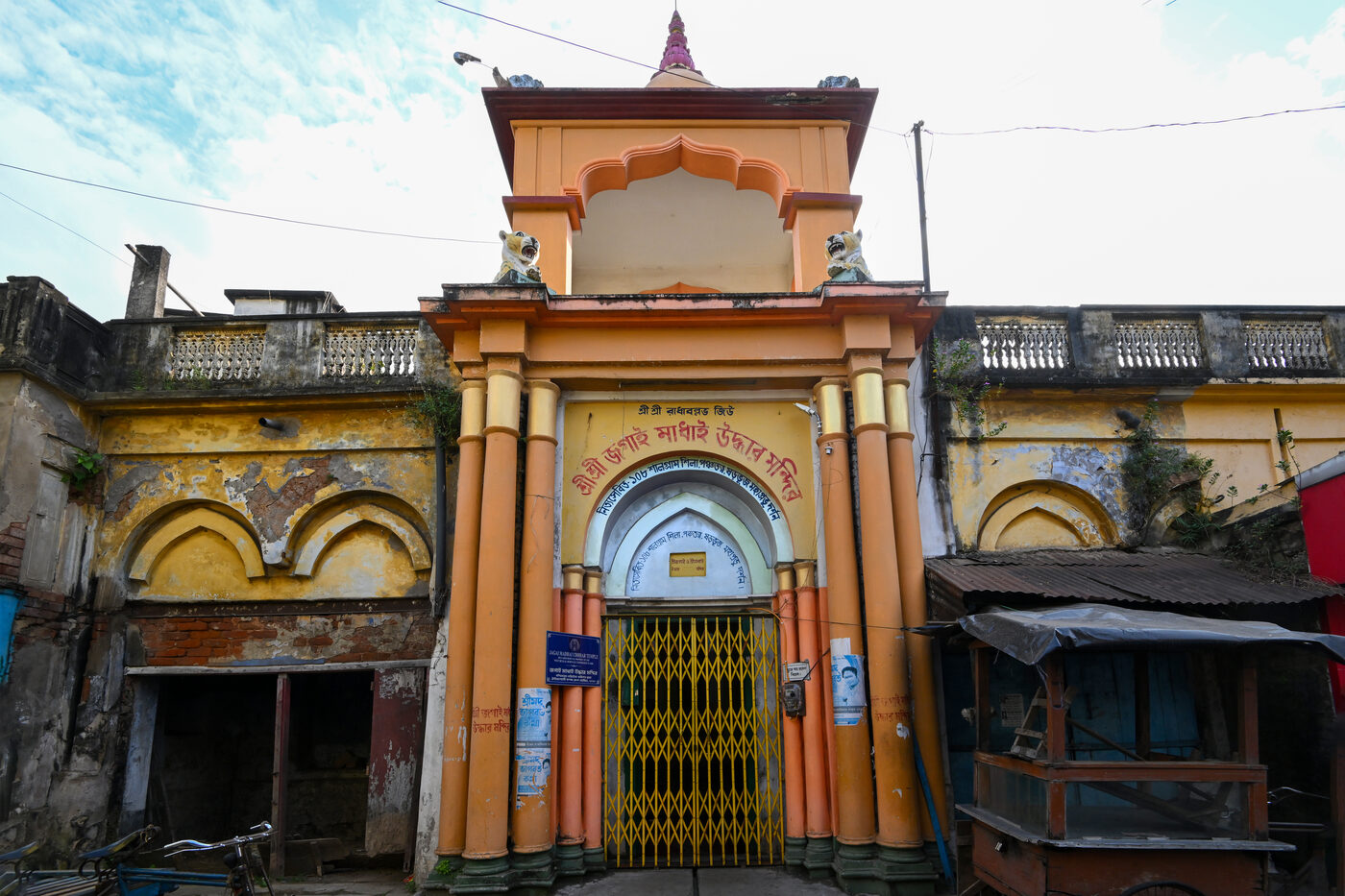
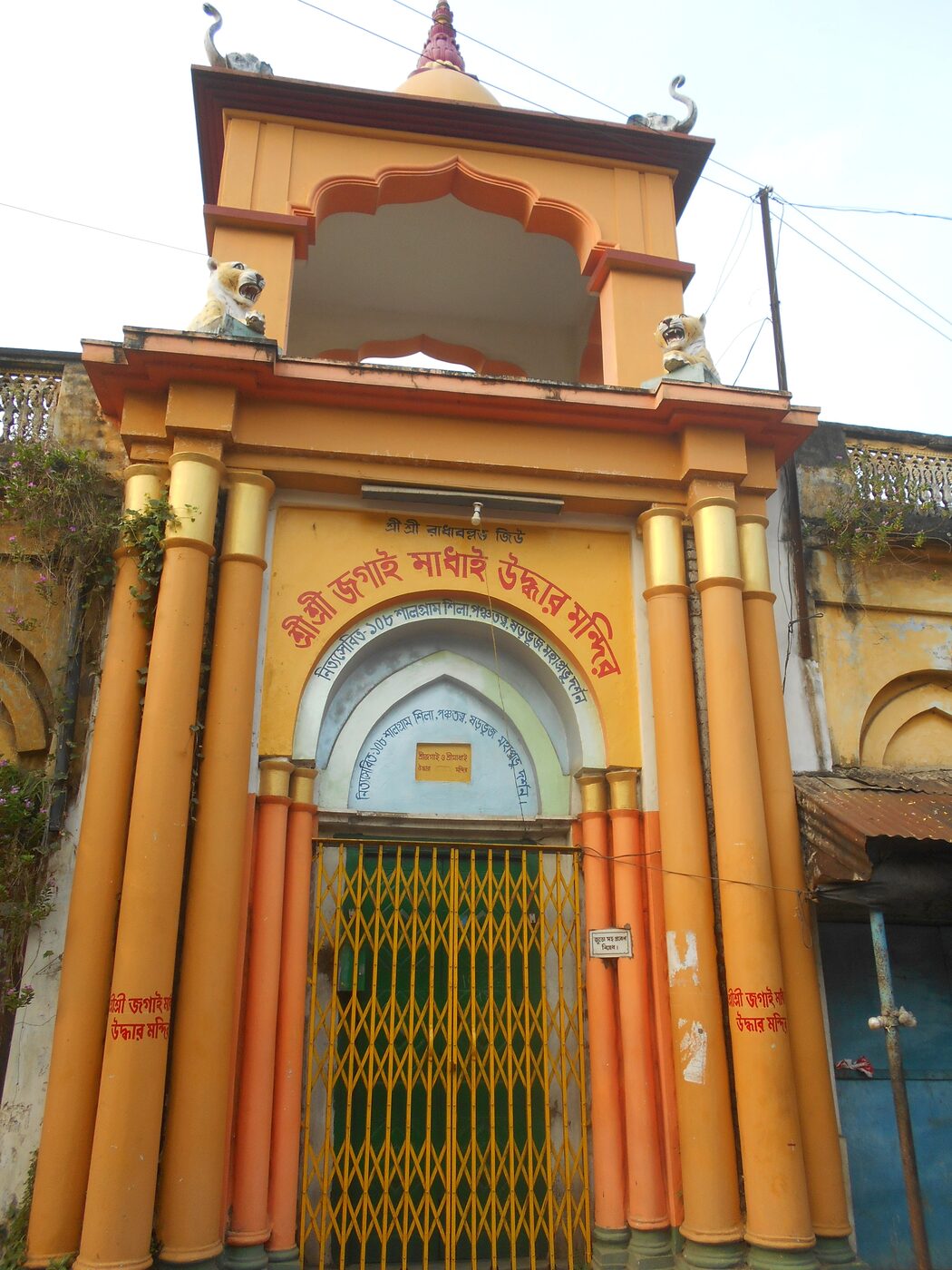
The Jagai Madhai Uddhar Temple at Nabadwip - the temple marking the traditional site where Nityananda Prabhu and Chaitanya delivered the brothers Jagai and Madhai.Wikimedia Commons · CC BY 4.0
Among the many souls touched by the sankirtana movement in Nabadwip, none is remembered more vividly, or cited more often, than the two brothers Jagai and Madhai. Born into a respectable brahmana family, the two had abandoned every trace of their upbringing: the biographies describe them as habitual drunkards, meat-eaters, thieves and troublemakers who terrorised the neighbourhood, so thoroughly degraded that ordinary townspeople crossed the street to avoid them and no one any longer expected — or even hoped for — their reform.
It was Nityananda Prabhu who first approached them directly. Encountering the two brothers drunk in the street, He spoke to them gently about the value of chanting the Lord's name and about the possibility, open to every soul without exception, of a different life.
Rather than receiving this compassion with gratitude, the intoxicated Madhai reacted with fury at what he took to be interference, and struck Nityananda Prabhu, cutting His forehead so severely that blood flowed freely; Jagai, though also drunk, was horrified at his brother's violence toward a Vaishnava sannyasi who had come only to help them and tried to restrain him.
Word of the assault on Nityananda Prabhu reached Chaitanya Mahaprabhu, who was said to have risen in righteous anger unlike any the devotees had seen from Him before, moving to confront the brothers Himself with the Sudarshana disc invoked in His hand — until Nityananda Prabhu, still bleeding, threw himself between the Lord and the two brothers and begged for their forgiveness, reminding Chaitanya Mahaprabhu that He had appeared in this age precisely to deliver the fallen, and that Jagai and Madhai, however degraded, were exactly the souls His mission existed for. Moved by His own devotee's mercy, the Lord relented.
What happened next is the heart of the story: seeing Nityananda Prabhu's blood and hearing of the Lord's compassion even after such an assault, Jagai and Madhai broke down completely, falling at the feet of both Nityananda Prabhu and Chaitanya Mahaprabhu, weeping and begging forgiveness for a lifetime of sin. Chaitanya Mahaprabhu accepted them on the spot, only asking that they give up their old habits of intoxication and violence; from that moment, Vaishnava tradition holds, the two brothers were transformed inwardly as completely as they had once been transformed outwardly into criminals — Madhai, in some tellings, remaining somewhat more prone to relapse and requiring the Lord's continued mercy, while both eventually became recognised as sincere, dedicated devotees.
News of the two most notorious sinners in Nabadwip becoming devotees spread through the town far faster than any sermon could have. Where the debate with Kashmiri Pandita had shown Nabadwip Nimai's unmatched intellect, and the sankirtana processions had shown the town His power to inspire ecstatic devotion, the deliverance of Jagai and Madhai showed something that convinced even sceptics of His mission's true nature: that the mercy of the holy name held no minimum qualification of birth, learning or past conduct. It is for this reason that "Jagai-Madhai" has become, across the whole of Gaudiya Vaishnava literature and preaching, the standard reference for the redemptive power of the holy name — devotees still pray, quoting the example of these two brothers, that if even they could be delivered by the Lord's mercy, no fallen soul is ever truly beyond hope.
তবে শচী দেখিল, রামকৃষ্ণ—দুই ভাই ।
তবে নিস্তারিল প্রভু জগাই–মাধাই ॥ ১৭ ॥
tabe śacī dekhila, rāma-kṛṣṇa — dui bhāi
tabe nistārila prabhu jagāi-mādhāi
Word for word
tabe — thereafter; śacī — mother Śacīdevī; dekhila — saw; rāma-kṛṣṇa — Lord Kṛṣṇa and Lord Balarāma; dui bhāi — two brothers; tabe — thereafter; nistārila — delivered; prabhu — the Lord; jagāi-mādhāi — the two brothers Jagāi and Mādhāi.
Thereafter mother Śacīdevī saw the brothers Kṛṣṇa and Balarāma in Their manifestation of Lord Caitanya and Nityānanda. Then the Lord delivered the two brothers Jagāi and Mādhāi.
The Adi-lila synopsis verse recording that the Lord delivered the brothers Jagai and Madhai.
হেন প্রেম শ্রীচৈতন্য দিলা যথা তথা ।
জগাই মাধাই পর্যন্ত—অন্যের কা কথা ॥ ২০ ॥
hena prema śrī-caitanya dilā yathā tathā
jagāi mādhāi paryanta — anyera kā kathā
Word for word
hena — such; prema — love of Godhead; śrī-caitanya — Lord Śrī Caitanya Mahāprabhu; dilā — has given; yathā — anywhere; tathā — everywhere; jagāi — Jagāi; mādhāi — Mādhāi; paryanta — up to them; anyera — of others; kā — what to speak; kathā — words.
Lord Śrī Caitanya Mahāprabhu has freely given this love of Kṛṣṇa everywhere and anywhere, even to the most fallen, such as Jagāi and Mādhāi. What then to speak of those who are already pious and elevated?
From the purport: Purport excerpt: “The two brothers Jagāi and Mādhāi epitomize the sinful population of this Age of Kali. They were most disturbing elements in society because they were meat-eaters, drunkards, woman-hunters, rogues and thieves.”
Chaitanya gave krsna-prema freely even to the most fallen, Jagai and Madhai.
মহা–কৃপাপাত্র প্রভুর জগাই, মাধাই ।
‘পতিতপাবন’ নামের সাক্ষী দুই ভাই ॥ ১২০ ॥
mahā-kṛpā-pātra prabhura jagāi, mādhāi
‘patita-pāvana’ nāmera sākṣī dui bhāi
Word for word
mahā-kṛpā-pātra — object of very great mercy; prabhura — of the Lord; jagāi mādhāi — the two brothers Jagāi and Mādhāi; patita-pāvana — deliverer of the fallen; nāmera — of this name; sākṣī — witness; dui bhāi — these two brothers.
Jagāi and Mādhāi, the eighty-ninth and ninetieth branches of the tree, were the greatest recipients of Lord Caitanya’s mercy. These two brothers were the witnesses who proved that Lord Caitanya was rightly named Patita-pāvana, “the deliverer of the fallen souls.”
From the purport: Purport excerpt: “Jagāi and Mādhāi were born in respectable brāhmaṇa families, but they adopted the professions of thieves and rogues and thus became implicated in all kinds of undesirable activities, especially woman-hunting, intoxication and gambling.”
jagāi-mādhāi dui karile uddhāra
tāhāṅ uddhārite śrama nahila tomāra
Word for word
jagāi-mādhāi — the two brothers Jagāi and Mādhāi; dui — two; karile — You did; uddhāra — deliverance; tāhāṅ — there; uddhārite — to deliver; śrama — exertion; nahila — there was not; tomāra — of You.
“You have delivered the two brothers Jagāi and Mādhāi, but to deliver them You did not have to exert Yourself very much.
The King said, “Śrī Caitanya Mahāprabhu has descended just to deliver all kinds of sinful, lowborn persons. Consequently He has delivered sinners like Jagāi and Mādhāi.